
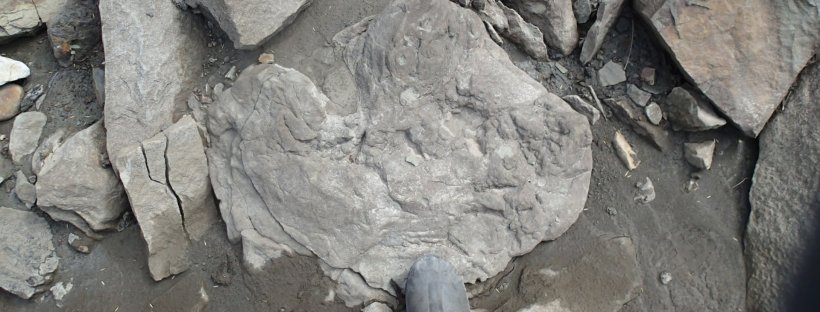
This past summer, Jack Milligan represented Ichnoplanet during fieldwork conducted by the Boreal Alberta Dinosaur Project (BADP) at the University of Alberta (UA), and the Philip J. Currie Dinosaur Museum (PJCDM) under the leadership of UA professor Dr. Corwin Sullivan, and USASK adjunct professor and PJCDM curator Dr. Emily Bamforth. Objectives of this fieldwork include collecting fossils from the late Cretaceous Wapiti Formation near the city of Grande Prairie. The Wapiti Formation is rich in fossils, including freshwater invertebrates, small vertebrates, and especially non-avian dinosaurs. The most common dinosaurs in northern Alberta based on the number of occurrences are the hadrosaurs, commonly referred to as the “duck-billed” dinosaurs. These are large herbivorous dinosaurs that have been suggested to travel in large herds in search of new food sources and as a defense against predatory theropod dinosaurs.
During July and August, BADP collected several large, three-toed hadrosaur tracks from various sites across northwestern Alberta. These tracks are isolated natural casts of footprints that infilled the original track and weathered out of situ. Some of these tracks were carried out of the site by hand across rushing rivers much to the chagrin, all be it temporary, by the team. Studying these tracks will allow the BADP team to learn more about the kinds of environments these dinosaurs were walking through and the taphonomy and different preservation of the tracks.
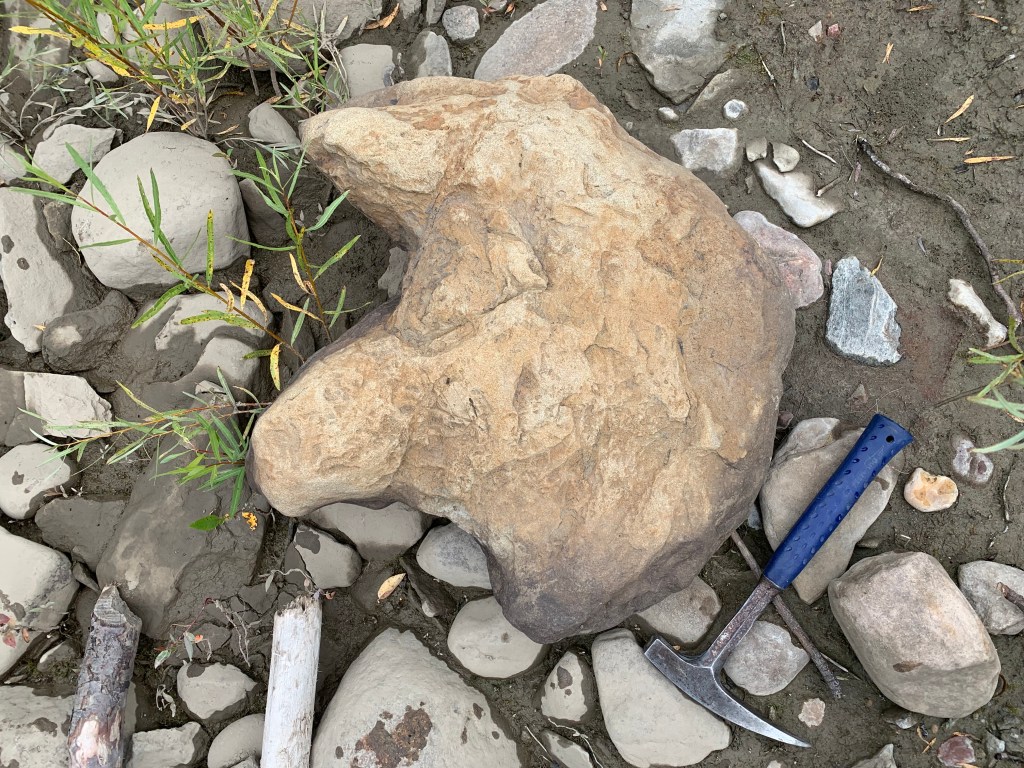
Images provided by Jack Milligan and Emily Bamforth.
Written by Jack Milligan
 ichnoplanet.ca