Dr. Pablo Joaquin Alonso-Muruaga
Assistant Researcher for the National Research Council of Argentina (IGEBA-CONICET); Assistant Professor for the University of Buenos Aires (UBA).

I was introduced to ichnology by my former professor of Historical Geology Dr. M. Gabriela Mángano, and by my undergraduate supervisor Dr. Luis Buatois at the University of Tucumán, Argentina. This prompted me to pursue a Ph.D. supervised by Dr. Buatois and Dr. Limarino from the University of Buenos Aires.
My research field is related to sedimentology, ichnology, and stratigraphy, mainly involving process-based sedimentology, trace fossil studies, and its integration into sedimentary facies analysis, in order to reconstruct ancient depositional environments and interpret their possible sequence stratigraphic framework.
Degrees: Ph.D. in Geological Sciences1 (Universidad de Buenos Aires); Geologist2 – (Universidad de Tucumán).
1- Doctoral Thesis: Sedimentología, Icnología e Estratigrafía de la Transgresión Postglacial del Carbonífero Superior en la Cuenca Paganzo y Áreas Relacionadas. Supervised by: Dr. Carlos O. Limarino and Dr. Luis A. Buatois
2- Undergrad Thesis: Análisis Paleoecológico de las Comunidades Marinas Bentónicas de la Fauna de Levipustula en la Formación Hoyada Verde, Sierra de Barreal, Provincia de San Juan. Supervised by: Dr. Gabriela A. Cisterna and Dr. Luis A. Buatois
Selected publications:
Alonso-Muruaga, P.J., Limarino, C.O.; Spalletti, L.A., Colombo Piñol, F. 2018. Depositional Settings and Evolution of a Fjord System During the Carboniferous Glaciation in Northwest Argentina. Sedimentary Geology, 369: 28-45.
Alonso-Muruaga P. J., Buatois, L.A. y Limarino, C. O. 2013. Ichnology of the Late Carboniferous Hoyada Verde Formation of Western Argentina: Exploring Postglacial Shallow-marine Ecosystems of Gondwana. Palaeogeography Palaeoclimatology Palaeoecology, 369: 228–238
Alonso-Muruaga P.J., Buatois, L.A.; Mángano G.; Limarino, C.O. 2012. Ichnology of the Paganzo and Calingasta -Uspallata Basins, Late Paleozoic of Western Argentina -a Review. In Netto, R. G.; Carmona, N.B. y Tognoli, F.M.W (Eds). Ichnology of Latin America – Selected Papers. Porto Alegre: Sociedade Brasileira de Paleontología, Monografías da Sociedade Brasileira de Paleontología, 196, p. 69-81
Dr. Mariano Arregui
Postdoctoral researcher at YTEC/CONICET, Argentina

I worked from 2010 to 2015 at the Paleontological and Archaeological Heritage Office of the Province of Buenos Aires, Argentina, and during this time I developed my interest in vertebrate and invertebrate ichnology. Then, in 2015, I started my Ph.D. at CONICET (National Council for Scientific and Technical Research) and Y-TEC (a research and development company for the energy industry in Argentina). During this period, I improved my knowledge in sedimentology and ichnology at the University of Saskatchewan, Saskatoon, Canada, under the supervision of Dr Luis Buatois and Dra. Gabriela Mángano. In 2020, I defended my thesis and became a postdoctoral researcher at YTEC. During all these years working at YTEC, I have participated in and led several subsurface studies in different Argentinean-producing basins and also continued with vertebrate ichnology studies. My interests include vertebrate and invertebrate ichnology, sedimentology, petroleum geology, palaeoenvironmental reconstruction, basin analysis and sequence stratigraphy.
Doctoral Thesis: Ichnology of the Lajas Formation, (Middle Jurassic), Cuyo Group, Neuquén Basin
Supervisors: Dr. M. Gabriela Mángano and Dr. Luis Buatois
Selected publications:
Zanella, A., Ruiz, R., Varela, A.N., & Arregui, M.G. (2024). Trace fossils as mechanical discontinuities in shales, insight for the generation of bedding-parallel veins (BPV). Scientific Reports, 14(1), 12746.
Arregui, M.G., Giannoni, I.E., & Varela, A.N. (2023). Dominance of Phycosiphon incertum vs Zoophycos in shelf environment: example from the transgressive Palermo Aike black shale deposits of the Austral-Magallanes Basin, Argentina. Marine and Petroleum Geology, 155, 106384.
Arregui, M.G., & Rodríguez, E. (2022). Sedimentological and ichnological signatures from a fluvialdominated delta in subsurface: Lajas Formation, Middle Jurassic, Neuquén Basin, Argentina. Latin American Journal of Sedimentology and Basin Analysis, 29(2), 97
Dr. Zain Belaústegui
Professor Lector at the Faculty of Earth Sciences of the University of Barcelona (Spain)

My main scientific interest is the ichnologic study (bioturbation and bioerosion) and the taphonomic analysis of marine, continental and transitional units (mainly from the Mesozoic and Cenozoic), emphasizing the implications of these studies for paleoecologic, paleoenvironmental and paleodepositional interpretations. Also interested in neoichnology.
I have a degree in Geology (2007) from the ‘Universidad Complutense de Madrid’ (Spain), a Master’s in Paleontology (2009) from the ‘Universitat de Barcelona’ and the ‘Universitat Autònoma de Barcelona’ (Spain), and a Ph.D. in Earth Sciences (2013) by the ‘Universitat de Barcelona’ with the thesis entitled: “Ichnologic and taphonomic study from the marine Miocene of El Camp de Tarragona Basin (NE Spain)” (Supervisor: Dr. Jordi M. de Gibert; Tutor: Prof. Jordi Martinell). I performed a formative stay at the University of Saskatchewan, under the supervision of Luis and Gabriela, during September and October 2010. Today, my current position is ‘Profesor Lector’ (partly equivalent to Lecturer) at the Faculty of Earth Sciences of the University of Barcelona (Spain).
Selected publications:
Belaústegui, Z.; Gibert, J.M. de (2013). Bow-shaped, concentrically laminated polychaete burrows: A Cylindrichnus concentricus ichnofabric from the Miocene of Tarragona, NE Spain. Palaeogeography Palaeoclimatology Palaeoecology(381-382), 119 – 127
Beláustegui, Z.; Muñiz, F.; Mángano, M.G.; Buatois, L.; Domènech, R.; Martinell, J. (2016). Lepeichnus giberti igen. nov. isp. nov. from the upper Miocene of Lepe (Huelva, SW Spain): Evidence for its origin and development with proposal of a new concept, ichnogeny. Palaeogeography Palaeoclimatology Palaeoecology, 452, 80 – 89 Belaústegui, Z.; Belaústegui, A. (2017). Modernist architecture in Barcelona reveals a new trace fossil from the Miocene of Montjuïc (NE Spain). Geologica Acta, 15(3), 169 – 186
Dr. Noelia Carmona
President of the Association for Women Geologists
I completed my undergraduate biology degree at Universidad Nacional de Tucumán, in 2001. After that, I continued my education at Universidad de Buenos Aires, where I finished my Ph.D. studies in 2005. I did a post-doc in Tierra del Fuego, during 2006-2008, where I studied the ichnology of Tertiary deep marine rocks. In 2008, I got a permanent position at CONICET in Argentina, and since 2011, I am also an Adjunct Professor in the Geology Department at Universidad Nacional de Río Negro.
My main interests cover the ichnology of shallow marine environments (mostly from Mesozoic and Cenozoic deposits), and also geobiological aspects in modern and ancient environments.
Ph.D. thesis: Carmona, N.B. 2005. Icnología del Mioceno marino en la Región del Golfo San Jorge. Tesis Doctoral, Facultad de Ciencias Exactas y Naturales. Universidad de Buenos Aires. 250 pp.
Supervisors: Dr. Luis Buatois and Dr. Gabriela Mángano
Selected publications:
Paz, M., Mángano, M.G., Buatois, L.A., Desjardins, P.R., Minisini, D., Tomassini, F.G., Rodríguez, M.N., Pereira, E., Fantín, M., Parada, M.N. and Carmona, N.B., 2023. Environmental controls on trace-fossil distribution in the Upper Jurassic-Lower Cretaceous Vaca Muerta Formation (Argentina): Implications for the analysis of fine-grained depositional systems. Sedimentary Geology, 454, p.106460.
Paz, M., Buatois, L.A., Mángano, M.G., Desjardins, P.R., Notta, R., Tomassini, F.G., Carmona, N.B. and Minisini, D., 2022. Organic-rich, fine-grained contourites in an epicontinental basin: the Upper Jurassic-Lower Cretaceous Vaca Muerta Formation, Argentina. Marine and Petroleum Geology, 142, p.105757.
Campetella, D.M., Rodriguez, M., Ponce, J.J., Carmona, N.B., Parada, M.N., Canale, N. and Irastorza, A., 2022. Análisis icnológico e implicancias paleoambientales de las formaciones Sierra Chacaicó y Los Molles en el área de Arroyo Lapa, Cuenca Neuquina, Argentina.
Check out her recent interview! (in Spanish)
Luc Chabanole

Associate at MLT Aikins, Regina, Saskatchewan
After completing my undergraduate degree in Geological Sciences at the University of Regina, I worked for two years in rare earth element exploration. In 2012 I returned to school, completing my Master’s at the University of Saskatchewan under the supervision of Dr. Luis Buatois in 2015.
M.Sc. thesis: Sedimentology, ichnology, and stratigraphic architecture of the upper Devonian-lower Mississippian Bakken Formation, west-central Saskatchewan.
Supervisors: Dr. Luis A. Buatois
Luc Chabanole -The Bakken Formation of west-central Saskatchewan has been here the whole time
Saskatchewan Geological Society, read more here
Dr. Sudipta Dasgupta
Assistant Professor in the Department of Earth Sciences, IIT Bombay, Mumbai, India.

After working for five years as a Senior Geoscientist with Reliance Industries (Navi Mumbai, India), I moved to Saskatchewan to pursue a doctoral degree under the supervision of Dr. Buatois. Once completed, I worked as a Research Associate for a year with Dr. Jenni Scott at Mount Royal University (Calgary, Canada) and then a year with Dr. Renata Netto at UNISINOS (São Leopoldo, Brazil). Since 2017 I have been in Mumbai India, working as an Assistant Professor of ichnology, sedimentology, and stratigraphy at the Department of Earth Sciences, IIT Bombay. Currently, I am exploring the Cenozoic Kutch Basin in Gujarat, India, from an ichnological, sedimentological, and stratigraphic viewpoint. Other research interests of mine include the ichnology of stressed depositional settings, process sedimentology, and high-resolution seismic and sequence stratigraphy.
Doctoral research opportunities: Canadian as well as international students with ichnology and sedimentology specializations may feel free to contact me.
Degrees: Ph.D. in Geology1 (University of Saskatchewan, Canada); M. Tech in Applied Geology2 – (IIT Roorkee, Uttarakhand, India); B.Sc. (honours) in Geology (Asutosh College, University of Calcutta, Kolkata, West Bengal, India).
1- Doctoral Thesis: Ichnology, depositional dynamics, and sequence stratigraphy of the Plio-Plaeistocene Orinoco Delta: Mayaro and Morne L’Enfer formations, southern Trinidad.
Supervisor: Dr. Luis A. Buatois
2- Master’s of Technology: Earthquake precursors in satellite thermal-infrared images
Supervised by: Dr. Arun Saraf
Dr. Andrei Ichaso Demianiuk

I completed my undergrad studies in Geological Engineering at the “Universidad Central de Venezuela” in Caracas, Venezuela. Then I worked for almost 2 years at the Venezuelan Foundation of Seismological Research (FUNVISIS) assessing urban geological hazards, vulnerability, and risks using Geographic Information Systems (GIS). I also participated as an assistant in paleoseismic trench investigation and regional geological mapping projects. In January 2014 I began an M.Sc. in Geological Sciences at the University of Saskatchewan focusing on establishing a depositional and sequence stratigraphy model for the Cambrian-Ordovician Deadwood Formation in Saskatchewan´s subsurface using stratigraphy, sedimentology, and ichnology. In late 2015 the project was upgraded into a Ph.D. and the study area was expanded into Alberta, North Dakota, and South Dakota. I started to become fond of ichnology when I learned of its importance in paleoenvironmental reconstruction and stratigraphic analysis and its applications in the oil industry.
During my PhD research, I worked doing sedimentologic, ichnologic, and stratigraphic analyses of the middle Cambrian to Lower Ordovician succession (Basal Sandstone Unit, Earlie Formation, and Deadwood Formation) in subsurface Alberta and Saskatchewan. For the past 10 years, these rocks have gained a lot of interest due to the occurrence of an economic amount of helium concentration. North American Helium (NAH), a company that explores, produces and refines this element in North America, contacted me and offered me the possibility of looking at their new cores recovered in southwestern Saskatchewan. I did facies and iconological analyses of their cores. This led to the discovery of unique facies for the Basal Sandstone Unit and the Earlie Formation, which record a transition from fan deltas to open embayment settings. Trace fossils were key to identifying the variety of sedimentary environments and helped to differentiate subaerial to subaqueous conditions in the fan-delta deposits. This work also led to the discovery of the first Cambrian trilobite fauna collection in Saskatchewan. My collaboration with NAH was highly valued and resulted in a job offer from the company, giving me the possibility to continue exploring and studying this fascinating succession.
Ph.D. thesis: Stratigraphy, sedimentology, and ichnology of the middle Cambrian to Early Ordovician Deadwood Formation in western Canada and the midwestern United States
Supervisors: Dr. Luis Buatois & Gabriela Mángano
Selected publications:
Handkamer, N.M., Ichaso, A., Pratt, B.R., Mángano, M.G. and Buatois, L.A., 2023. Systematics and biostratigraphy of a new trilobite fauna collected from the subsurface Earlie Formation (Wuliuan Stage, Miaolingian Series, Cambrian) in southwestern Saskatchewan. Canadian Journal of Earth Sciences, 60(9), pp.1307-1326.
Ichaso, A., Buatois, L., and Mángano, M. 2016. Transition from tide- to wave-dominated regimes in a middle Cambrian to Lower Ordovician seaway in southern Saskatchewan: Integrating ichnologic and sedimentologic datasets. Abstract submitted to Ichnia 2016: abstract book (2016): 260-261. UNESCO Geopark Naturtejo/International Ichnological Association, Castelo Branco.
Ichaso, A. 2011. Caracterización geológico-estratigráfica de la Formación Matatere en la región de Siquisique-Santa Inés-Santa Cruz de Bucaral, estados Lara y Falcón, Venezuela. Geos, UCV, 43(2012): 16 + 190 p. in DVD, folder 08.
Urbani, F., Grande, W., Reategui, W., Muñoz, P., Rodríguez, H., Ichaso, A., Mendi, D., and Baquero, M. 2012. Geología de la Ofiolita de Siquisique y unidades sedimentarias asociadas. Región de Siquisique-Mapararí, edos. Lara y Falcón, Venezuela. Boletin Geos 42 (2012):114-117.
Dr. Patricio Desjardins
Regional Geologist, Shell Exploration & Production Company (Texas, U.S.A) 
I am a sedimentologist and stratigrapher by background and that is where my passion in geology has been able to flourish. I have a wide experience in clastic and mixed carbonate-siliciclastic systems including a wide range of sedimentary environments, from fluvial to deep water, and everything in between. I strongly believe that subsurface studies need to be anchored to rocks, thus I include most of my work packages in core and outcrop studies. I specialize in the recognition and understanding of geologic controls on hydrocarbon accumulations and well performance enabling high-quality business decisions. I can successfully integrate multiple disciplines across multiple asset and support organizations. I tailor specialist studies to business needs and steer projects toward asset value drivers.
Ph.D. thesis: Sedimentology, Ichnology and Sequence Stratigraphy of the Lower Cambrian Gog Group.
Supervisors: Dr. Luis Buatois & Gabriela Mángano
Selected publications:
Desjardins, P.R., Buatois, L.A., Pratt, B.R., Mángano, M.G., 2012. Sedimentological–ichnological model for tide-dominated shelf sandbodies: Lower Cambrian Gog Group of western Canada. Sedimentology 59, 1452–1477
Desjardins, P.R., Buatois, L.A., Pratt, B.R. and Mángano, M.G., 2012. Forced-regressive tidal flats: Response to falling sea level in tide-dominated settings. Journal of Sedimentary Research 82, 149–162
Desjardins, P.R., Mángano, M.G., Buatois, L.A., Pratt, B.R. 2010. Skolithos pipe rock and associated ichnofabrics form the southern Rocky Mountains, Canada: Colonisation trends and environmental controls in an Early Cambrian sand-sheet complex. Lethaia 43, 507–528
Desjardins, P.R., Aguirre, H., 2016. Chapter 7: Sierras Blancas. In: González, G., Desjardins P.R. et al. (eds), Regional Transect of the Vaca Muerta Formation, IAPG, Buenos Aires, Argentina
Desjardins, P.R., Buatois, L.A., Mángano, M.G. 2012. Tidal Flats and Subtidal Sand Bodies. In: Knaust, D. & Bromley, R.G. (Eds.), Trace Fossils as indicators of Sedimentary Environments. Development in Sedimentology 64, 529–561. Elsevier
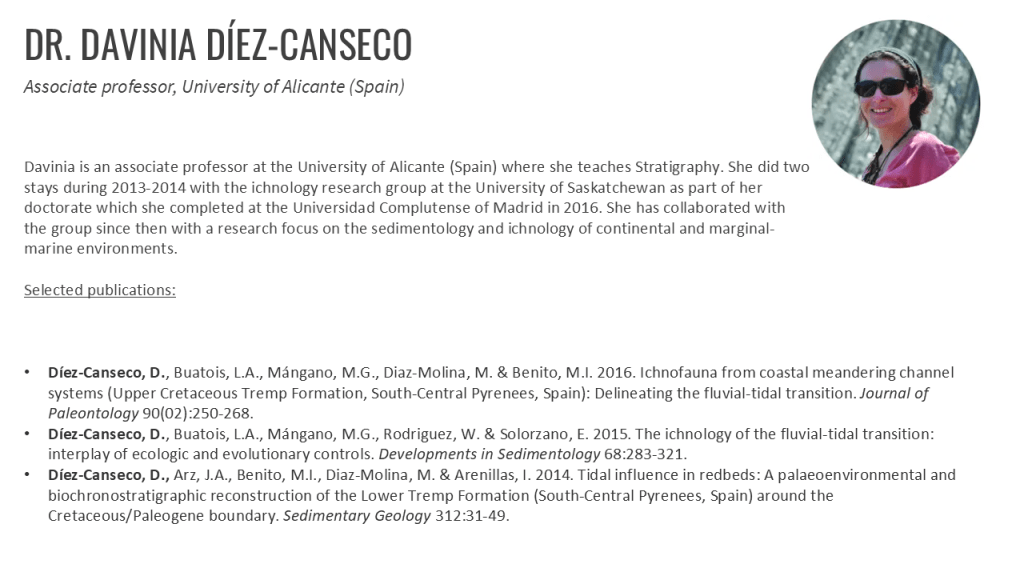
Dr. Davinia Díez-Canseco

Associate professor, University of Alicante (Spain)
Davinia is an associate professor at the University of Alicante (Spain) where she teaches Stratigraphy. She did two stays during 2013-2014 with the ichnology research group at the University of Saskatchewan as part of her doctorate which she completed at the Universidad Complutense of Madrid in 2016. She has collaborated with the group since then with a research focus on the sedimentology and ichnology of continental and marginal-marine environments.
Selected publications:
Díez-Canseco, D., Buatois, L.A., Mángano, M.G., Diaz-Molina, M. & Benito, M.I. 2016. Ichnofauna from coastal meandering channel systems (Upper Cretaceous Tremp Formation, South-Central Pyrenees, Spain): Delineating the fluvial-tidal transition. Journal of Paleontology 90(02):250-268.
Díez-Canseco, D., Buatois, L.A., Mángano, M.G., Rodriguez, W. & Solorzano, E. 2015. The ichnology of the fluvial-tidal transition: interplay of ecologic and evolutionary controls. Developments in Sedimentology 68:283-321.
Díez-Canseco, D., Arz, J.A., Benito, M.I., Diaz-Molina, M. & Arenillas, I. 2014. Tidal influence in redbeds: A palaeoenvironmental and biochronostratigraphic reconstruction of the Lower Tremp Formation (South-Central Pyrenees, Spain) around the Cretaceous/Paleogene boundary. Sedimentary Geology 312:31-49.
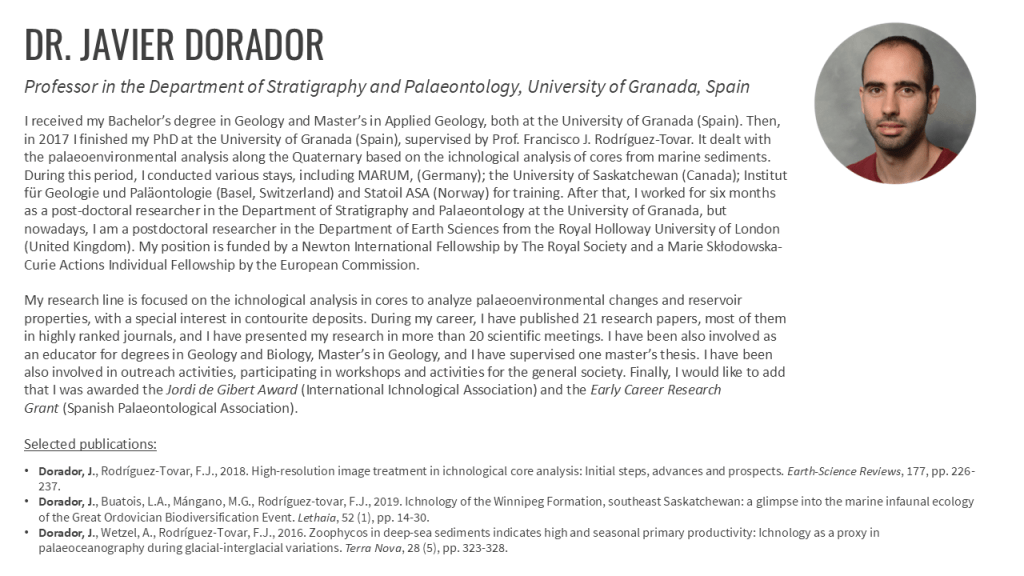
Dr. Javier Dorador
Postdoctoral researcher in the Department of Earth Sciences at the Royal Holloway University of London (UK)

I received my Bachelor’s degree in Geology and Master’s in Applied Geology, both of them at the University of Granada (Spain). Then, in 2017 I finished my PhD at the University of Granada (Spain), supervised by Prof. Francisco J. Rodríguez-Tovar. It dealt with the palaeoenvironmental analysis along the Quaternary based on the ichnological analysis of cores from marine sediments. During this period I conducted various stays, including MARUM, (Germany); the University of Saskatchewan (Canada); Institut für Geologie und Paläontologie (Basel, Switzerland) and Statoil ASA (Norway) for training.
After that, I worked for six months as a post-doctoral researcher in the Department of Stratigraphy and Palaeontology at the University of Granada, but nowadays, I am a postdoctoral researcher in the Department of Earth Sciences from the Royal Holloway University of London (United Kingdom). My position is funded by a Newton International Fellowship by The Royal Society and a Marie Skłodowska-Curie Actions Individual Fellowship by the European Commission.
My research line is focused on the ichnological analysis in cores to analyze palaeoenvironmental changes and reservoir properties, with a special interest in contourite deposits.
During my career, I have published 21 research papers, most of them in highly ranked journals, and I have presented my research in more than 20 scientific meetings. I have been also involved as an educator for degrees in Geology and Biology, Master’s in Geology, and I have supervised one master’s thesis. I have been also involved in outreach activities, participating in workshops and activities for the general society. Finally, I would like to add that I was awarded the Jordi de Gibert Award (International Ichnological Association) and the Early Career Research Grant (Spanish Palaeontological Association).
Selected publications:
Dorador, J., Rodríguez-Tovar, F.J., 2018. High-resolution image treatment in ichnological core analysis: Initial steps, advances and prospects. Earth-Science Reviews, 177, pp. 226-237.
Dorador, J., Buatois, L.A., Mángano, M.G., Rodríguez-tovar, F.J., 2019. Ichnology of the Winnipeg Formation, southeast Saskatchewan: a glimpse into the marine infaunal ecology of the Great Ordovician Biodiversification Event. Lethaia, 52 (1), pp. 14-30.
Dorador, J., Wetzel, A., Rodríguez-Tovar, F.J., 2016. Zoophycos in deep-sea sediments indicates high and seasonal primary productivity: Ichnology as a proxy in palaeoceanography during glacial-interglacial variations. Terra Nova, 28 (5), pp. 323-328.
Martin Ezequiel Farina
Doctoral Student, Vertebrate Paleontology Lab, Faculty of Exact and Natural Sciences, University of Buenos Aires, Argentina
I am PhD student (in Biological Science) at the Facultad de Ciencias Exactas y Naturales at the Universidad de Buenos Aires. In addition to my studies, I serve as a Teacher Assistant in the Department of Ecology, Genetics, and Evolution at the same university. My research is conducted at the Laboratorio de Paleontología de Vertebrados in the Instituto de Estudios Andinos “Don Pablo Groeber” (IDEAN-CONICET), located in Buenos Aires City, Argentina. I focus on the paleoecology of birds, using fossil tracks as a reference. My geographical focus spans Western Gondwana, covering sites from the Cretaceous period to the present. Currently, I am working on neoichnological studies of vertebrates to understand the relationship between behavior and sediment support, and I am involved in reconstructing avian paleocommunities and studying their changes over time, all through the lens of fossil tracks.
In addition to my research, I hold a Postgraduate Diploma in Public Communication of Science and Technology from the Faculty of Exact and Natural Sciences at the University of Buenos Aires. I regularly give talks on various topics and collaborate with different media outlets in Argentina, including print, television, and theater. Outside of my academic pursuits, I am passionate about birdwatching, sports, and history. These are subjects that I not only enjoy in my leisure time but also write articles about.
Doctoral Thesis: Paleobiological and paleoecological interpretations based on Mesozoic and Cenozoic avian and avian-like footprints from Gondwana
Supervisors: Dr. Verónica Krapovickas and Dr. Claudia Marsicano
Selected publications:
Juan, M., Vera, R.B., Farina, M.E. and Krapovickas, V., 2025. Small mammal trackways from the Neogene Vinchina Basin, Argentina: Insights into Xenarthra (Dasypodidae), Notoungulata (Typotheria), and Rodentia (Caviomorpha). Journal of South American Earth Sciences, 152, p.105297.
Krapovickas, V; Vera, R.B.; Farina; M.E.; Fernandez Piena, L.R.; Koelewijnd, A. A new vertebrate ichnological association sheds light into the small metatherian record of the Middle Miocene in South America. Enviado a Journal of South American Earth Sciences el 31 de mayo de 2023.
Valencia, G.L.; Buatois, L.A.; Mángano, M.G.; Krapovickas, V.; Farina, M.E. Trace fossils and fluvial architecture from the Miocene Vinchina Formation, Vinchina Basin, western Argentina: Assessing colonization in channel and overbank deposits. Enviado a revisión en PALAIOS en agosto de 2023.
Graglia, Hugo Oscar. O. & Farina, Martin. E. (2022). Lista de aves de la Reserva Natural Laguna de Rocha (Esteban Echeverría, Provincia de Buenos Aires). Revista Científica y Técnica Agropecuaria, Agroindustrial y Ambiental, 9(2).
Leardi, Juan M.; Farina, Martin E.; Gómez, Raúl O.; Marsicano, Claudia A. (2022). Paleoherpetologia en la Universidad de Buenos Aires: pasado, presente y futuro. Publicación Electrónica de la Asociación Paleontológica Argentina, 22(1), 226-234.

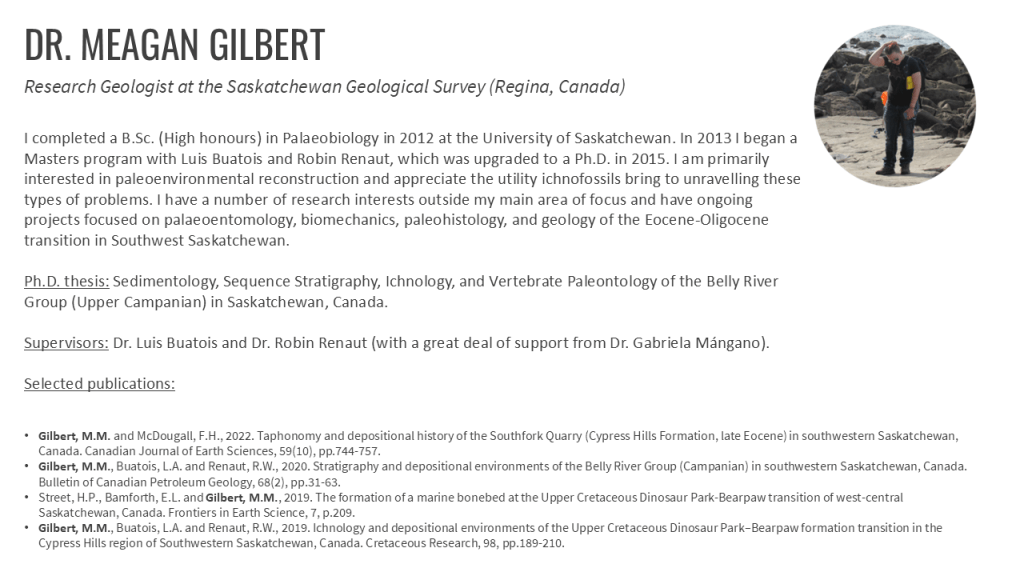
Dr. Meagan Gilbert
Research Geologist at the Saskatchewan Geological Survey (Regina, Canada)

I completed a B.Sc. (High honours) in Palaeobiology in 2012 at the University of Saskatchewan. In 2013 I began a Masters program with Luis Buatois and Robin Renaut, which was upgraded to a Ph.D. in 2015. I am primarily interested in paleoenvironmental reconstruction and appreciate the utility ichnofossils bring to unravelling these types of problems. I have a number of research interests outside my main area of focus and have ongoing projects focused on paleoentomology, biomechanics, paleohistology, and geology of the Eocene-Oligocene transition in Southwest Saskatchewan.
Ph.D. thesis: Sedimentology, Sequence Stratigraphy, Ichnology, and Vertebrate Paleontology of the Belly River Group (Upper Campanian) in Saskatchewan, Canada.
Supervisors: Dr. Luis Buatois and Dr. Robin Renaut (with a great deal of support from Dr. Gabriela Mángano).
Selected publications:
Gilbert, M.M. and McDougall, F.H., 2022. Taphonomy and depositional history of the Southfork Quarry (Cypress Hills Formation, late Eocene) in southwestern Saskatchewan, Canada. Canadian Journal of Earth Sciences, 59(10), pp.744-757.
Gilbert, M.M., Buatois, L.A. and Renaut, R.W., 2020. Stratigraphy and depositional environments of the Belly River Group (Campanian) in southwestern Saskatchewan, Canada. Bulletin of Canadian Petroleum Geology, 68(2), pp.31-63.
Street, H.P., Bamforth, E.L. and Gilbert, M.M., 2019. The formation of a marine bonebed at the Upper Cretaceous Dinosaur Park-Bearpaw transition of west-central Saskatchewan, Canada. Frontiers in Earth Science, 7, p.209.
Gilbert, M.M., Buatois, L.A. and Renaut, R.W., 2019. Ichnology and depositional environments of the Upper Cretaceous Dinosaur Park–Bearpaw formation transition in the Cypress Hills region of Southwestern Saskatchewan, Canada. Cretaceous Research, 98, pp.189-210.
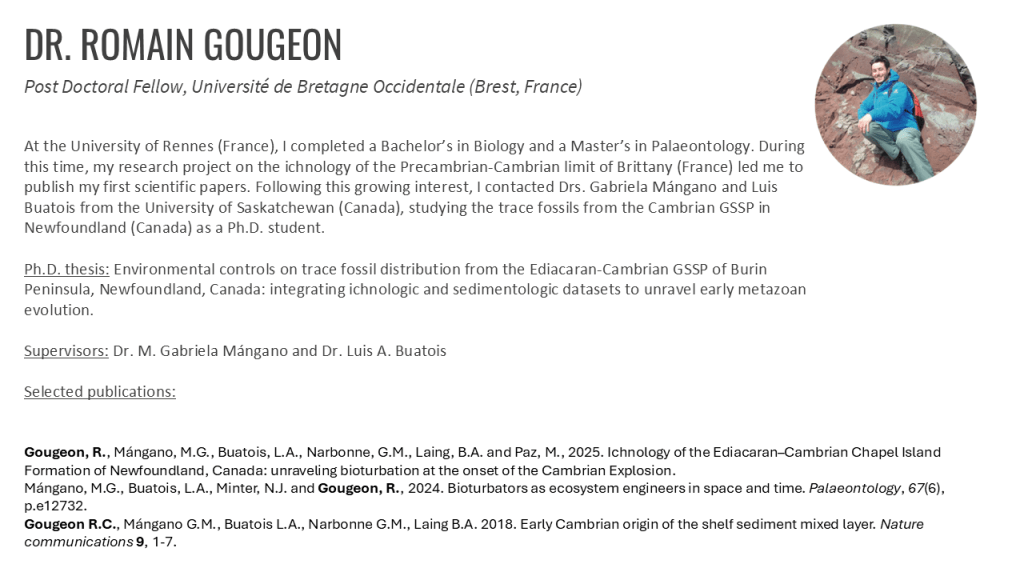
Dr. Romain Gougeon
Post Doctoral Fellow, Université de Bretagne Occidentale (Brest, France)
At the University of Rennes 1 (France), I completed a Bachelor’s in Biology and a Master’s in Palaeontology. During this time, my research project on the ichnology of the Precambrian-Cambrian limit of Brittany (France) led me to publish my first scientific papers. Following this growing interest, I contacted Drs. Gabriela Mángano and Luis Buatois from the University of Saskatchewan (Canada), studying the trace fossils from the Cambrian GSSP in Newfoundland (Canada) as a Ph.D. student.
Ph.D. thesis: Environmental controls on trace fossil distribution from the Ediacaran-Cambrian GSSP of Burin Peninsula, Newfoundland, Canada: integrating ichnologic and sedimentologic datasets to unravel early metazoan evolution.
Supervisors: Dr. M. Gabriela Mángano and Dr. Luis A. Buatois
Selected publications:
Gougeon R.C., Mángano G.M., Buatois L.A., Narbonne G.M., Laing B.A. 2018. Early Cambrian origin of the shelf sediment mixed layer. Nature communications 9, 1-7.
Gougeon R., Néraudeau D., Dabard M.P., Pierson-Wieckmann A.C., Polette F., Poujol M., Saint-Martin J.P. 2018. Trace fossils from the Brioverian (Ediacaran-Fortunian) in Brittany (NW France). Ichnos 25, 14-24.
Dr. Fernando Muñiz Guinea
Senor Lecturer in the Department of Crystallography, Mineral and Agricultural Chemistry, Universidad de Sevilla, Spain
I met Gabriela and Luis in 1999 when I was doing a research stay at the CONICET-INSUGEO in San Miguel de Tucumán (Argentina). I was professor of paleontology at the University of Huelva (Andalusia, SW Spain). During that stay we studied ichnofossils from the Cambrian in NW Argentina. Subsequently, my ichnological research works have focused on the ichnology of Mio-Pliocene materials from the Lepe area, a town on the coast of Huelva in SW Andalusia. In this work we describe a new ichnogenus and ichnospecies Lepeichnus giberti, dedicated to our great friend and colleague Jordi María de Gibert. Likewise, the importance of this work lies in the creation of an ichnological neologism, the concept of ichnogeny. I had the honor of making two reviews of the books “ICHNOLOGY: ORGANISM-SUBSTRATE INTERACTIONS IN SPACE AND TIME” in the Revista Española de Paleontología and “THE TRACE-FOSSIL RECORD OF MAJOR EVOLUTIONARY EVENTS” for Ameghinia.
Selected publications:
de Carvalho, C.N., Muñiz, F., Cáceres, L.M., Belaústegui, Z., Rodríguez-Vidal, J., Belo, J., Moreira, N., Cachão, M., Cunha, P.P., Figueiredo, S. and Galán, J.M., 2022. Aurochs roamed along the SW coast of Andalusia (Spain) during Late Pleistocene. Scientific Reports, 12(1), p.9911.
Belaústegui, Z., Muñiz, F., Mángano, M.G., Buatois, L.A., Domènech, R. and Martinell, J., 2016. Lepeichnus giberti igen. nov. isp. nov. from the upper Miocene of Lepe (Huelva, SW Spain): evidence for its origin and development with proposal of a new concept, ichnogeny. Palaeogeography, Palaeoclimatology, Palaeoecology, 452, pp.80-89.
Guinea, F.M., Mángano, M.G., Buatois, L.A., Podeniene, V., Vintaned, J.A.G. and Alfaro, E.M., 2014. Compound biogenic structures resulting from ontogenetic variation: An example from a modern dipteran. Spanish Journal of Palaeontology, 29(1), pp.83-94.
Mángano, MG, Buatois, LA and Guinea, FM, 2005. Ichnology of the Alfarcito Member (Santa Rosita Formation) of northwestern Argentina: animal-substrate interactions in a lower Paleozoic wave-dominated shallow sea. Ameghiniana , 42 (4), pp.641-668.
Gabriela Mángano, M., Carmona, N.B., Buatois, L.A. and Muñiz Guinea, F., 2005. A new ichnospecies of Arthrophycus from the Upper Cambrian-Lower Tremadocian of northwest Argentina: Implications for the Arthrophycid lineage and potential in ichnostratigraphy. Ichnos, 12(3), pp.179-190.
Mángano, MG, Buatois, LA and Muñiz-Guinea, F., 2002. Rusophycus moyensis n. isp. in the Cambrian-Tremadocian transition of northwest Argentina: paleoenvironmental and biostratigraphic implications. Revista Brasileira de Paleontologia , 4 , pp.35-44.
Dr. Richard Hofmann
Postdoctoral researcher at Museum für Naturkunde, Leibniz Institute for Research on Evolution and Biodiversity (Germany)

I got interested in marine palaeoecology as an undergraduate at Freiberg University (Germany). My later M.Sc. supervisor Dr. Olaf Elicki encouraged me to join a field trip to Jordan in March 2006 where I met Dr. Mángano, and we investigated animal-substrate interactions in Cambrian shallow marine siliciclastics. In spring 2007 I was lucky to join the Lab of Dr. Mángano and Dr. Buatois as a visiting student. Dr. Elicki and Dr. Mángano then supervised my thesis on said Cambrian trace fossils from Jordan which was completed in the summer of 2008. In early 2009, I became a Ph.D. student in the Lab of Prof. Hugo Bucher and Dr. Michael Hautmann working on Early Triassic marine macrofossils to better understand the recovery from the end-Permian mass extinction. After attaining the degree in late 2013, and staying for a postdoc on Permian benthic communities, I am currently studying diversification patterns of Early and Middle Ordovician benthic communities with projects at the Museum für Naturkunde Berlin (Germany) since 2015. Although ichnology, unfortunately, has never been a main interest ever since my time in Saskatoon, this fascinating field never left me. The ichnological tools developed under the tutelage of Gabriela and Luis are always in my backpack, which enabled me to publish a number of papers along the way.
M.Sc.-Thesis: Trace fossil analysis and sedimentary environments of the “Middle” Cambrian Hanneh Member, Southern Dead Sea (Burj Formation, Jordan). (Supervised by: Dr. Olaf Elicki and Dr. Gabriela Mángano)
Selected publications:
Hofmann, R. (2016): The end-Permian mass extinction. In Mángano, M. G. and Buatois, L. A.: The trace-fossil record of major evolutionary events. Topics in Geobiology, Springer, 325-349
Hofmann, R., Buatois, L. A., MacNaughton R. B., Mángano, M. G. (2015): Loss of the sedimentary mixed layer as a result of the end-Permian extinction. Palaeogeography, Palaeoclimatology, Palaeoecology. 428, 1-11
Mángano, M. G., Buatois, L.A., Hofmann, R., Elicki, O., Shinaq, R. (2013): Exploring the aftermath of the Cambrian explosion: The evolutionary significance of marginal- to shallow-marine ichnofaunas of Jordan. Palaeogeography, Palaeoclimatology, Palaeoecology. 374(1), 1-15.
Hofmann, R., Mángano, M. G., Elicki, O. and Shinaq, R. (2012): Paleoecologic and biostratigraphic significance of trace fossils from shallow- to marginal-marine environments from the Middle Cambrian (Stage 5) of Jordan. Journal of Paleontology. 86(6), 931-955.
Hofmann, R., Goudemand, N., Wasmer, M., Bucher, H., Hautmann, M. (2011): New trace fossil evidence for an early recovery signal in the aftermath of the end-Permian mass extinction. Palaeogeography, Palaeoclimatology, Palaeoecology. 310, 216-226.
Dr. Verónica Krapovickas
Consejo Nacional de Investigaciones Científicas y Técnicas (CONICET); Research Assistant at the Universidad de Buenos Aires, Argentina.
Currently, I have a research position at the Consejo Nacional de Investigaciones Científicas y Técnicas (CONICET) and a Teaching position at Universidad de Buenos Aires, Argentina. I met Gabriela Mángano and Luis Buatois in 2001 when I was an undergraduate student at the University of Tucumán (Argentina). Their enthusiasm made me interested in ichnology. Gabriela Mángano and Claudia Marsicano were my PhD. advisers at Universidad de Buenos Aires, Argentina and I spent three terms (2007, 2009, 2013) as a PhD student and postdoc at the University of Saskatchewan.
I am interested in the interrelationship between animals and their environments, particularly in how ecosystems and their functions have changed through time in response to major events in the history of the Earth. I use animal-sediment interactions as a proxy for investigating such questions. My projects are currently focused on: (1) The role of tetrapod footprints on continental ichnofacies models and paleoenvironmental reconstruction; (2) the implication of tetrapod ichnology in the reconstruction of arid-semiarid environments and ancient ecosystems; and (3) the ichnological evidence of evolution of South American mammals.
Ph.D. thesis: Continental Ichnofacies Models: The Role of Vertebrate Trace Fossils (Supervised by: M. Gabriela Mángano and Claudia A. Marsicano)
Selected publications:
Krapovickas, V., Mángano, M.G., Buatois, L.A., Marsicano C.A. 2016. Integrated ichnofacies models for deserts. Earth Science Reviews157, 61-85.
Krapovickas, V., Marsicano, C., Mancuso, A.C., de la Fuente, M. S., Ottone, E.G. 2015. Tetrapod and invertebrate trace fossils from aeolian deposits of the lower Permian of central-western Argentina. Historical Biology, 27 (7): 827–842.
Krapovickas, V., Ciccioli, P.L., Mángano, M.G., Marsicano, C.A., Limarino, C.O. 2009. Paleobiological and paleoecological significance of a Miocene South American ichnofauna in anastomosed fluvial deposits. Países Bajos. Palaeogeography, Palaeoclimatology, Palaeoecology 284: 129-152. ISSN 0031-0182.
Dr. Brittany Laing
Outreach and Community Liaison Geologist, Government of Saskatchewan, Regina, Saskatchewan

During my time at Queen’s University (Kingston, Canada), I was introduced to ichnology by my undergraduate supervisor, Dr. Guy Narbonne. Increasingly, I was curious about the insights trace fossils can provide into evolution, be it of behaviour, environments, or body plans. This prompted me to pursue an M.Sc. at the University of Saskatchewan with Dr.’s Mángano, Buatois, and Narbonne (Queen’s) studying the ichnology at the Ediacaran and Cambrian GSSP in Newfoundland, which I completed in May 2018. Currently, I am pursuing a Ph.D. jointly supervised by Dr.’s Mángano and Buatois, as well as Dr. Brock from Macquarie University (Sydney, Australia).
Ph.D. thesis: Quantitative tools to decipher changes in behaviour and bioturbation using trace fossils spanning the Ediacaran-Cambrian transition
Supervisors: Dr. M. Gabriela Mángano, Dr. Luis Buatois, and Dr. Glenn Brock (Macquarie University)
Selected publications:
Laing, B.A., Mángano, M.G., Buatois, L.A., Narbonne, G.M., & Gougeon, R.C. (2019). A protracted Ediacaran-Cambrian transition: an ichnologic ecospace analysis of the Fortunian in Newfoundland, Canada. Geological Magazine. 156(9), 1623-1630. 10.1017/S0016756819000141
Laing, B.A., Buatois, L.A., Mángano, M.G., Narbonne, G.M., & Gougeon, R.C. (2018). Gyrolithes from the Ediacaran-Cambrian boundary section in Fortune Head, Newfoundland, Canada: Exploring the onset of complex burrowing. Palaeogeography, Palaeoclimatology, Palaeoecology, 495, 171-185. 10.1016/j.palaeo.2018.01.010
Kaitlin Lindblad
M.Sc., Paleoartist

I am Kaitlin (KT) Lindblad. My undergraduate work consisted of descriptions of a skeleton of the eusuchian Borealosuchus griffithi from the early Paleocene of Saskatchewan. My master’s research synthesized the diversity and community structure of Saskatchewan crocodyliforms, incorporating taphonomic and sedimentological data, ichnology, and paleobotany alongside the vertebrate fossils. My research was supervised by Dr. Gabriela Mángano and Dr. Emily Bamforth.
I have also illustrated various figures and paleoart reconstructions for research articles (including Mángano et al. (2024)) and institutions including the University of Saskatchewan, Philip J. Currie Dinosaur Museum, and the Canadian Museum of Nature. Currently, I’m illustrating figures for the second edition of Ichnology: Organism-Substrate Interactions in Space and Time.
M.Sc. thesis: Diversity and structure of Late Cretaceous–Paleogene crocodyliform communities in southern Saskatchewan, Canada
Supervisors: Dr. Emily Bamforth and Dr. Gabriela Mángano
Selected publications:
Lindblad, K., Moreno-Bernal, J., McKellar, R., & Vélez, M.I.. (2022). The Northern Crocodile: first report of Borealosuchus (Eusuchia: Crocodylia) from Saskatchewan’s Lower Ravenscrag Formation (earliest Paleocene) with implications for biogeography. Canadian Journal of Earth Sciences. 59. 10.1139/cjes-2022-0010.
Lindblad. K, Moreno-Bernal. J, McKellar. R, & Vélez. M. (2021) The first occurrence of Borealosuchus (Crocodyliformes: Eusuchia) from the Lower Ravenscrag Formation (Earliest Paleocene) of Saskatchewan: implications for range and diversity. GAC-MAC 2021 Annual Conference: London, Canada. Conference presentation.
Dean Meek
M.Sc., GIS and Database Specialist

I am currently working as a GIS and Database Specialist at the Mineral Exploration Research Centre, Laurentian University. As part of the $104 million Metal Earth research program, I am working to create and maintain databases for the large volumes of geological data created as a result of this project, followed by visualizing this data in traditional maps and 3-dimensional models. In my spare time, I am working on publishing results from my MSc thesis regarding the design and implementation of an ichnology database.
M.Sc. thesis: Data processing methodologies to investigate associations between depositional environments and trace fossil occurrence
Supervisors: Dr. Bruce Eglington & Dr. Luis Buatois
Selected publications:
Meek, D.M., Buatois, L.A., Mángano, M.G. and Eglington, B.M., 2023. Increased habitat segregation at the dawn of the Phanerozoic revealed by correspondence analysis of bioturbation. Scientific Reports, 13(1), p.22328.
Mángano, M.G., Buatois, L.A., MacNaughton, R.B., Jensen, S., Gougeon, R., Marcos, A., Meek, D., Piñuela, L. and García-Ramos, J.C., 2022. The Psammichnites-Taphrhelminthopsis conundrum: Implications for calibrating the Cambrian explosion. Earth-Science Reviews, 227, p.103971.
Meek, D.M., Eglington, B.M., Buatois, L.A. and Mángano, M.G., 2020. IchnoDB: Structure and importance of an ichnology database. Ichnos, 28(1), pp.1-11.
Gabriel Mendoza
Researcher at Servico Geológico Colombiano (Colombia)
I am Gabriel Mendoza. The object of my study is to build a reservoir model of the Ciénaga de Oro Formation in the San Jacinto Fold Belt Basin-Columbia (SJFB), taking into account the ichnology, sedimentology, and sequence stratigraphy. My MSc research is under the supervision of DR. Luis Buatois and Gabriela Mángano.
During my undergraduate at the Universidad Industrial de Santander, I studied the Ciénaga de Oro Formation in the SJFB deepening in trace fossils and sedimentary structures. During my work at the Colombia Institute of Petroleum, I developed the facies maps of the Paleocene, Eocene, Oligocene, and Miocene, the unification of facies in the Cretaceous-Oligocene, as well as the spatial model distribution of the siliciclastics environments in the Eocene and transition to the Oligocene. All studies previously mentioned were performed in the Sinú-San Jacinto Fold Belt Basin, in the project Pre-Neogene evaluation.
I am also working on the Caribbean offshore project of the Colombian Petroleum Institute, a project in which I am part of the description of piston cores, cores, and paleoenvironmental analysis of the offshore basin of the Colombian Caribbean.
Supervisors: Dr. Luis Buatois and Dr. Gabriela Mángano
Selected publications:
Mendoza-Rodríguez, G., Buatois, L.A., Rincón-Martínez, D., Mángano, M.G. and Baumgartner-Mora, C., 2020. The armored burrow Nummipera eocenica from the upper Eocene San Jacinto Formation, Colombia: morphology and paleoenvironmental implications. Ichnos, 27(2), pp.81-91.
Mendoza, G., Buatois, L. A., Mángano, M. G., & Rincón, D. A. (2016). Nummipera eocenica, A trace fossil from the upper Eocene San Jacinto formation, Colombia: morphology and palaeoenvironmental implications. In Fourth International Congress on Ichnology, Idanha-a-Nova, Portugal.
Jack Milligan
M.Sc., Ichnology Research Assistant, University of Saskatchewan

For my master’s research, I’m studying the depositional and ichnological context of osteic bioerosion trace fossils on ceratopsian bones from the latest Cretaceous (Maastrichtian) Frenchman Formation, in southwestern Saskatchewan. The aim of this study is to describe trace fossils on ceratopsian bones created by continental invertebrates and ancient plant roots and the associated sedimentary environments to understand their implications for taphonomy, palaeoecology, and sequence stratigraphy. My research is being supervised by Dr. Luis Buatois, Dr. Gabriela Mángano, and Dr. Emily Bamforth.
During my undergraduate studies at the University of Saskatchewan, I argued that the use of alpha and beta palaeobiodiversity statistics of microvertebrate localities from the Frenchman Formation can be used as a method for identifying habitat heterogeneity within a larger paleoenvironmental framework. I worked for the Royal Saskatchewan Museum in collaboration with the Canadian Museum of Nature from 2019 to 2021 on a collaborative project to relocate and study the sedimentology and sequence stratigraphy of lost Triceratops quarries collected in southwest Saskatchewan since the 1920s.
In addition to my master’s research, I am helping to describe the depositional environments and bioerosion trace fossils on turtle shell material from the Paleocene Salamanca Formation of the Río Chico Group, San Jorge Basin, southern Chubut province, Patagonia, Argentina. I’m part of a joint team that includes paleontologists and geologists from the Museo Paleontológico Egidio Feruglio, Trelew, Argentina.
M.Sc. thesis: The Ichnological and Depositional Context of Bioeroded Triceratops Bones from the Maastricthian Frenchman Formation of Southern Saskatchewan, Canada
Supervisors: Dr. Luis Buatois, Dr. Gabriela Mángano, and Dr. Emily Bamforth
Selected publications:
Milligan, J. R., Bamforth, E. L., Mángano, M. G., & Buatois, L. A. (2025). Taphonomic history of a dinosaur skeleton from the upper Cretaceous Frenchman Formation, Canada: insights from ancient rhizoetchings and invertebrate bioerosion trace fossils. Ichnos, 1–20. https://doi.org/10.1080/10420940.2025.2449656
Milligan, J., & Bamforth, E. (2021) Palaeobiodiversity statistics and paleoenvironmental implications of microvertebrate localities from the Frenchman Formation (Late Cretaceous, Upper Maastrichtian,) of Saskatchewan, Canada. Murray, A. M., Street, H., & Holmes, R. B. (2021). CSVP 2021 abstracts. Vertebrate Anatomy Morphology Palaeontology, 9(1). https://doi.org/10.18435/vamp29374. Poster Presentation.
Dr. Nic Minter
Senior Lecturer at the University of Portsmouth
I am interested in the co-evolution between life and the planet. My research is at the interface among paleontology, sedimentology and behavioural ecology; focusing on organism-sediment interactions, both when they were alive (trace fossils) and dead (taphonomy), and what they can tell us about ecosystems through time and their responses to major events in the history of life on Earth. These include evolutionary radiations, colonization events and mass extinctions. My research involves field, laboratory, collections, and database studies; studying organism-sediment interactions ranging from half a billion years old through to conducting actualistic experiments and observations with modern animals, and across deep marine to desert environments. I have been lucky enough to work on world-renowned geological localities, including the Cambrian Burgess Shale of British Columbia, the Carboniferous of Atlantic Canada, the Permian Robledo Mountains of New Mexico, the Triassic Petrified Forest National Park of Arizona, and the Cretaceous Dinosaur Coast of Korea.
I graduated from the University of Bristol with a BSc in Geology and Biology in 2003 before going on to complete a PhD in continental ichnology in 2007 from the same institution. I undertook postdoctoral research at the University of Bristol from 2009-2010 and then at the University of Saskatchewan from 2010-2012. After my postdoctoral research at the University of Saskatchewan, I took up a permanent lectureship at the University of Portsmouth in 2013 where I am now a Senior Lecturer in Geoscience in the School of the Environment, Geography and Geosciences Portsmouth.
My research at the University of Saskatchewan was funded by a Government of Canada Post-doctoral Research Fellowship under the Canadian Commonwealth Scholarship Programme, and then an NSERC Engage Grant. I worked with Luis and Gabriela on the trace fossil record of the colonization of land and developed methods for quantifying eco-space occupation and ecosystem engineering using trace fossils. We continue to work together on several projects, including applying these methods to other important events in the history of life on Earth; as well as experimental work on the effects of transport on the preservation of soft-bodied organisms and allochthonous trace-producers.
Selected publications:
Bath Enright OG, Minter NJ, Sumner EJ, Mángano MG & Buatois LA (2021) Flume experiments reveal flows in the Burgess Shale can sample and transport organisms across substantial distances. Communications Earth and Environment 2, 104.
Buatois LA, Mángano MG, Minter NJ, Zhou K, Wisshak M, Wilson MA, Olea R (2020) Quantifying ecospace utilization and ecosystem engineering during the early Phanerozoic – the role of bioturbation and bioerosion. Science Advances 6, eabb0618.
Minter NJ, Buatois LA, Mángano MG, Davies NS, Gibling MR, MacNaughton RB & Labandeira CC (2017) Early bursts of diversification defined the faunal colonization of land. Nature Ecology and Evolution 1, 0175.
Minter NJ, Mángano MG & Caron J-B (2012) Skimming the surface with Burgess Shale arthropod locomotion. Proceeding of the Royal Society B. 279, 1613-1620.
Dr. Ali Mirza
Visiting Lecturer at the Center of Humanistic Inquiry and Department of History, Amherst College
I work on the history and philosophy of paleontology & ichnology, along with their interaction with studies of living organisms. More specifically, I look at the development of “fossil psychology” over the past two centuries, tracking how thinking about the minds, habits, and behaviors of ancient animals has helped scientists understand the morphology, ecology, and evolutionary trends exhibited by animal life on Earth. One example is how Edward Hitchcock’s studies of fossil footprints influenced Charles Darwin’s theory of evolution in the early 19th century. Another is how contemporary research on modern burrows is commonly, and unexpectedly, guided by fossil research. From such case studies, I not only attempt to determine how scientists adapt methods to answer difficult problems about the deep past but also help identify and revive forgotten methods that may be suitable for contemporary application.
Postdoctoral Supervisors: Dr. Gabriela Mángano and Dr. Luis Buatois
Doctoral Thesis: Living in Stone: The History and Philosophy of Behavior, Morphology, and Traces in the Fossil Record
Degrees: Ph.D. History and Philosophy of Science (Indiana University Bloomington); M.A. Philosophy (University of South Florida); B.S. Industrial Engineering (University of South Florida)
Selected publications:
Winsberg, Eric, and Ali Mirza. “Considerations from the philosophy of simulation.” The Routledge Handbook of Scientific Realism (2017): 250-260
Mirza, Ali. “Of chimeras, harmony, and kintsugi: towards a historicist epistemology of paleontological reconstruction, theory-change, and exploring heuristics,” Perspectives on Science 30, 4 (2022): 657-695
Dr. Diego F. Muñoz
Conicet Assistant Researcher at the National University of Córdoba

I finished my Geology degree (2009) at the Universidad Nacional de Córdoba (Argentina) studying the taphonomy of Lower Ordovician marine siliciclastic environments shell beds from NW Argentina, supervised by Dr. B. G. Waisfeld. Afterward, I worked for private oil companies until 2012. Between 2012 and 2016 I studied, together with my supervisor Dr. J. L. Benedetto, the systematics, diversity, biostratigraphy, taphonomy, and palaeobiogeography of Lower Ordovician brachiopods, mainly from NW Argentina. During my Ph.D., I became interested in the diverse trace fossils found in the Central Andean Basin and I decided to turn my scientific life into Ichnology. This is why now I’m studying marine siliciclastic trace fossils, particularly cruzianids, supervised by Dr. M. G. Mángano and B. G. Waisfeld. I am particularly interested in the relationship between the occurrences between trace fossils and their probable producers, and to study the ichnological record from a paleobiological perspective.
Postdoctoral Supervisors: Dr. M. Gabriela Mángano and Dr. Beatriz G. Waisfeld
Degrees: PhD (Universidad Nacional de Córdoba)1; Geologist (Universidad Nacional de Córdoba)2.
1- Doctoral Thesis: Biostratigraphy, taphonomy, and diversity of Lower Ordovician brachiopods from the Cordillera Oriental, northwestern Argentina. (in Spanish). Supervised by: Dr. Juan Luis Benedetto and Dr. Beatriz G. Waisfeld.
2- Undergraduate Thesis: Taphonomic analysis in upper Tremadocian deposits, Quebrada de Humacha, Huacalera area, Cordillera Oriental, Jujuy Province. (in Spanish). Supervised by: Dr. Beatriz G. Waisfeld and Dr. Juan Luis Benedetto.
Selected publications:
Muñoz, D.F., Mángano M.G, Buatois, L.A. Unravelling Phanerozoic evolution of radial to rosette trace fossils. Lethaia. In press. DOI: 10.1111/let.12317
Muñoz, D.F., Mángano M.G, Buatois, L.A. Gyrophyllites cristinae isp. nov. from Lower Ordovician shallow-marine deposits of northwest Argentina. Ichnos. In press. DOI: 10.1080/10420940.2018.1538983
Muñoz, D.F., Benedetto, J.L. The eoorthid brachiopod Apheoorthina in the Lower Ordovician of NW Argentina and the dispersal pathways along western Gondwana. Acta Palaeontologica Polonica, 2016, 61 (3): 633-644. DOI: 10.4202/app.00241.2016
Dr. Maximilliano Paz
Visiting Assistant Professor, Oberlin College, Oberlin, United States
I completed my Licenciatura degree with an orientation in Geology of Hydrocarbons at Universidad Nacional de Río Negro, Argentina. My Ph.D. involved the sedimentological, ichnological, and geochemical analysis of the Vaca Muerta Formation black shales of Argentina, with a focus on understanding bottom water oxygenation levels. My interests are in ichnology applied to sedimentary environment analysis, fine-grained sedimentology, and geochemical redox proxies.
Doctoral Thesis: Ichnology, sedimentary facies, sequence stratigraphy, and geochemistry of black shales from the Upper Jurassic – Lower Cretaceous Vaca Muerta Formation, Neuquén Basin, Argentina
Supervisors: Dr. M. Gabriela Mángano and Dr. Luis Buatois
Selected publications:
Paz, M., Buatois, L.A., Mángano, M.G., Desjardins, P.R., Rodríguez, M.N., Ponce, J.J., Minisini, D., Tomassini, F.G., Pereira, E., Carmona, N.B. and Fantín, M., 2023. Basin circulation affecting sediment partitioning in a fine-grained carbonate–siliciclastic, subaqueous clinoform: the Upper Jurassic–Lower Cretaceous Vaca Muerta Formation, Neuquén Basin, Argentina. Journal of the Geological Society, 180(2).
Paz, M., Mángano, M.G., Buatois, L.A., Desjardins, P.R., Notta, R., Tomassini, F.G. and Carmona, N.B., 2022. Ichnology of muddy shallow-water contourites from the upper Jurassic–lower Cretaceous Vaca Muerta Formation, Argentina: implications for trace-fossil models. Palaios, 37(5), pp.201-218.
Paz, M., Ponce, J.J., Buatois, L.A., Mángano, M.G., Carmona, N.B. and Pereira, E. (submitted). Bottomset and foreset sedimentary processes in the mixed carbonate-siliciclastic Upper Jurassic Vaca Muerta Formation, Picún Leufú area, Argentina. Sedimentology.
Dr. Elizabeth Schoenthal
PhD, Alumni at Memorial University of Newfoundland, Prince George, British Columbia, Canada
The purpose of my research was to study animal-substrate interactions within fjord environments to further expand our understanding of the biological and physical processes that characterize Canadian Arctic fjords. The project used an integrative approach of two data sets: recent biogenic structures on the sea floor (based on seafloor photographs) and ichnofabrics of Holocene glaciomarine sediment core samples. The results of this study contribute to refining ideas on ichnological fjord models, setting up an agenda for future research in ichnology of high-latitude depositional systems.
Master’s thesis: The ichnology of Holocene glaciomarine sediments: Maktak, Coronation, and North Pangnirtung, Baffin Island, Canada
Bachelors thesis: The ichnology of the Guandacol Formation, Late Carboniferous from western Argentina
Supervisors: Dr. M. Gabriela Mángano and Dr. Luis Buatois
Selected publications:
Schatz, E.R., Mángano, M.G., Aitken, A., Buatois, L.A. 2013. Response of benthos to stress factors in Holocene Arctic fjord settings: Maktak, Coronation and North Pangnirtung Fjords, Baffin Island, Canada. Palaeogeography, Palaeoclimatology, Palaeoecology, 386:652-668.
Schatz, E.R., Aitken, A., and Mángano, M.G. 2011. Ichnology of Glaciomarine Sediments: Maktak, Coronation and North Pangnirtung Fjords, Baffin Island, Canada. Proceedings #2338 GeoHydro2011 conference. Joint Meeting of the Canadian Quaternary Association and the Canadian Chapter of the International Association of Hydrogeologists. August 28-31, 2011. Quebec City, Quebec.
Schatz, E.R., Mángano, M.G., Buatois, L.A., and Limarino, C.O. 2011. Life in the Late Paleozoic ice age: trace fossils from glacially influenced deposits in a Late Carboniferous fjord of western Argentina. Journal of Paleontology, 85(3):502-518.

Dr. Alina Shchepetkina

Freelance Scientific Editor at Cactus Communications
I am a trilingual (English, Spanish, and Russian), field- and laboratory-based sedimentologist and ichnologist. I completed my BSc and MSc in Petroleum Geology and Lithology at the Gubkin State University of Oil and Gas (Moscow, Russia). My MSc thesis helped refine the paleoenvironments of deposition and spatial distribution of reservoir rocks by petrographic characterization and detailed facies analysis of Jurassic and Cretaceous deltaic successions in the Caspian Basin. I also led and contributed to a diverse array of clastic and carbonate sedimentological projects for various basins of the Russian Federation.
In 2011, I emigrated to Canada to earn a Ph.D. in the fields of sedimentology and ichnology at the University of Alberta (Edmonton, AB), working with S. George Pemberton and Murray K. Gingras. I conducted research in modern coastal sedimentary environments (Petitcodiac River estuary in New Brunswick, Bay of Fundy in Nova Scotia, Netarts Bay in Oregon, and Ogeechee River estuary in Georgia) and ancient rock record (Cretaceous McMurray Fm., Bluesky and Gething Fm.). My work efforts have been recognized internationally and resulted in a number of peer-reviewed publications. In 2017, I secured a position in a competitive Postdoctoral Research Fellowship Program (CONICET, Argentina), and moved to the Instituto de Investigación en Paleobiología y Geología (General Roca, Rio Negro) to build a geological model of the continental to marginal-marine Cretaceous Centenario Fm., Neuquén Basin. During the postdoctoral fellowship, I was invited for a 3-month internship at the University of Saskatchewan to work in collaboration with Gabriela Mángano and Luis Buatois.
I also have energy experience, having conducted several internships with leading Russian and international companies (e.g., TNK-BP, Gazpromneft-NTC, SNGEO, Shell Canada), working as a part-time sedimentologist at the Petroleum Lithology Department (Gubkin State University), as an MWD D&M engineer at Schlumberger, and a scientific consultant for YPF. My research interests span the fields of clastic sedimentology, neo- and paleoichnology, petroleum geology, sequence stratigraphy, and petrography.
Selected publications:
Schchepetkina, A., Gingras, M.K., Zonnevel, J-P., and Pemberton, S.G. 2018. Modern observations of floccule ripples: Petitcodiac River estuary, New Brunswick, Canada. Sedimentology, 65(2), 582-596.
Shchepetkina, A., Speta, M., Gingras, M.K., Rivard, B., and Pemberton, S.G. 2017. Hyperspectral imaging as an aid for facies analysis in massive-appearing sediments: A demonstrative case study for the middle McMurray Formation. Bulletin of Canadian Petroleum Geology. 65(2), 262-278
Shchepetkina, A., Gingras, M.K., and Pemberton, S.G. 2016. Sedimentology and ichnology of the fluvial reach to inner estuary of the Ogeechee River estuary, Georgia, USA. Journal of Sedimentary Geology. 342, 202-217.
Shchepetkina, A., Gingras, M.K., Pemberton, S.G., and MacEachern, J.A. 2016. What does the ichnological content of the middle McMurray Formation tell us? Bulletin of Canadian Petroleum Geology. 64(1), 24-46.
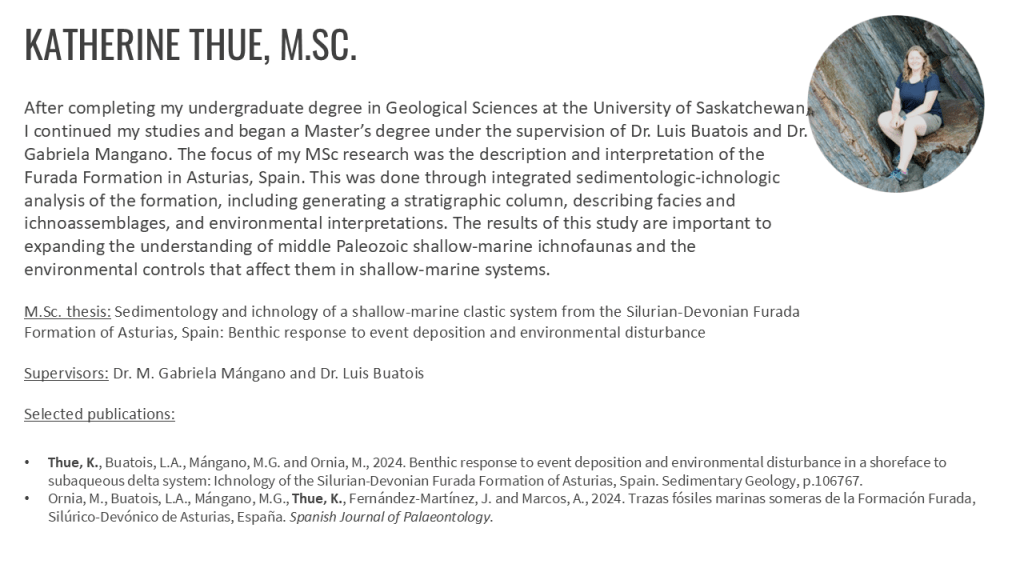
Katherine Thue
Master’s student
After completing my undergraduate degree in Geological Sciences at the University of Saskatchewan, I continued my studies and began a Master’s degree under the supervision of Dr. Luis Buatois and Dr. Gabriela Mangano. The focus of my MSc research was the description and interpretation of the Furada Formation in Asturias, Spain. This was done through integrated sedimentologic-ichnologic analysis of the formation, including generating a stratigraphic column, describing facies and ichnoassemblages, and environmental interpretations. The results of this study are important to expanding the understanding of middle Paleozoic shallow-marine ichnofaunas and the environmental controls that affect them in shallow-marine systems.
M.Sc. thesis: Sedimentology and ichnology of a shallow-marine clastic system from the Silurian-Devonian Furada Formation of Asturias, Spain: Benthic response to event deposition and environmental disturbance
Supervisors: Dr. M. Gabriela Mángano and Dr. Luis Buatois
Selected publications:
Thue, K., Buatois, L.A., Mángano, M.G. and Ornia, M., 2024. Benthic response to event deposition and environmental disturbance in a shoreface to subaqueous delta system: Ichnology of the Silurian-Devonian Furada Formation of Asturias, Spain. Sedimentary Geology, p.106767.
Ornia, M., Buatois, L.A., Mángano, M.G., Thue, K., Fernández-Martínez, J. and Marcos, A., 2024. Trazas fósiles marinas someras de la Formación Furada, Silúrico-Devónico de Asturias, España. Spanish Journal of Palaeontology.

Dr. Fernando Valencia
Carbonate Sedimentologist at CGG (UK)

I hold a B.Sc. in Geochemistry and a B.Sc. in Geological Engineering, both from the Central University of Venezuela (UCV). After my undergraduate studies, I worked as a reservoir geologist in the oil and gas industry for more than 7 years, mostly in the world-class carbonate reservoir Perla field (the largest offshore gas field in the Western Hemisphere). Recently, I earned an M.Sc. in Petroleum Geosciences at the Simon Bolivar University (USB), where I did interesting research on carbonate diagenesis. My professional and academic experience working with carbonate systems increased my interest in trace fossils and their influence on the dynamic petrophysical behavior (porosity and permeability) in carbonate rocks and sediments, which is now the subject of my current Ph.D. project at the University of Saskatchewan.
Ph.D. thesis: Bioturbation and its effects on porosity and permeability in carbonate rocks and sediments.
Supervisors: Dr. Luis Buatois and Dr. Juan C. Laya (Texas A&M University)
Selected publications:
Valencia, F. & Laya, J.C. (2020) Deep-burial dissolution in an Oligocene-Miocene giant carbonate reservoir (Perla Limestone), Gulf of Venesuela Basin: Implications on microporosity development. Marine and Petroleum Geology. 113 (104144): 1-22. DOI: 10.1016/j.marpetgeo.2019.104144.
Valencia, F. and D’Alterio, F. (2014). Application of Isotope Geochemistry for the determination of Non-hydrocarbon gases origin in the Perla field, Sub-Block Cardon IV West, Gulf of Venezuela. Memories of the I Natural Gas Venezuelan Conference (ICVGAS). EX-14.
D’Alterio, F; Reveron, M.; Bertolo, F.; Maffioletti, F.; Sanseviero, R. and Valencia, F. (2013). Workflow for the construction of the static and dynamic model of the carbonate reservoir MIO-Perla-1, Perla field (Block Cardon IV West). SPE WVPS Second South American Oil and Gas Conference. SPE-WS-172.
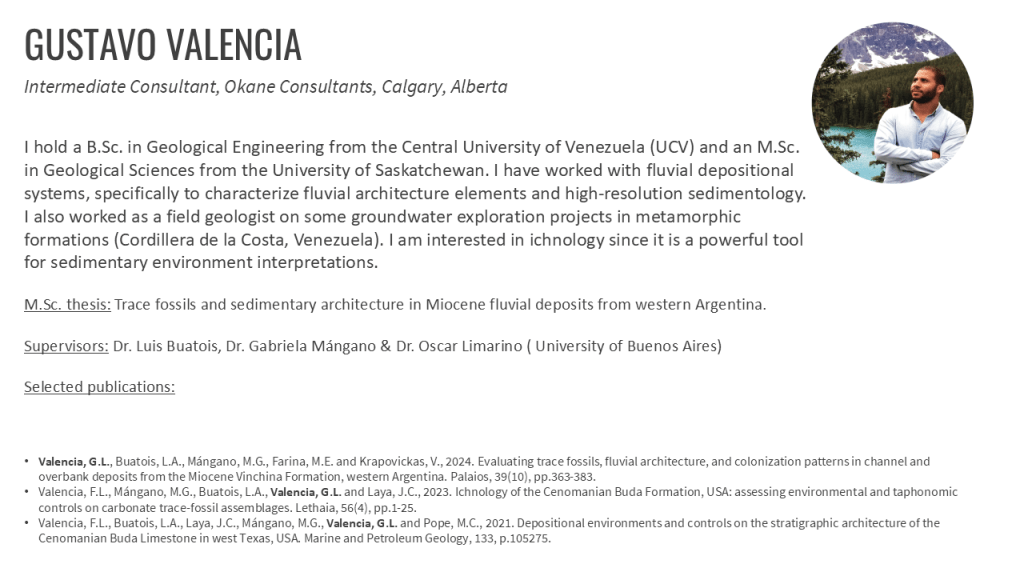
Gustavo Valencia
Environmental Engineer at New Gold Inc. (Calgary, Canada)

I hold a B.Sc. in Geological Engineering from the Central University of Venezuela (UCV) and an M.Sc. in Geological Sciences from the University of Saskatchewan. I have worked with fluvial depositional systems, specifically to characterize fluvial architecture elements and high-resolution sedimentology. I also worked as a field geologist on some groundwater exploration projects in metamorphic formations (Cordillera de la Costa, Venezuela). I am interested in ichnology since it is a powerful tool for sedimentary environment interpretations.
M.Sc. thesis: Trace fossils and sedimentary architecture in Miocene fluvial deposits from western Argentina.
Supervisors: Dr. Luis Buatois, Dr. Gabriela Mángano & Dr. Oscar Limarino ( University of Buenos Aires)
Selected publications:
Valencia, G.L., Buatois, L.A., Mángano, M.G., Farina, M.E. and Krapovickas, V., 2024. Evaluating trace fossils, fluvial architecture, and colonization patterns in channel and overbank deposits from the Miocene Vinchina Formation, western Argentina. Palaios, 39(10), pp.363-383.
Valencia, F.L., Mángano, M.G., Buatois, L.A., Valencia, G.L. and Laya, J.C., 2023. Ichnology of the Cenomanian Buda Formation, USA: assessing environmental and taphonomic controls on carbonate trace-fossil assemblages. Lethaia, 56(4), pp.1-25.
Valencia, F.L., Buatois, L.A., Laya, J.C., Mángano, M.G., Valencia, G.L. and Pope, M.C., 2021. Depositional environments and controls on the stratigraphic architecture of the Cenomanian Buda Limestone in west Texas, USA. Marine and Petroleum Geology, 133, p.105275.
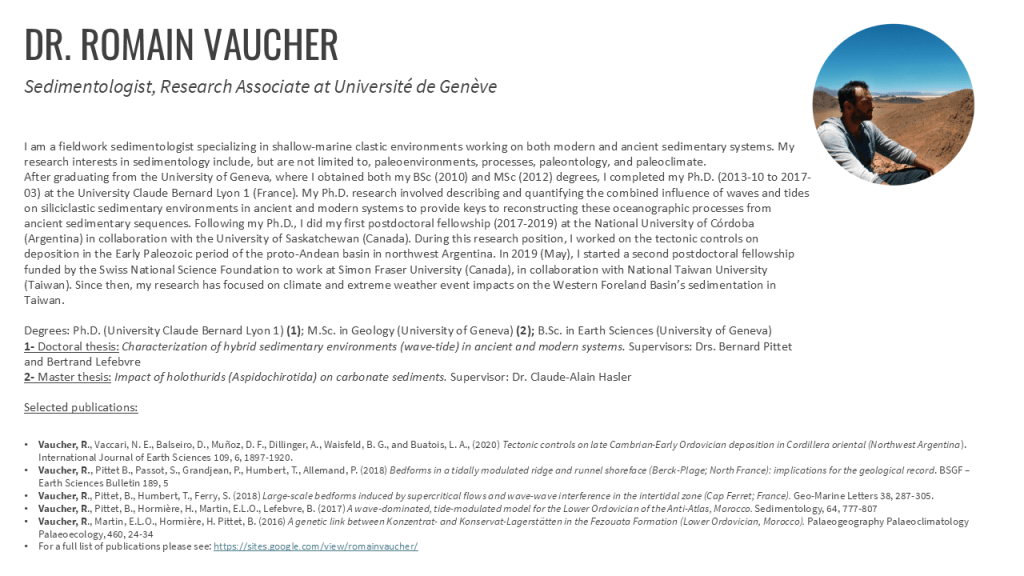
Dr. Romain Vaucher
Sedimentologist, Research Associate at Université de Genève

I am a fieldwork sedimentologist specializing in shallow-marine clastic environments working on both modern and ancient sedimentary systems. My research interests in sedimentology include, but are not limited to, paleoenvironments, processes, paleontology, and paleoclimate.
After graduating from the University of Geneva, where I obtained both my BSc (2010) and MSc (2012) degrees, I completed my Ph.D. (2013-10 to 2017-03) at the University Claude Bernard Lyon 1 (France). My Ph.D. research involved describing and quantifying the combined influence of waves and tides on siliciclastic sedimentary environments in ancient and modern systems to provide keys to reconstructing these oceanographic processes from ancient sedimentary sequences. Following my Ph.D., I did my first postdoctoral fellowship (2017-2019) at the National University of Córdoba (Argentina) in collaboration with the University of Saskatchewan (Canada). During this research position, I worked on the tectonic controls on deposition in the Early Paleozoic period of the proto-Andean basin in northwest Argentina. In 2019 (May), I started a second postdoctoral fellowship funded by the Swiss National Science Foundation to work at Simon Fraser University (Canada), in collaboration with National Taiwan University (Taiwan). Since then, my research has focused on climate and extreme weather event impacts on the Western Foreland Basin’s sedimentation in Taiwan.
Degrees: Ph.D. (University Claude Bernard Lyon 1) (1); M.Sc. in Geology (University of Geneva) (2); B.Sc. in Earth Sciences (University of Geneva)
1- Doctoral thesis: Characterization of hybrid sedimentary environments (wave-tide) in ancient and modern systems. Supervisors: Drs. Bernard Pittet and Bertrand Lefebvre
2- Master thesis: Impact of holothurids (Aspidochirotida) on carbonate sediments. Supervisor: Dr. Claude-Alain Hasler
Selected publications:
Vaucher, R., Vaccari, N. E., Balseiro, D., Muñoz, D. F., Dillinger, A., Waisfeld, B. G., and Buatois, L. A., (2020) Tectonic controls on late Cambrian-Early Ordovician deposition in Cordillera oriental (Northwest Argentina). International Journal of Earth Sciences 109, 6, 1897-1920.
Vaucher, R., Pittet B., Passot, S., Grandjean, P., Humbert, T., Allemand, P. (2018) Bedforms in a tidally modulated ridge and runnel shoreface (Berck-Plage; North France): implications for the geological record. BSGF – Earth Sciences Bulletin 189, 5
Vaucher, R., Pittet, B., Humbert, T., Ferry, S. (2018) Large-scale bedforms induced by supercritical flows and wave-wave interference in the intertidal zone (Cap Ferret; France). Geo-Marine Letters 38, 287-305.
Vaucher, R., Pittet, B., Hormière, H., Martin, E.L.O., Lefebvre, B. (2017) A wave-dominated, tide-modulated model for the Lower Ordovician of the Anti-Atlas, Morocco. Sedimentology, 64, 777-807
Vaucher, R., Martin, E.L.O., Hormière, H. Pittet, B. (2016) A genetic link between Konzentrat- and Konservat-Lagerstätten in the Fezouata Formation (Lower Ordovician, Morocco). Palaeogeography Palaeoclimatology Palaeoecology, 460, 24-34
For a full list of publications please see: https://sites.google.com/view/romainvaucher/
Federico Wenger
M.Sc., Doctoral student, Universidad Nacional de La Plata, La Plata, Argentina

I am Federico Daniel Wenger, from Argentina. I graduated from the National University of La Plata. My Final Project “Study of the sedimentary provenance of the Villavicencio Formation, Devonian of the Mendoza Precordillera, Argentina” consisted of the study of the provenance of the Villavicencio Formation, Western Argentina. Although that work is mainly focused on zircon morphology and typology, it also includes petrological and geochemical analyses.
I studied the ichnology and sedimentology of the Talacasto Formation, in western Argentina. This Lower Devonian unit is located north of the Villavicencio Formation in the same geological province (Precordillera). The project involves the sequential stratigraphy of the unit due to the comparison of three different localities from north to south involving different positions of the Devonian basin.
Although the fields of work between my undergraduate project and the Master’s project are different, the interaction of these fields and their complementarity for the same region is a great contribution to my professional training.
M.Sc. thesis: Ichnology of Devonian Shallow-Marine Deposits in Precordillera, Argentina: Delineating Changes in Ichnodiversity and Bioturbation Intensity, and Deciphering Limiting Factors
Supervisors: Dr. Luis Buatois and Dr. Gabriela Mángano
Selected publications:
Wenger, F.D., Buatois, L.A., Mángano, M.G., Muñoz, D.F. and Rustán, J.J., 2025. An anomalous shallow-marine ichnofacies gradient from the Lower Devonian Talacasto Formation of the Argentine Precordillera. Palaeogeography, Palaeoclimatology, Palaeoecology, p.112747.
Arnol, J.A., Rolan, J.D., Borya, A., Do Campo, M., Rustán, J.J., Wenger, F.D., Uriz, N.J. and Cingolani, C.A., Unravelling “The Keidel Horizon”: A Multi-Proxy Analysis of a Siliciclastic Marker Bed and its Implications in the Devonian Foreland Basin Evolution of the Argentine Precordillera. Available at SSRN 5003825.
Wenger, F.D., Arnol, J.A., Uriz, N.J., Cingolani, C.A., Abre, P. and Basei, M.A., 2023. Multiproxy provenance analyses in the Devonian Villavicencio Formation of the Mendoza Precordillera, Argentina: correlation and geotectonic implications for the SW Gondwana margin. Journal of Sedimentary Research, 93(8), pp.552-570.
Lindsey Wesolowski
M.Sc. student
My current research focuses on integrated Sedimentological, Stratigraphic, and Ichnologic study of the Late Campanian Dorothy Tongue, Bearpaw Formation near Dorothy, Alberta, Canada.
M.Sc. thesis: Trace fossils, sedimentary facies, and parasequence architecture from the Lower Cretaceous Mulichinco Formation of Argentina: The role of fair-weather waves in shoreface deposits.
Supervisors: Dr. Luis Buatois and Dr. Gabriela Mángano
Selected publications:
Wesolowski, L.J.N., Buatois, L.A., Mángano, M.G., Ponce, J.J., and Carmona, N. B. (2018). Trace fossils, sedimentary facies and parasequence architecture of the Lower Cretaceous Mulichinco Formation of Argentina: The role of fair-weather waves in shoreface deposits. Sedimentary Geology 367, 146-163.
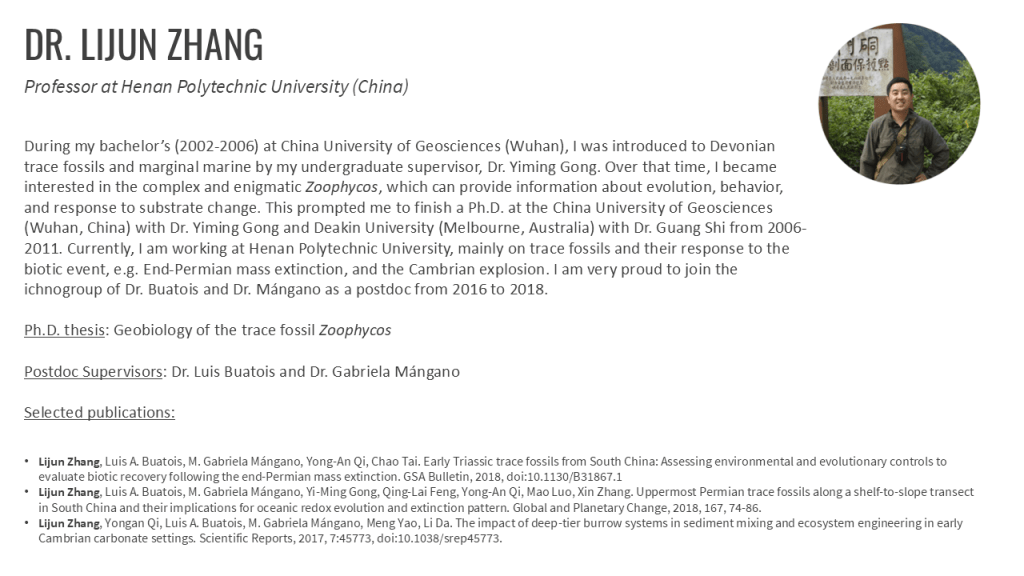
Dr. Lijun Zhang
Professor at Henan Polytechnic University (China)

During my bachelor’s (2002-2006) at China University of Geosciences (Wuhan), I was introduced to Devonian trace fossils and marginal marine by my undergraduate supervisor, Dr. Yiming Gong. Over that time, I became interested in the complex and enigmatic Zoophycos, which can provide information about evolution, behavior, and response to substrate change. This prompted me to finish a Ph.D. at the China University of Geosciences (Wuhan, China) with Dr. Yiming Gong and Deakin University (Melbourne, Australia) with Dr. Guang Shi from 2006-2011. Currently, I am working at Henan Polytechnic University, mainly on trace fossils and their response to the biotic event, e.g. End-Permian mass extinction, and the Cambrian explosion. I am very proud to join the ichnogroup of Dr. Buatois and Dr. Mángano as a postdoc from 2016 to 2018.
Ph.D. thesis: Geobiology of the trace fossil Zoophycos
Postdoc Supervisors: Dr. Luis Buatois and Dr. Gabriela Mángano
Selected publications:
Lijun Zhang, Luis A. Buatois, M. Gabriela Mángano, Yong-An Qi, Chao Tai. Early Triassic trace fossils from South China: Assessing environmental and evolutionary controls to evaluate biotic recovery following the end-Permian mass extinction. GSA Bulletin, 2018, doi:10.1130/B31867.1
Lijun Zhang, Luis A. Buatois, M. Gabriela Mángano, Yi-Ming Gong, Qing-Lai Feng, Yong-An Qi, Mao Luo, Xin Zhang. Uppermost Permian trace fossils along a shelf-to-slope transect in South China and their implications for oceanic redox evolution and extinction pattern. Global and Planetary Change, 2018, 167, 74-86.
Lijun Zhang, Yongan Qi, Luis A. Buatois, M. Gabriela Mángano, Meng Yao, Li Da. The impact of deep-tier burrow systems in sediment mixing and ecosystem engineering in early Cambrian carbonate settings. Scientific Reports, 2017, 7:45773, doi:10.1038/srep45773.
See our publication page for a full list of publications
Liya Zhang
M.Sc., Geologist at Shell Canada

Currently, I am working as a geologist with Shell Canada. Before this, I completed a Bachelor’s degree in Geological Engineering at the China University of Petroleum (Beijing) and a Master’s degree in Geology at the University of Saskatchewan.
M.Sc. thesis: Sedimentology, Ichnology, and Sequence Stratigraphy of the Upper Devonian-Lower Carboniferous Bakken Formation in the Southeastern Corner of Saskatchewan.
Supervisors: Dr. Luis Buatois and Dr. Gabriela Mángano
Selected publications:
Zhang, L., Buatois, L.A. and Knaust, D., 2016. Sedimentology, ichnology and sequence stratigraphy of the Upper Devonian–Lower Mississippian Bakken Formation in eastern Saskatchewan. Bulletin of Canadian Petroleum Geology, 64(3), pp.415-437.
Charlie (Yu-Chen) Zheng
M.Sc., Ph.D. candidate
After finishing my undergraduate degree in Geoscience at the National Taiwan University, I moved to Saskatoon, Canada. There, under the supervision of Dr. Mángano and Dr. Buatois, I completed my Master’s thesis. I am currently pursuing my Ph.D. at the University of Texas, Austin, under the supervision of Dr. Loucks and Dr. Kerans.
Ph.D. thesis: Implications of the OAE3 Distribution in Time and Space through the Integration of Depositional Environments, Ichnology, and Geochemistry of the Austin Chalk
M.Sc. thesis: Ichnology and sequence stratigraphy of the Ordovician Stony Mountain Formation in the Williston Basin. (Supervised by Dr. Mángano and Dr. Buatois)
Selected publications:
Charlie Y.C. Zheng, M. Gabriela Mángano, Luis A. Buatois, 2018. Ichnology and depositional environments of the Upper Ordovician Stony Mountain Formation in the Williston Basin, Canada: Refining ichnofacies and ichnofabric models for epeiric sea carbonates. Palaeogeography, Palaeoclimatology, Palaeoecology 501, 13-29.
Charlie Y.C. Zheng, M. Gabriela Mángano, Luis A. Buatois, 2017. Sedimentary facies variability of the Ordovician Williams Member in the Williston Basin, southern Manitoba: Lithostratigraphic implication. Manitoba Geological Survey, Report of Activities 2017, 148-157.
Mayra Zuniga
Exploration Geologist at Longford Exploration Vancouver, British Columbia, Canada

I am a proud geologist who’s always trying to learn more and more. I received my bachelor’s degree in Ecuador, from the Polytechnic National School. My main interest lies in everything related to the petroleum industry. I have some experience working in the oil & gas field. For almost two years I worked on several projects at Schlumberger, a petroleum services international company. I am really passionate about exploring and interpreting geology.
M.Sc. thesis: A Sedimentologic, Sequence Stratigraphic, and Ichnologic Characterization of the M2 Sandstone of the Cretaceous Napo Formation, Eastern Ecuadorian Basin.
Supervisors: Dr. Luis Buatois & Dr. Gabriela Mángano
Selected publications:
Zuniga, M., Buatois, L.A., Vallejo, C. and Mángano, M.G., 2021. Paleoenvironmental significance of trace fossils from mixed tide-and river-influenced marginal-marine settings, Cretaceous U and M2 Sandstone members, Napo Formation, Oriente Basin of Ecuador. Journal of South American Earth Sciences, 110, p.103326.