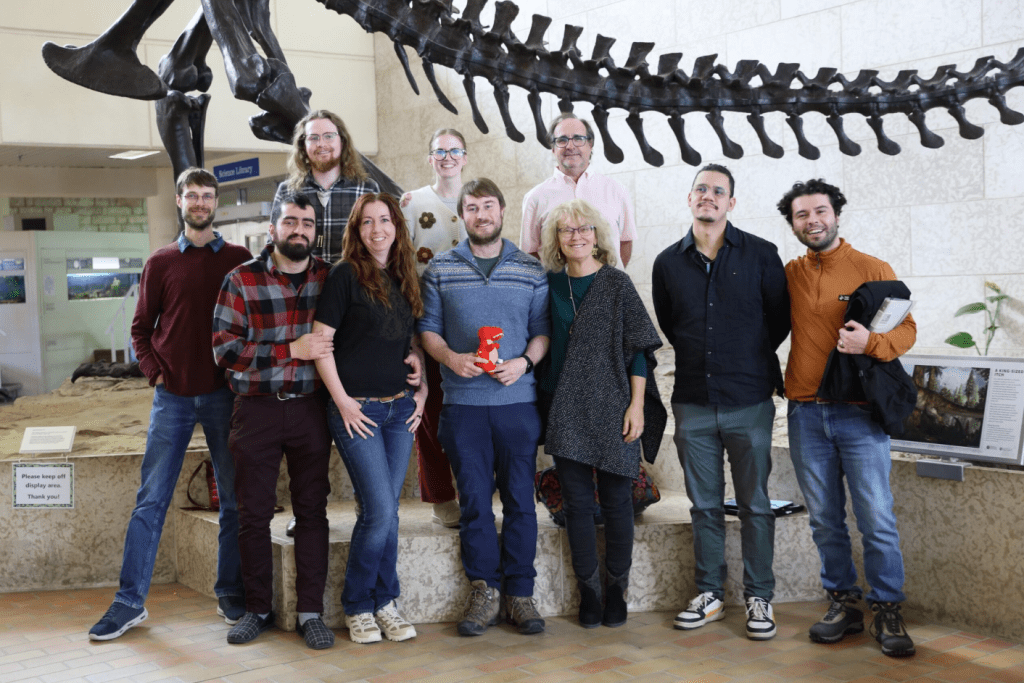
We would love to congratulate Dr. Brittany Laing on her recent successful PhD defence! Her thesis focused on the behavioural evolution and ecological impact of organisms as seen through trace fossils, specifically applying theories and methodologies from mathematics & behavioural biology to trace fossil datasets in order to quantitatively examine behavioural and ecological changes through time. She also completed a master’s degree with our research group where she studied the ichnology at the Ediacaran and Cambrian GSSP in Newfoundland, Canada. She is also to thank for the Ichnoplanet website!
We are forever grateful for your contributions and wish you all the best in your future endeavours!
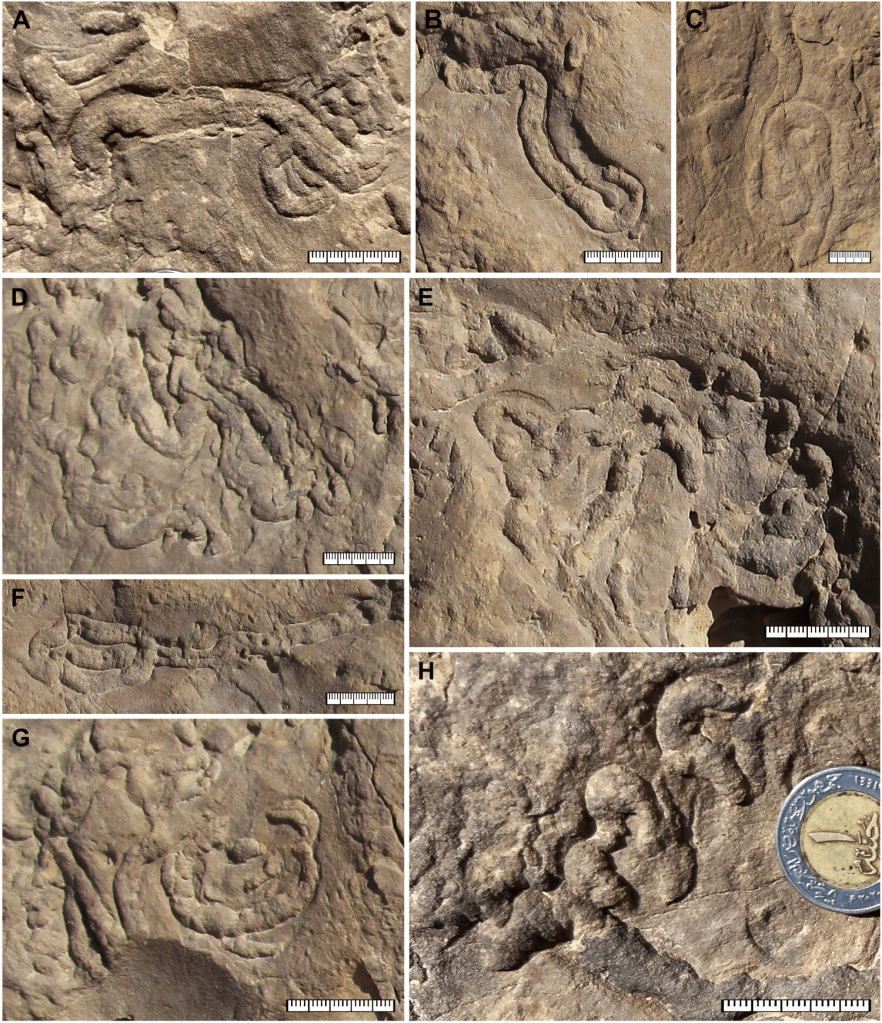
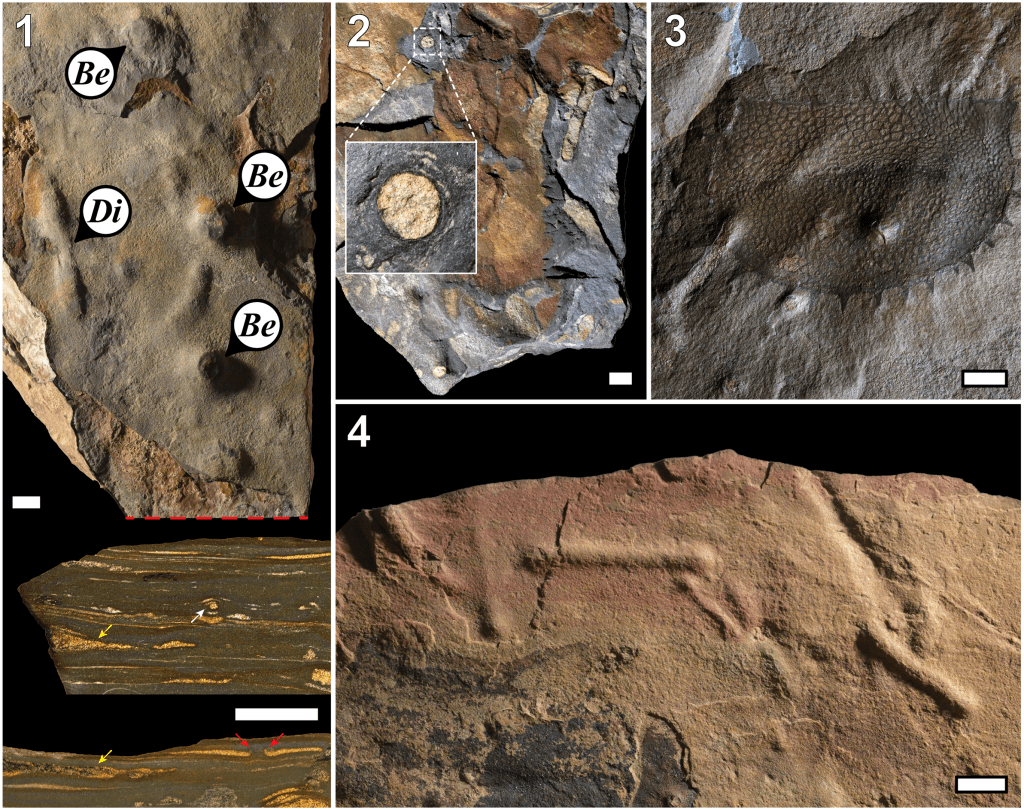
Recently, an international team of ichnologists led by Katherine A. Turk described a new ichnogenus from the late Ediacaran Huns Member of the Urusis Formation, in southern Namibia. They described a series of meandering, intertwining tubes exhibiting dual lineation patterns preserved in convex relief, appearing to disappear into the sediment and reemerge on the sediment surface. The distal terminal ends of the tubes are rounded and bulbous. Modern priapulid worms have produced such structures via peristaltic probing. This is similar to the famous Ediacaran-Cambrian biostratigraphic marker trace fossil Treptichnus pedum, also attributed to priapulid worms.
Figure 2 from Turk et al., 2024 showing the holotype of Himatiichnus mangano. See paper here.
The team also noted that these new trace fossils represented the earliest occurrence of Scalidophora, and are much like those traces of worms in the Cambrian, suggesting ecological interactions typical of the Cambrian Explosion appeared earlier than previously thought (the long fuse hypothesis). The morphological evidence pointed to these trace fossils being a novel ichnogenus and ichnospecies. The team gave the trace fossils the name Himatiichnus mangano, named after our very own Dr. M. Gabriela Mángano!
We couldn’t agree more with this decision, as Dr. Mángano has not only spent her career furthering the field of ichnology from all aspects, but has also contributed greatly to research on the Ediacaran-Cambrian transition around the world. Congrats Dr. Mangano on this great honour and achievement!
We have had a busy summer, and we want to start by congratulating Jack Milligan, Kaitlin Lindblad, Federico Wenger, and Kathrine Thue for successfully defending their M.Sc. theses!
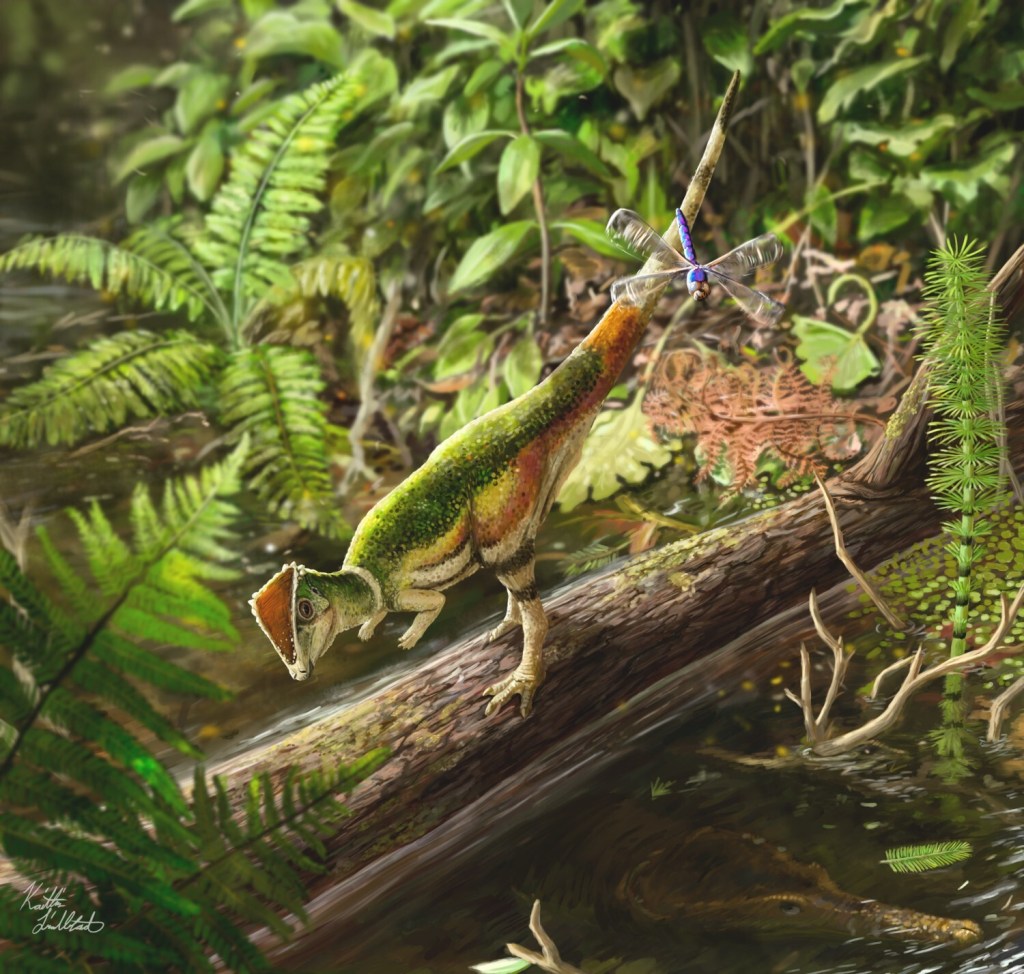
Jack studied the depositional context of bioeroded dinosaur bones from the upper Cretaceous of Saskatchewan; Kaitlin studied the biogeography, environment and paleoecology of crocodylians from the northern plains; Federico studied the ichnodiversity and bioturbation of Devonian shallow marine deposits in Argentina, and Kathrine studied the sedimentology and ichnology of Silurian-Devonian deposits in Asturias, Spain.
Once again, congrats to these new masters of ichnology!
Towards the end of the summer, I had the opportunity to continue fieldwork at two multitaxic Edmontosaurus quarries within the Uppermost Cretaceous Frenchman Formation in the East Block of Grasslands National Park in southern Saskatchewan under the supervision of Dr. Emily Bamforth of the Philip J. Currie Dinosaur Museum and Dr. Ryan McKellar of the Royal Saskatchewan Museum. These excavations have been ongoing and have yielded some fantastic fossil specimens and interesting geology.
T. rex tooth found at Leo quarry. Photo by Jack Milligan
One of the coolest fossils we collected this past season was a limb bone from one of our Edmontosaurus quarries, named the Leo Edmontosaurus quarry. This bone was a Cretaceous chew toy, as evidenced by well-defined tooth traces. During the excavation, a shed tooth from a Tyrannosaurus rex was collected from the same depositional layer as the bones. This association of tooth traces on Edmontosaurus bones and T. rex teeth suggests that Leo was scavenged during subaerial exposure on a floodplain near a point bar of a meandering river system. Limb bones have a high likelihood of being consumed due to large locomotor muscles being present (a great food source for predators like T. rex), and thus will tend to have more tooth traces on the bone.
Edmontosaurus limb bone with tooth traces. Photo by Jack Milligan
Teeth found at the Clifford quarry; Right, T. rex tooth; Left, Borealosuchus tooth. Photos by Jack Milligan
The point bar deposit contains the second quarry that is being excavated, named the Clifford Edmontosaurus quarry. While this Edmontosaurus has yet to produce elements with tooth traces, teeth from T. rex and the crocodyliform Borealosuchus have shown up this past season. Adding to the mystery of this quarry, several articulated turtle skeletons have been collected from this deposit, showing no evidence of being scavenged.
Further excavation of the quarries is required, and research into the taphonomy of these two Edmontosaurus quarries is ongoing, but there are sure to be some exciting discoveries to be made in future field seasons!
Throughout this past summer, I had the opportunity to volunteer with the Saskatchewan Geologic Survey under Dr. Meagan Gilbert in my hometown of Eastend, Saskatchewan. This project aimed to characterize the stratigraphy and depositional environments of the Upper Cretaceous and lower Paleogene of southwest Saskatchewan.
Skolithos isp. in a crossbedded sandstone fluvial channel deposit in the buff facies of the Upper Ravenscrag Formation in southwestern Saskatchewan. Photo provided by Mollie Black
We went to many different geologic outcrops around the town of Eastend. A typical day consisted of taking measurements and samples (so many samples) across the section. A section was first chosen based on the extent of exposed bedrock and then measured from the lowermost exposed bedrock to the top. It wasn’t all just rocks, though! We also found many neat trace fossils and plant fossils, including many just above the KPg boundary.
A huge thank you to all landowners who allowed access to their land.