Grasslands National Park Fieldwork 2024

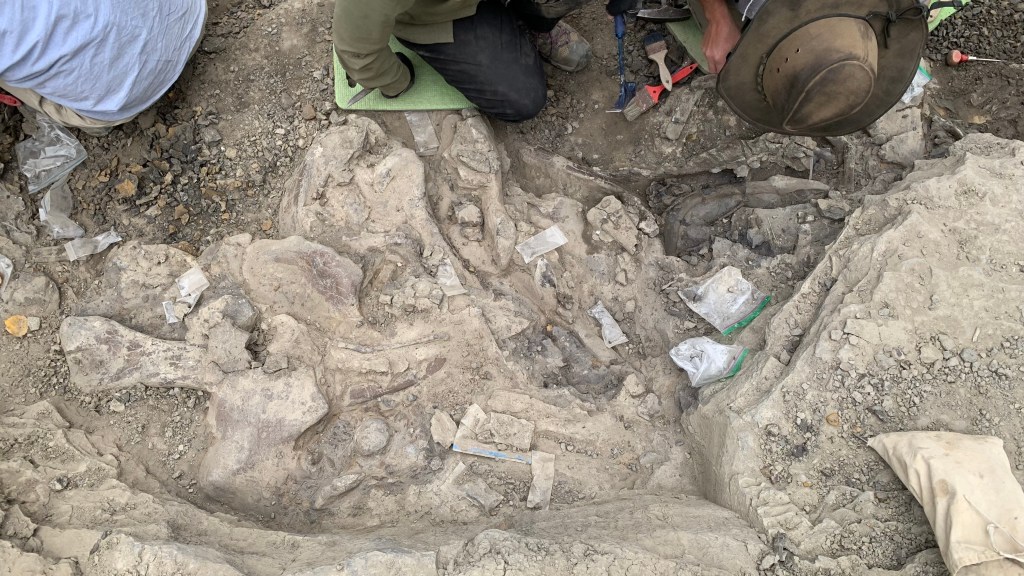
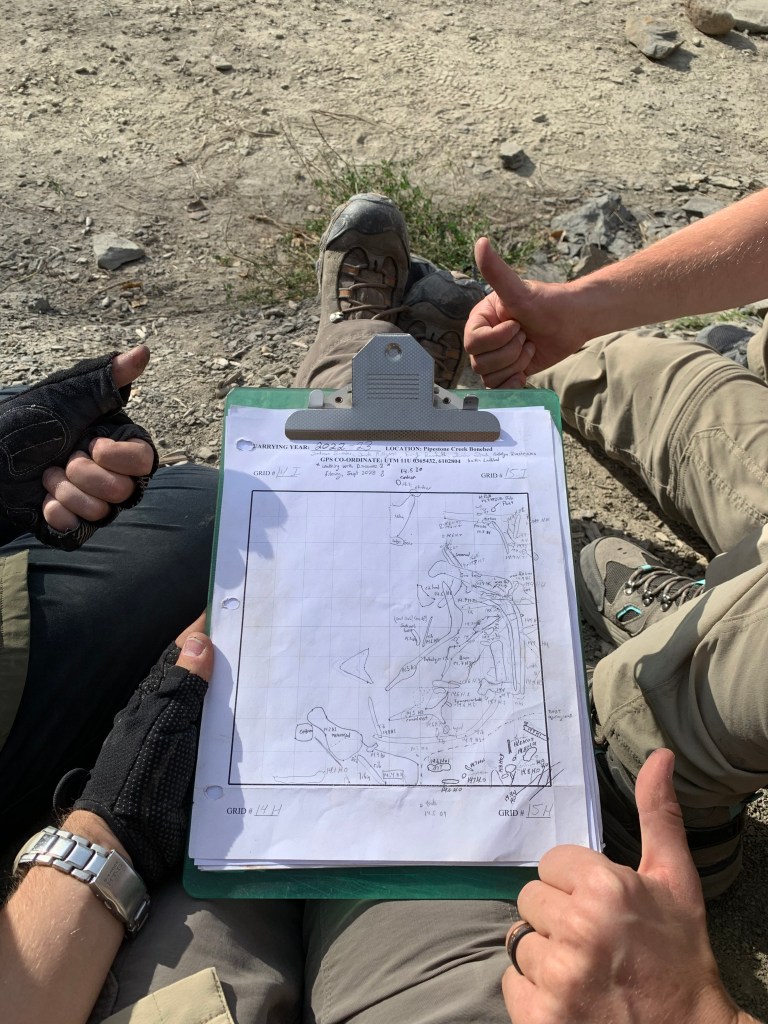
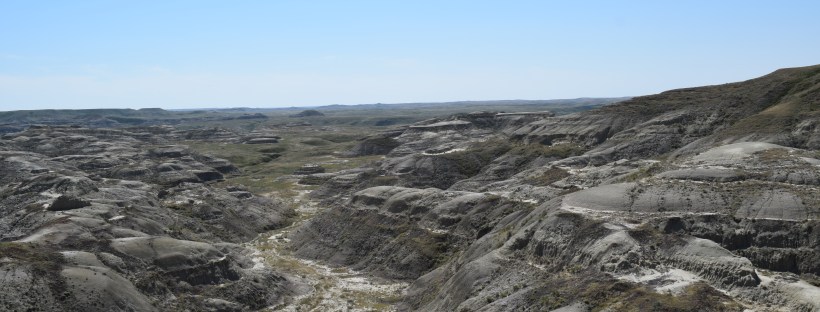
Towards the end of the summer, I had the opportunity to continue fieldwork at two multitaxic Edmontosaurus quarries within the Uppermost Cretaceous Frenchman Formation in the East Block of Grasslands National Park in southern Saskatchewan under the supervision of Dr. Emily Bamforth of the Philip J. Currie Dinosaur Museum and Dr. Ryan McKellar of the Royal Saskatchewan Museum. These excavations have been ongoing and have yielded some fantastic fossil specimens and interesting geology.

T. rex tooth found at Leo quarry. Photo by Jack Milligan

One of the coolest fossils we collected this past season was a limb bone from one of our Edmontosaurus quarries, named the Leo Edmontosaurus quarry. This bone was a Cretaceous chew toy, as evidenced by well-defined tooth traces. During the excavation, a shed tooth from a Tyrannosaurus rex was collected from the same depositional layer as the bones. This association of tooth traces on Edmontosaurus bones and T. rex teeth suggests that Leo was scavenged during subaerial exposure on a floodplain near a point bar of a meandering river system. Limb bones have a high likelihood of being consumed due to large locomotor muscles being present (a great food source for predators like T. rex), and thus will tend to have more tooth traces on the bone.

Edmontosaurus limb bone with tooth traces. Photo by Jack Milligan
Teeth found at the Clifford quarry; Right, T. rex tooth; Left, Borealosuchus tooth. Photos by Jack Milligan

The point bar deposit contains the second quarry that is being excavated, named the Clifford Edmontosaurus quarry. While this Edmontosaurus has yet to produce elements with tooth traces, teeth from T. rex and the crocodyliform Borealosuchus have shown up this past season. Adding to the mystery of this quarry, several articulated turtle skeletons have been collected from this deposit, showing no evidence of being scavenged.

Further excavation of the quarries is required, and research into the taphonomy of these two Edmontosaurus quarries is ongoing, but there are sure to be some exciting discoveries to be made in future field seasons!

Written by Jack Milligan

Eastend Summer Fieldwork 2024

Throughout this past summer, I had the opportunity to volunteer with the Saskatchewan Geologic Survey under Dr. Meagan Gilbert in my hometown of Eastend, Saskatchewan. This project aimed to characterize the stratigraphy and depositional environments of the Upper Cretaceous and lower Paleogene of southwest Saskatchewan.

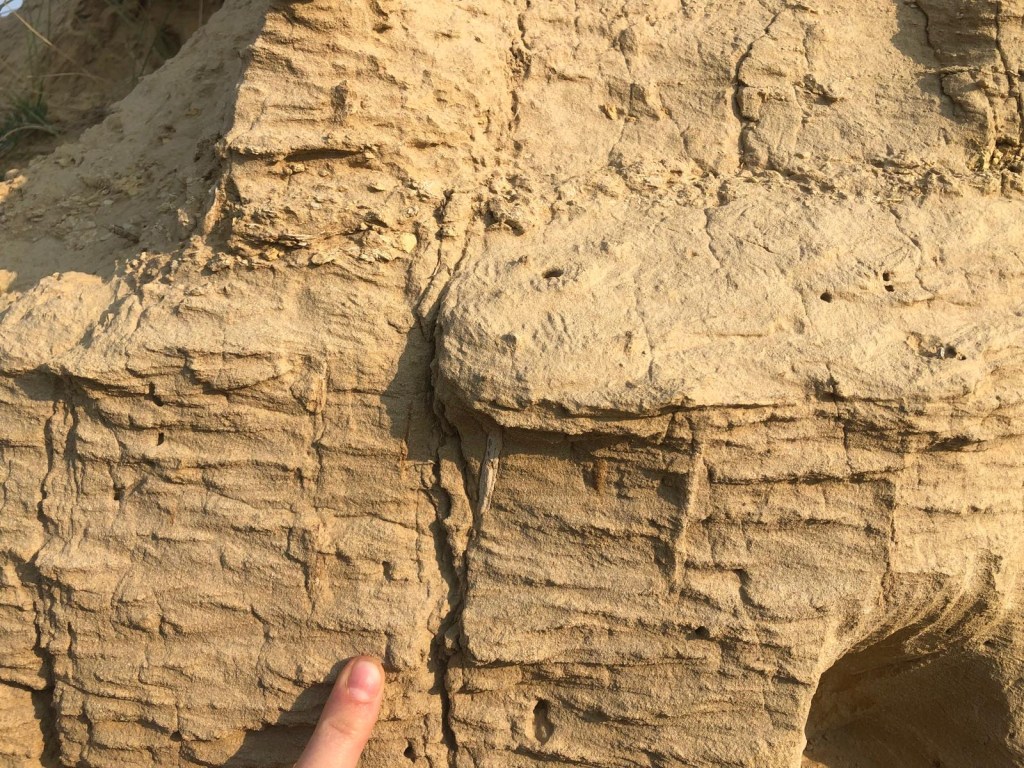
Skolithos isp. in a crossbedded sandstone fluvial channel deposit in the buff facies of the Upper Ravenscrag Formation in southwestern Saskatchewan. Photo provided by Mollie Black

We went to many different geologic outcrops around the town of Eastend. A typical day consisted of taking measurements and samples (so many samples) across the section. A section was first chosen based on the extent of exposed bedrock and then measured from the lowermost exposed bedrock to the top. It wasn’t all just rocks, though! We also found many neat trace fossils and plant fossils, including many just above the KPg boundary.

A huge thank you to all landowners who allowed access to their land.

Written by Mollie Black and Dr. Meagan Gilbert

Jurassic paleosurfaces with fecal mounds reveal the last supper of arenicolid worms

Recently, new research by Gabriela Mángano, Luis Buatois, and coauthors from Stoney Brook University and the MUJA near Colunga, Asturias, Spain, on fecal mounds produced by arenicolid worms from the Upper Jurassic Lastres Formation in Asturias, Spain, has been featured in local news in Asturias. Students who have recently taken the Asturias geology field course offered through the University of Saskatchewan had the opportunity to see these trace fossils in the collections/galleries at the Museo del Jurásico de Asturias (MUJA).

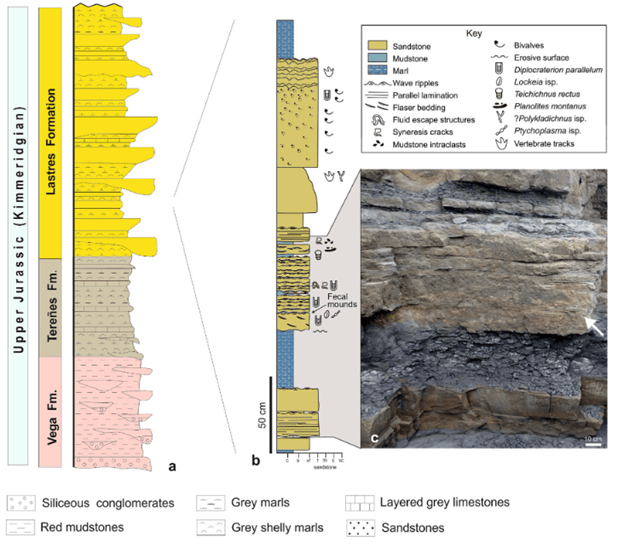
Figure from Mángano et al., 2024 showing the stratigraphy and detailed sedimentologic characteristics of the lowermost Upper Jurassic interval of the Lastres Formation at Arroyo Solero containing one of the surfaces with fecal cast mounds, including a close-up picture of the deposits showing the bedding surface that contains fecal cast mounds in cross-section.

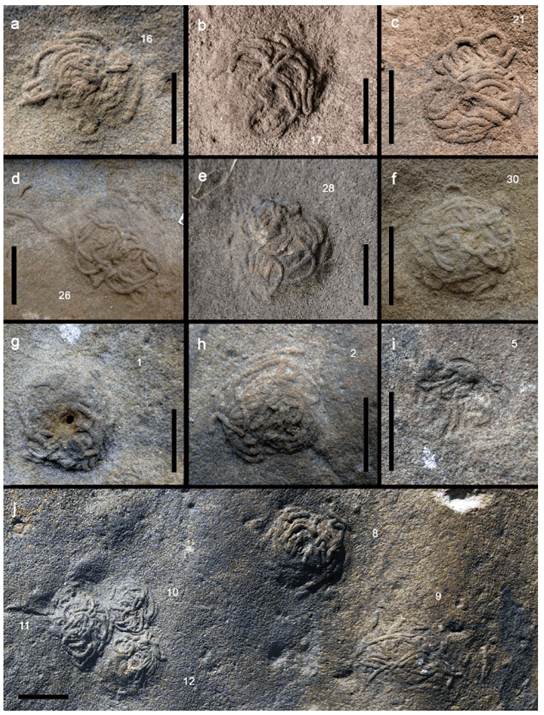
The fecal mounds were given the name Cumulusichnus asturiensis. They are made up of an accumulation of thin sandstone cords roughly 1 to 2.3 mm thick and are preserved on a paleosurface comprised of rippled sandstone formed by wave action. The traces are preferentially located within the depressions located between the crests of the ripples. In the modern, the worms that generate this type of structure are known as Arenicola marina, a benthic polychaete from the family Arenicolidae (also called lugworms) that can be found in estuaries, deltas, tidal flats, and shallow marine settings of Europe. North America and New Zealand. The worm lives upside down inside the sediment inside an L- or J-shaped tube (domichnia) and feeds on bacteria and various microorganisms that live within the substrate. The worm swallows sand, takes in nutrients, and expels the waste, forming small sandy fecal piles on the surface that resemble squiggles or spaghetti.

Figure from Mángano et al., 2024, showing examples of arenicolid fecal mounds from Playa España, Upper Jurassic Lastres Formation of Asturias, Spain. Scale bars are 2 cm long.

You can read the paper in the journal Nature here. You can watch a brief news clip (in Spanish) here (skip to 11 min 40 sec). You can also read an article and watch another video highlighting the discovery here. Once again, congratulations to Gabriela, Luis, and the other researchers involved with this project!

Written by Jack Milligan

Tracking hadrosaurs in northwestern Alberta with the Boreal Alberta Dinosaur Project

This past summer, Jack Milligan represented Ichnoplanet during fieldwork conducted by the Boreal Alberta Dinosaur Project (BADP) at the University of Alberta (UA), and the Philip J. Currie Dinosaur Museum (PJCDM) under the leadership of UA professor Dr. Corwin Sullivan, and USASK adjunct professor and PJCDM curator Dr. Emily Bamforth. Objectives of this fieldwork include collecting fossils from the late Cretaceous Wapiti Formation near the city of Grande Prairie. The Wapiti Formation is rich in fossils, including freshwater invertebrates, small vertebrates, and especially non-avian dinosaurs. The most common dinosaurs in northern Alberta based on the number of occurrences are the hadrosaurs, commonly referred to as the “duck-billed” dinosaurs. These are large herbivorous dinosaurs that have been suggested to travel in large herds in search of new food sources and as a defense against predatory theropod dinosaurs.

During July and August, BADP collected several large, three-toed hadrosaur tracks from various sites across northwestern Alberta. These tracks are isolated natural casts of footprints that infilled the original track and weathered out of situ. Some of these tracks were carried out of the site by hand across rushing rivers much to the chagrin, all be it temporary, by the team. Studying these tracks will allow the BADP team to learn more about the kinds of environments these dinosaurs were walking through and the taphonomy and different preservation of the tracks.

Large hadrosaur track with a rock hammer for scale, surrounded by grass and mud covered stones

Images provided by Jack Milligan and Emily Bamforth.

Written by Jack Milligan