Tracking hadrosaurs in northwestern Alberta with the Boreal Alberta Dinosaur Project

This past summer, Jack Milligan represented Ichnoplanet during fieldwork conducted by the Boreal Alberta Dinosaur Project (BADP) at the University of Alberta (UA), and the Philip J. Currie Dinosaur Museum (PJCDM) under the leadership of UA professor Dr. Corwin Sullivan, and USASK adjunct professor and PJCDM curator Dr. Emily Bamforth. Objectives of this fieldwork include collecting fossils from the late Cretaceous Wapiti Formation near the city of Grande Prairie. The Wapiti Formation is rich in fossils, including freshwater invertebrates, small vertebrates, and especially non-avian dinosaurs. The most common dinosaurs in northern Alberta based on the number of occurrences are the hadrosaurs, commonly referred to as the “duck-billed” dinosaurs. These are large herbivorous dinosaurs that have been suggested to travel in large herds in search of new food sources and as a defense against predatory theropod dinosaurs.

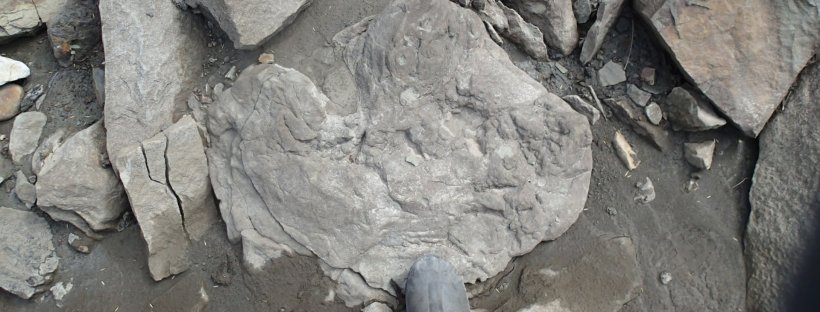
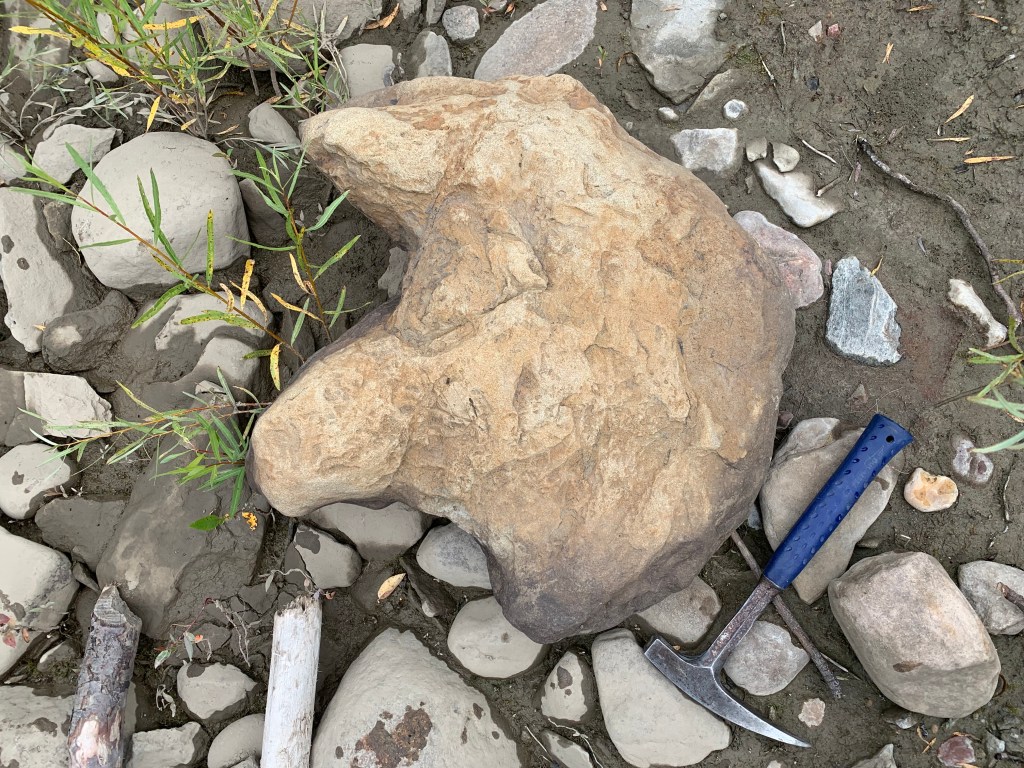
During July and August, BADP collected several large, three-toed hadrosaur tracks from various sites across northwestern Alberta. These tracks are isolated natural casts of footprints that infilled the original track and weathered out of situ. Some of these tracks were carried out of the site by hand across rushing rivers much to the chagrin, all be it temporary, by the team. Studying these tracks will allow the BADP team to learn more about the kinds of environments these dinosaurs were walking through and the taphonomy and different preservation of the tracks.

Large hadrosaur track with a rock hammer for scale, surrounded by grass and mud covered stones

Images provided by Jack Milligan and Emily Bamforth.

Written by Jack Milligan

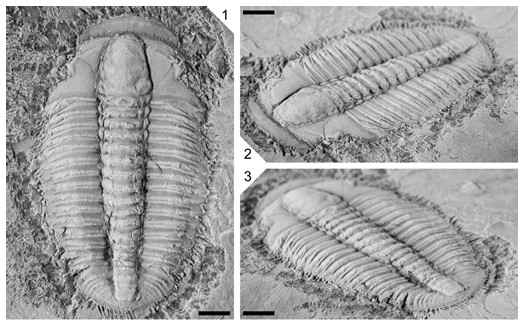
Trilobite fossil recovered from southwestern Saskatchewan subsurface Earlie Formation core sample

During his studies on the subsurface geology and ichnology of the Basal Sandstone Unit and Earlie Formation in Alberta and Saskatchewan, Ph.D. student Andrei Ichaso conducted core analysis of the study area. One of the studied core samples records the tide-influenced marginal-marine shales of the middle Cambrian Earlie Formation (~500 Ma), and also happened to capture something else. The complete body fossil of a trilobite, a Paleozoic marine invertebrate, was caught and preserved within the drill core! The trilobite was identified by a National University of Cordoba Ph.D. student, and former M.Sc. student in the Department of Geological Sciences at USask, Neal Handkamer, as Ehmania weedi. The specimen is around 32 mm long and recovered from a drilling depth of 2.3 km (see figure below, Handkamer et al., 2023).

This discovery marks the first occurrence of a trilobite body fossil of Cambrian age from the province of Saskatchewan. Following this discovery, the trilobite was featured on the front cover of the 2023 Saskatchewan Geoscience Calendar from the Saskatchewan Geological Society! You can read more in the Canadian Journal of Earth Sciences here.

Congratulations to Andrei on this awesome and remarkable find!

Written by Jack Milligan

Three Ichnoplanet students at the University of Saskatchewan receive awards from the International Association of Sedimentologists!

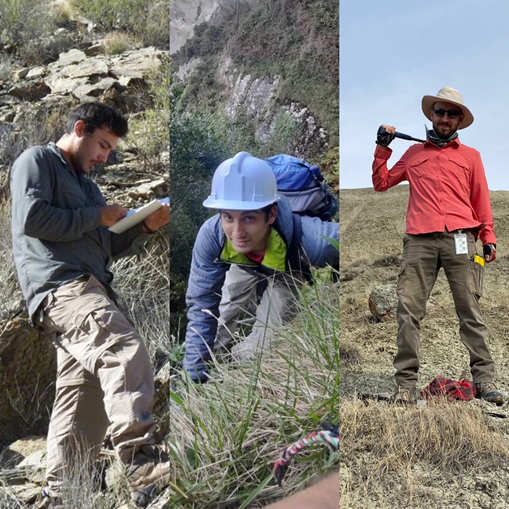
Dr. Maximiliano Paz has received the International Association of Sedimentologists (IAS) Postdoctoral Research Grant. He is currently studying the sedimentology and ichnology of the Cambrian-Ordovician Los Cabos Series. These funds will be used to cover one month of fieldwork expenses to log 4000 m of the succession in the rocky cliffs of western Asturias, Spain.

Jack Milligan has received the IAS Judith McKenzie Fieldwork Award. He is studying the sequence stratigraphy and taphonomy of dinosaur bones including describing osteic bioerosion trace fossils from the latest Cretaceous Frenchman Formation. This funding will cover fieldwork expenses to measure coastal floodplain and fluvial outcrops along the Frenchman River Valley of southwestern Saskatchewan.

Federico Wenger also received the IAS Judith McKenzie Fieldwork Award. He will be studying the sequence stratigraphy and ichnology including the degree of bioturbation, ichnodisparity, and ichnodiversity to understand the different environmental zones of the Devonian Talacasto Formation, in the geological province of Precordillera, western Argentina. This funding will help finance the trip to the study area.

Congratulations to Maximiliano, Jack, and Federico, and best of luck with your fieldwork, and thank you to the International Association of Sedimentologists for helping fund Ichnoplanet research at USask!

Written by Jack Milligan

Dr. Anthony Shillito receives Banting Postdoctoral Fellowship to conduct research at USask on animal aquatic-terrestrial transition

Dr. Anthony Shillito from the University of Oxford, England, is one of the recent recipients of the Banting Postdoctoral Fellowship, which allows exceptional scholars to continue their research with the help of federal funding.

Dr. Shillito’s project at the University of Saskatchewan will be focused on understanding why animals began the transition from marine to terrestrial, and the factors that may have played a part in establishing terrestrial faunal communities. He has previously conducted fieldwork looking into this research question in places such as the United Kingdom, Australia, and the Canadian Arctic. His work will look at this transition through the perspective of the trace fossil record including burrows and trackways, including analysis of the sedimentology associated with these important fossils. Congratulations on receiving this prestigious award Anthony, we are excited to have you join our research group!

You can read more of Dr. Shillito’s research on his ResearchGate page!

Written by Jack Milligan

Modern animal life could have arisen in a storm-dominated deltaic environment

Our understanding of how and where the ancestors of modern life evolved has been the question of many paleontologists for a long time. Recently, an international team of sedimentologists and paleontologists, including Dr. Luis Buatois, Dr. Gabriela Mángano, and Dr. Maximiliano Paz, demonstrated that a world-famous Cambrian soft-bodied fossil assemblage in Yunnan province, China, lived and died in a delta front environment affected by storms. The Chengjiang Biota records the exquisite preservation of soft-bodied marine invertebrates, including worms, early arthropods, and early vertebrates. This assemblage is around 518 million years old, around the time of the famous Cambrian explosion, where modern communities of animals first started to truly diversify. The Chenjiang biota has a similar faunal makeup to the Burgess Shale biota from British Columbia, Canada. The team analyzed a core taken from Cambrian outcrops in Yunnan, China, and discovered that the sequence of strata was formed in a shallow marine, deltaic environment. High rates of sedimentation and indications of high salinity point to this deltaic environment being dominated by storms and river floods. These kinds of sediments help us to understand the exceptional taphonomy of fossils from these Cambrian assemblages.

Figure. Block diagram showing the storm-flood-dominated delta and associated cores showing depositional sequences. (From F. Saleh et al., 2022)

The full article can be accessed in Nature Communications.

Written by Jack Milligan