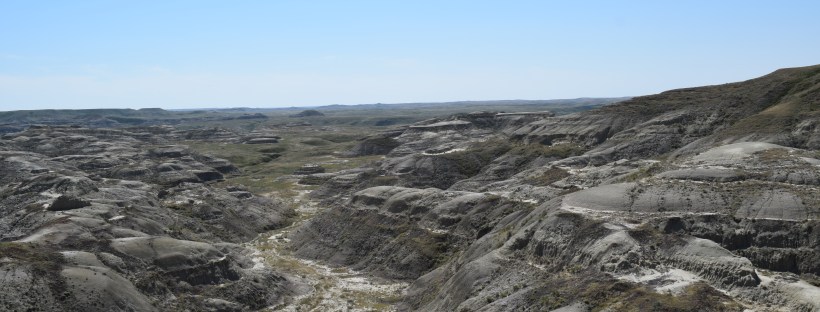
Towards the end of the summer, I had the opportunity to continue fieldwork at two multitaxic Edmontosaurus quarries within the Uppermost Cretaceous Frenchman Formation in the East Block of Grasslands National Park in southern Saskatchewan under the supervision of Dr. Emily Bamforth of the Philip J. Currie Dinosaur Museum and Dr. Ryan McKellar of the Royal Saskatchewan Museum. These excavations have been ongoing and have yielded some fantastic fossil specimens and interesting geology.
We collected a limb bone (tibia) from one of our two Edmontosaurus quarries, called the “Leo” quarry. The tibia shows feeding traces as evidenced by well-defined tooth marks. During the excavation of the tibia, a shed tooth from a tyrannosaurid (Tyrannosaurus rex) was collected from the same depositional layer. This association of tooth traces on Edmontosaurus bones and T. rex teeth suggests that Leo was scavenged during subaerial exposure on a floodplain within a meandering fluvial system. Limb bones have a high likelihood of being consumed due to large locomotor muscles being present (a great food source for predators like T. rex), and thus will tend to have more tooth traces on the bone.
On an adjacent butte within the same depositional layer as the “Leo” quarry, there is a point bar deposit containing a second active quarry named the “Clifford“ quarry. While the Edmontosaurus in this quarry has yet to produce elements with tooth marks, teeth from T. rex and the crocodyliform Borealosuchus have shown up this past season. Adding to the mystery of this quarry, several articulated turtle skeletons have been collected from this deposit, showing no evidence of being scavenged.
Tooth marks have been a widely debated aspect of vertebrate ichnology. Recently, the category-modifier (CM) system was proposed by Wyenberg-Henzler et al., 2024, as a method to identify different morphologies of tooth marks and their associated behaviours. While not strictly defined within a traditional ichnological framework, it is the most comprehensive overview of tooth marks on bones in the literature to date. Based on the CM system, the tooth marks left on the Edmontosaurus tibia appear to be internally chattered, referring to the crescentic depression on the inside of the tooth mark. Shed carnivore teeth from both quarries suggest that the dominant predators within this ecosystem were crocodyliforms and tyrannosaurs.
Further excavation of the quarries is required, and research into the taphonomy of these two Edmontosaurus quarries is ongoing, but there are sure to be some exciting discoveries to be made in future field seasons!
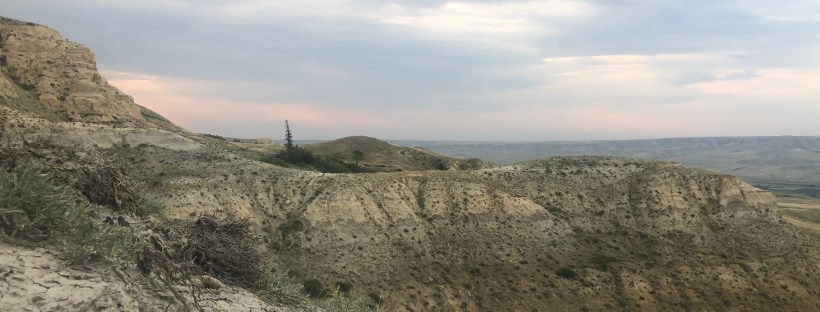
Throughout this past summer, I had the opportunity to volunteer with the Saskatchewan Geologic Survey under Dr. Meagan Gilbert in my hometown of Eastend, Saskatchewan. This project aimed to characterize the stratigraphy and depositional environments of the Upper Cretaceous and lower Paleogene of southwest Saskatchewan.
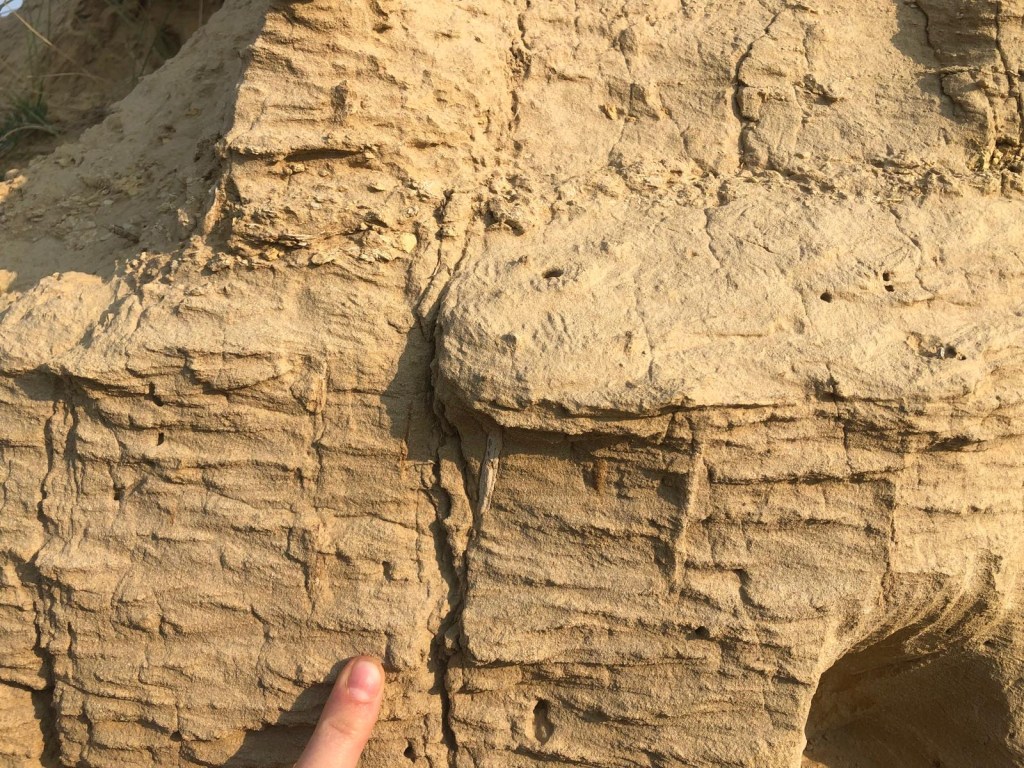
Skolithos isp. in a crossbedded sandstone fluvial channel deposit in the buff facies of the Upper Ravenscrag Formation in southwestern Saskatchewan. Photo provided by Mollie Black
We went to many different geologic outcrops around the town of Eastend. A typical day consisted of taking measurements and samples (so many samples) across the section. A section was first chosen based on the extent of exposed bedrock and then measured from the lowermost exposed bedrock to the top. It wasn’t all just rocks, though! We also found many neat trace fossils and plant fossils, including many just above the KPg boundary.
A huge thank you to all landowners who allowed access to their land.
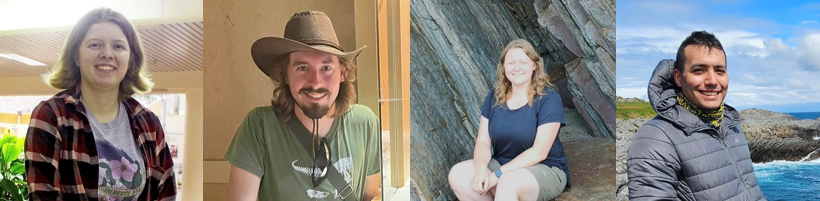
We have had a busy summer, and we want to start by congratulating Jack Milligan, Kaitlin Lindblad, Federico Wenger, and Kathrine Thue for successfully defending their M.Sc. theses!
Jack studied the depositional context of bioeroded dinosaur bones from the upper Cretaceous of Saskatchewan; Kaitlin studied the biogeography, environment and paleoecology of crocodylians from the northern plains; Federico studied the ichnodiversity and bioturbation of Devonian shallow marine deposits in Argentina, and Kathrine studied the sedimentology and ichnology of Silurian-Devonian deposits in Asturias, Spain.
Once again, congrats to these new masters of ichnology!
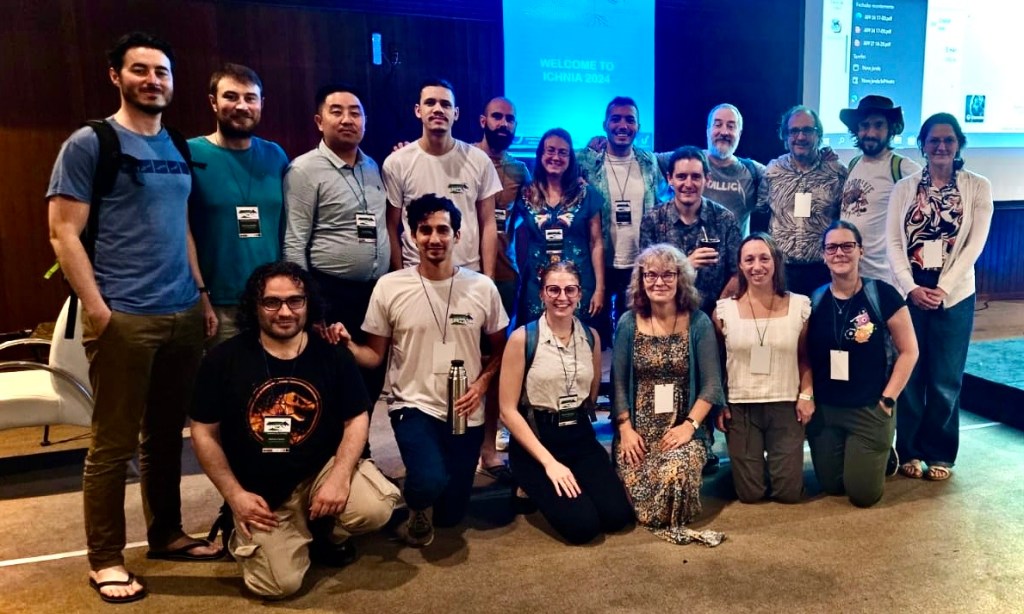
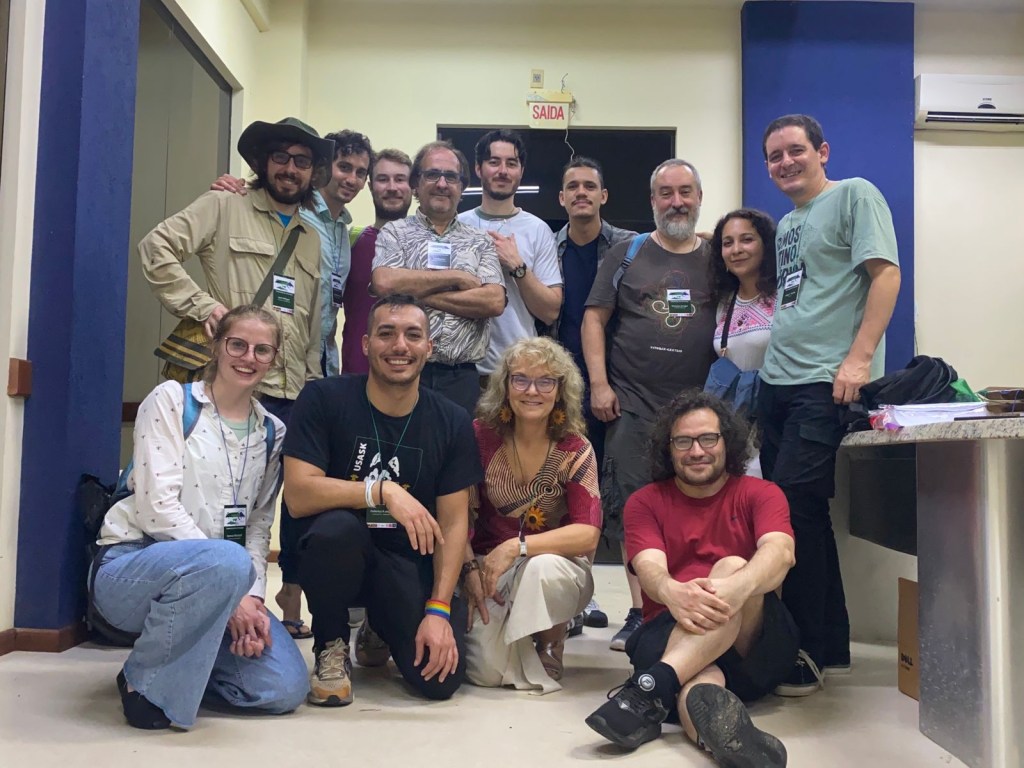
ICHNIA 2024 was a success! Several current and former Ichnoplanet students journeyed to Florianopolis, Brazil, to present their latest research on trace fossils, sedimentology and paleobiology.
Jack Milligan and Cecilia Pirrone presented their research on reconstructing the taphonomic pathway of turtle fossils from the transitional marine sediments of the early Paleocene Salamanca Formation of Chubut, Argentina that have been bioeroded by alligators, beetles, leeches and barnacles.
Jessica Morstad had a poster going over imaging techniques and the response of benthic organisms within submarine canyons from the Barkley Canyon in the northeastern Pacific Ocean off the coast of British Columbia, Canada.
Luis Buatois presented research on the ichnological signatures at mass extinction boundaries to quantify and qualify evolutionary trends in trace fossils at and across major mass extinction events and the rate of recovery of ichnodiversity following these events.
Gabriela Mángano presented on using the Burgess Shale-type high-density, low-diversity trace-fossil assemblages at Marble Canyon, middle Cambrian Thick Stephen Formation to study the penetrative bioturbation of Burgess Shale-type deposits.
Alejandro Garcia-Corrales had a poster exploring the ichnofauna of surficial epifauna and shallow-tier infauna from the lower Cambrian Cranbrook Lagerstätte from the Eager Formation of British Columbia, Canada, where the ichnofauna is dominated by worm burrows and, to a lesser extent, arthropod trackways.
Martin Farina and Verónica Krapovickas had a poster proposing the concept of an ecoichnotype for avian footprints, accounting for morphological variability and body mass estimates to ascertain paleoecological and paleoenvironmental details.
Romain Gougeon presented his research on the paleoecology of ichnofaunas in the early Paleozoic by analyzing the occurrences, morphology, and bioturbation indices to reveal global trends in evolutionary radiations that led to the establishment of the Phanerozoic paleosphere. Romain won the award for best oral presentation!
Anthony Shillito and Romain Gougeon presented their recent work on the significance of outcrop morphology and the use of true substrates in ichnological research by looking at bedding plane surfaces, and the physical shape and structure of geological exposures as they relate to trace fossils.
Federico Wenger gave a presentation on his research into the paleoecology and paleoenvironmental implications of the shallow-marine lower Devonian Talacasto Formation in the Central Precordillera in western Argentina, incorporating paleoenvironmental controls and sedimentology to determine ichnofacies trends.
Maximilliano Paz and Patricio Desjardins proposed a method to estimate the intensity of bioturbation in the mixed layer of mud-rich successions by looking at the degree of bioturbation to improve ichnofabrics descriptions and transitions between successions of ichnocoenoses.
Mariano Arregui and Verónica Krapovickas presented exceptionally well-preserved large-sized burrows from the Pleistocene of Necochea, Buenos Aires, Argentina, thought to have been produced by pampatheres based on the size of the burrows and phenetic correlation of claw marks with the anatomy of the forelimb.
Mariano Arregui also presented on subsurface bioturbation and bioerosion structures in core samples from external storm-influenced estuarine deposits from the Springhill Formation, Austral-Magallanes Basin, Tierra del Fuego, Argentina.
Sudipta Dasgupta was a coauthor on a presentation looking at the ichnological response to the Eocene hyperthermal events from the onshore deposits of the Kutch Basin, western India, which acted as stressors controlling the distribution and benthic dynamics of successive Eocene ichnocoenoses.
Verónica Krapovickas had a presentation on the behaviour, paleoecology, and locomotion dynamics of early mammals and early dinosaurs based on trackways from the middle Jurassic La Matilde Formation, Patagonia, Argentina.
Nicolas Minter and Lijun Zhang worked with Luis and Gabriela on a presentation on the infaunal response to environmental extremes during critical intervals of deep time using trace fossil evidence during the End-Permian mass extinction event.
Diego Muñoz proposed refining the stratigraphy of Cruziana by using transitional ichnotaxa Cruziana semiplicata and Cruziana rugosa groups from the Central Andean Basin, northwestern Argentina using trace fossil and trilobite body fossil evidence.
Maximiliano Paz presented a poster looking at the ichnofauna of a delta complex from the Cambrian-Ordovician Los Cabos Group, Asturias, Spain, identifying two distinct trace fossil assemblages including storm and flood-influenced assemblages. He also presented the deep-sea trace fossil Lingulichnus verticalis from the upper Ordovician proximal turbidite deposits of Asturias, Spain, and associated brachiopod body fossils.
Noelia Carmona coauthored a presentation on the analysis of Mole Cricket burrows and their implications for understanding substrate moisture changes on preservation and morphology.
Congratulations to everyone on the amazing and informative oral presentations and posters, the contributions of current and former Ichnoplanet students made the conference much better. Thanks to the organizers and committees that made ICHNIA 2024 possible! One ichnology!
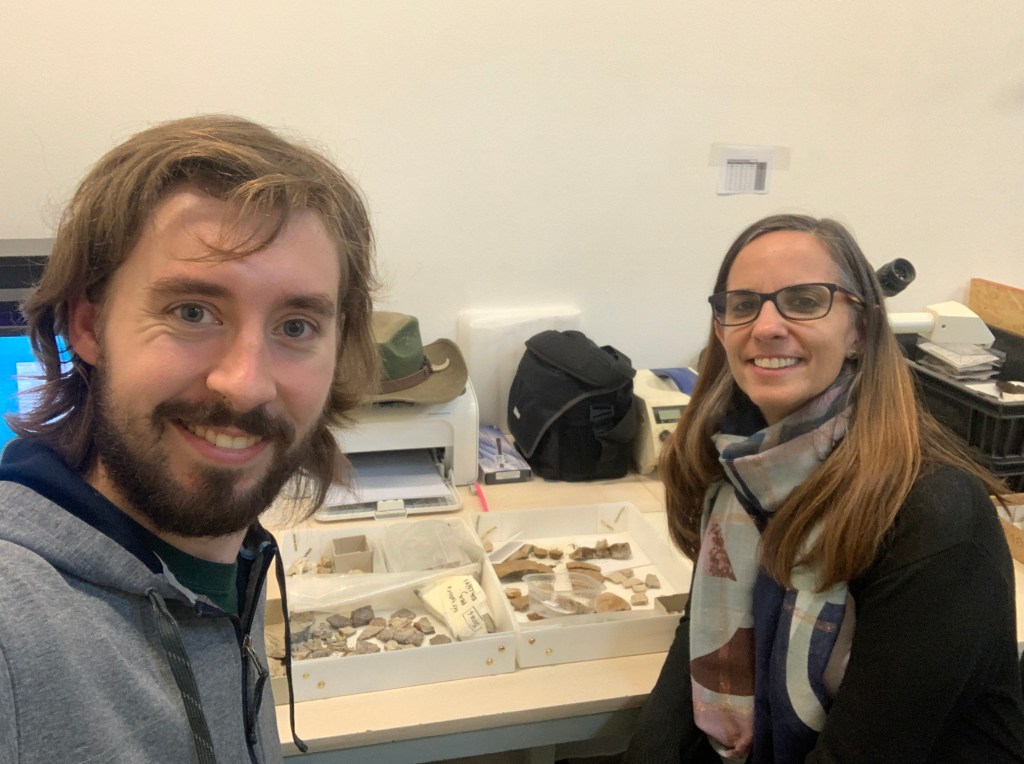
Jack Milligan recently visited Patagonia to study turtle fossils from the Paleocene Salamanca Formation in Chubut, Argentina, analyzing trace fossils on turtle shells. This study is ongoing, but early observations indicate that the tracemakers behind the trace fossils seen on Chelid and Pan-chelid turtle carapaces and plastrons include alligatoroids, beetles, leeches, and barnacles.
The imageshows an example of a trace fossil left on a turtle fossil by a beetle, the morphologysimilar to Osteocallis isp.
Through this research, the trace fossils can be used to understand the taphonomic pathway of these turtles, and how the trace fossils can be used to inform paleoenvironmental conditions at different stages of taphonomy. In addition to the trace fossils, several paleopathologies were identified, many of which could have resulted from trophic interactions between the turtles and other animals.
Thanks to Dr. Juliana Sterli and Dr. Marcelo Krause for hosting this research at the MEF, this will be a very cool project!







 ichnoplanet.ca