Ichnoplanet alumna Kaitlin Lindblad’s paleoart published in the Journal of Vertebrate Paleontology

Kaitlin Lindblad who completed her master’s degree working on crocodyliforms from Saskatchewan has had her paleoart featured in a new article, the ontogenetically youngest known pachycephalosaur (Dinosauria: Ornithischia) postcranium, in the Journal of Vertebrate Paleontology.

Researchers Bryan R. S. Moore, David C. Evans, Michael J. Ryan, R. Timothy Patterson, and Jordan C. Mallon found disarticulated pachycephalosaur remains including vertebral, hindlimb, pelvic and postcranium material in uppermost Maastrichtian Frenchman Formation in southern Saskatchewan. Given the lack of diagnostic material, they do not assign the fossil (CMNFV 22039) a taxonomic identity, however Sphaerotholus buchholtzae is considered the most likely candidate given the stratigraphic age and geographic location of the specimen. Morphometric analysis of CMNFV 22039 suggests that the skeleton is that of an early-stage juvenile and very likely the youngest pachycephalosaur ever recorded. This is supported by the sample’s small size and histological analysis showing a rapidly growing woven bone of the tibia and fibula. This research is key for understanding the growth and development of pachycephalosaurs.
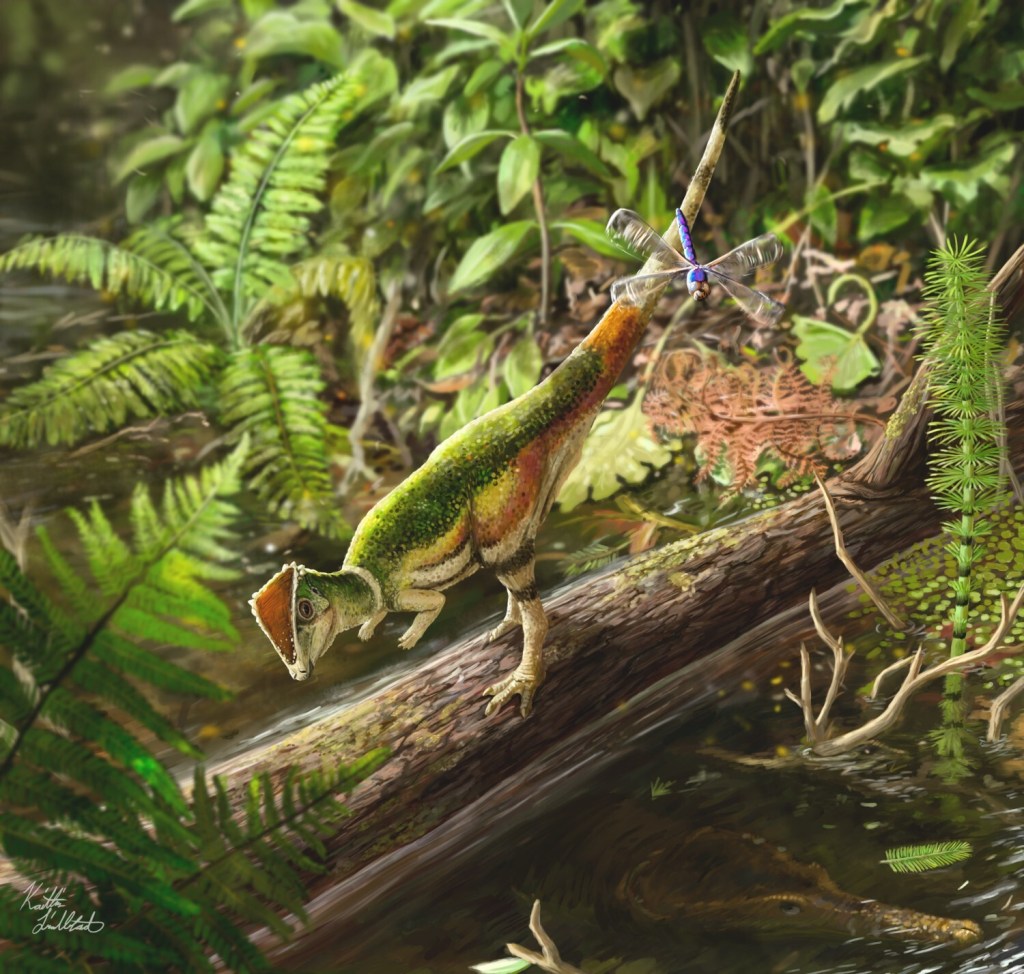
FIGURE 18. Life reconstruction of CMNFV 22039 in an environment typical of the upper Maastrichtian Frenchman Formation. Illustration by Kaitlin Lindblad. Used with permission.

Check out the research in JVP here.

Written by Zane Gabriel Goodell
Psammichnites from the Pennsylvanian Rod El-Hamal Formation of Egypt: revisiting paleoenvironmental and paleogeographic patterns of distribution of late Paleozoic ichnospecies

New research has just been published in Ichnos by authors Ahmed A. El-Refaiy, Luis Buatois, Magdy M. El Hedeny, Ahmed M. El-Sabbagh, Ahmed N. El-Barkooky and Ahmed S. Mansour on Psammichnites in the Pennsylvanian Rod El-Hamal Formation of Egypt.

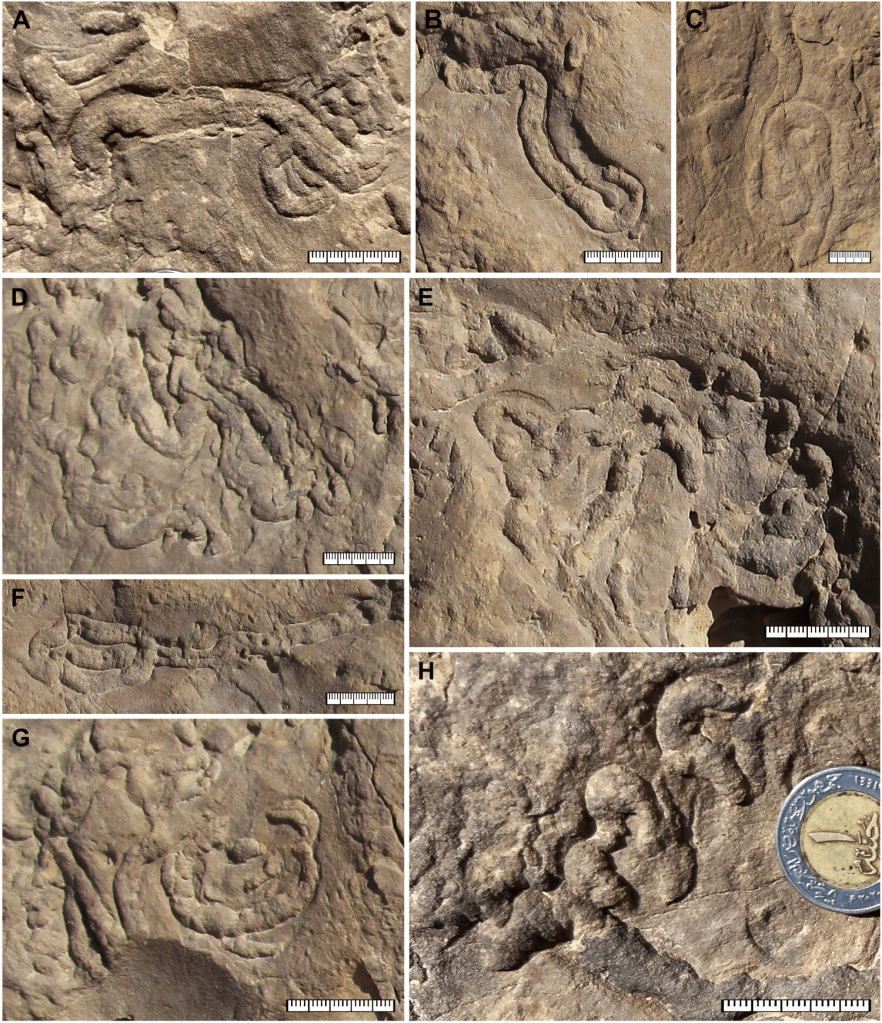
The researchers found high density occurrences of three different ichnospecies of Psammichnites preserved in the rippled troughs of sandstones in off-shore transition settings. Global compilation of Psammichnites show its presence in marginal and fully-marine deposits, showing its tolerance to brackish to normal marine salinity conditions. Psammichnites appears to be a cosmopolitan ichnogenus showing a broad latitudinal distribution during the late Paleozoic, having been particularly widespread during the Pennsylvanian.

Figure 3. Psammichnites ichnospecies from the Pennsylvanian Rod El-Hamal Formation, Wadi Araba, Eastern Desert of Egypt. Scale bars are 2.5 cm. (A–D) Psammichnites plummeri (Fenton & Fenton,1937). (E–H) Psammichnites grumula (Romano & Meléndez, 1979). From El-Refaiy et al. (2026).

Learn more about this research published in Ichnos here.

Written by Zane Gabriel Goodell