
Dr. Debora Mical Camptella
Postdoctoral fellow
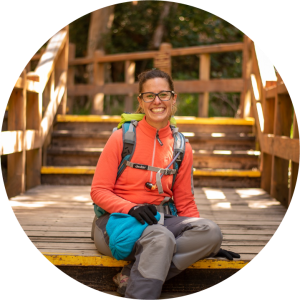
I obtained my PhD degree at the Universidad Nacional de Río Negro in 2022. I developed my postdoctoral research at the Instituto de Investigación en Paleobiología y Geología (CONICET-UNRN), Río Negro, Argentina. In addition to my research, I serve as a Teacher Assistant in the Sedimentology course of the Geology and Paleontology careers of the Universidad Nacional de Río Negro. I work in the ichnological record of marine invertebrates from the early Jurassic in sediments affected by volcanism, specifically in La Primavera Formation which is the most basal unit of the Cuyo Group, in Cuenca Neuquina, Argentina.
Postdoctoral Project: Sedimentology, ichnology and provenance analysis of the La Primavera Formation (Pliensbachian – lower Toarcian) in the Chacay Melehue area – Neuquén Basin
Postdoctoral Supervisors: Dr. Silvio Casadío and Dr. Gabriela Mángano
Degrees: Ph.D. from the Universidad Nacional de Río Negro, Ciencias de la Tierra Mention (Universidad Nacional de Río Negro, Río Negro, Argentina), Bachelor degree in Geological Sciences (Universidad Nacional del Sur, Bahía Blanca, Argentina)
Doctoral Thesis: Sedimentology and ichnology of Los Molles Formation at Picún Leufú, Sierra de Chacaico, and Cordillera del Viento localities, Neuquén Basin, Argentina
Select publications:
Campetella, D.M., Palópolo, E.E., Rodriguez, M.N, Thuy B., Ponce, J.J., Carmona, N.B., Casadío S.A. 2023. First Jurassic brittle-star record from Neuquén Basin, Argentina. Acta Palaeontologica Polonica, 68(1): 143-153.
Paz, M., Mángano, M.G., Buatois, L.A., Campetella, D.M., Sproat, C., Pérez-Pueyo, M., Piñuela, L., García-Ramos, J.C. 2023. Deep-sea Ordovician lingulide brachiopods and their associated burrows suggest an early colonization of proximal turbidite systems. Scientific Reports, 13(1): 22753.
Rodriguez, M.N., Campetella, D.M., Carmona, N.B., Ponce, J.J., Parada, M.N. Microbial mats and their palaeoenvironmental analysis in offshore – shelf facies of the Los Molles Formation (Toarcian – Lower Callovian) in the Chacay Melehue area, Neuquén Basin, Argentina. Geobiology, 22(1): e12580.
Campetella, D.M., Carmona, N.B., Ponce, J.J., Wetzel, A., Rodriguez, M.N., Parada, M.N. 2020. Trace fossils as tools to unravel oxygen conditions: A case study from Los Molles Formation (Toarcian-lower Callovian). Revista de la Asociación Geológica Argentina, 77(3): 463 – 477.

Dr. Cecilia R. Méndez
Postdoctoral fellow
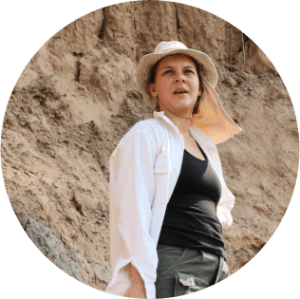
My research focuses on the ichnological record of invertebrate bioerosion on fossil vertebrate remains, detailing these modifications and comparing them with modern analogues. This approach contributes to understanding the impact of environmental changes from the Late Cenozoic to the present, with a particular emphasis on Late Pleistocene vertebrate assemblages from Northeastern Argentina, specifically those of the Toropí/Yupoí (Corrientes) and Río Bermejo (Formosa) Formations. Previous undergraduate and doctoral research, in which I investigated, analyzed, described, and interpreted the genesis of two formations in the same region, highlighted the need to analyze these bioerosional traces to refine paleoenvironmental interpretations by identifying the bioerosion producers. This study is pioneering in the region and complements my doctoral dissertation.
Postdoctoral Project: Agentes bioerosivos en huesos como indicadores de cambios ambientales durante el Cenozoico tardío del Nordeste de Argentina
Postdoctoral Supervisors: Dr. Luis Buatois and Dr. Alfredo Zurita
Degrees: Degree in Biological Sciences and Ph.D. Biology (Facultad de Ciencias Exactas y Naturales y Agrimensura – Universidad Nacional del Nordeste). University Professor of Biology (Facultad de Humanidades – Universidad Nacional del Nordeste).
Doctoral Thesis: Tafonomía y bioestratigrafía de los vertebrados del Pleistoceno tardío de las provincias de Corrientes (Formación Toropí/Yupoí) y Formosa (Formación Río Bermejo), Argentina.
Select publications:
Méndez, Cecilia R., Montalvo, C. I., Luna, C. A., Zurita, A. E. (2024). Well‐drained floodplain taphonomic mode of Late Pleistocene vertebrates from Northeast Argentina. Journal of Quaternary Science.doi.org/10.1002/jqs.3608
Álvarez-Herrera, Gerardo P.; Agnolín, Federico L.; Méndez, Cecilia; Luna, Carlos; Cuaranta, Pedro; Contreras, Silvina; Zurita, Alfredo E. (2022). The Northernmost record of the goose genus Chloephaga (Eyton, 1838) (Aves, Anatidae) and its biogeographical implications. Journal Of South American Earth Sciences: Pergamon-Elsevier Science doi.org/10.1016/j.jsames.2022.103988
Prevosti, Francisco J.; Méndez, Cecilia; Schiaffini, Mauro; Cirignoli, Sebastián; Contreras, Silvina; Zurita, Alfredo E.; Luna, Carlos A. (2021). The fossil record of the ocelot Leopardus pardalis (Carnivora, Felidae): a new record from the southern range of its distribution and its paleonvironmental context. Journal Of Vertebrate Paleontology: Soc Vertebrate Paleontology. doi.org/10.1080/02724634.2021.1922867
Dr. Anthony Shillito
Postdoctoral fellow
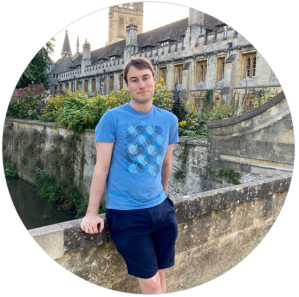
I work on the ichnological record of the initial colonization of land by invertebrates during the lower to middle Palaeozoic. While my previous research has focussed on understanding the geography and mechanics of terrestrialization, my research in Saskatoon seeks to uncover the key driving forces behind this major evolutionary event. After finishing my undergraduate degree and MSci in Natural Sciences, focussing on geology, at Cambridge University in 2015, I remained there to complete my Ph.D. with Dr. Neil Davies, submitting my thesis in 2019. I then spent three years at the University of Oxford as a Junior Research Fellow working on the project: “The rise and impact of Earth’s earliest non-marine biomes: how fauna shaped the continents and how the continents shaped fauna”. I joined the Ichnoplanet family in October 2022 on a two-year Banting Postdoctoral Fellowship.
Postdoctoral Project: Environmental and ecological drivers for the initial colonization of the continents
Postdoctoral Supervisors: Dr. Luis Buatois and Dr. Gabriela Mángano
Degrees: Ph.D. Geology (St Catharine’s College, University of Cambridge); MSci, MA Natural Sciences, Geology (St Catharine’s College, University of Cambridge)
Doctoral Thesis: Understanding the theatre of terrestrialization: Silurian-Devonian sedimentary landscapes and continental ecosystems
Select publications:
Shillito, A.P. & Davies, N.S. 2022. Grain size controlled the Siluro-Devonian colonization of non-marine substrates by infaunal invertebrates. Palaios, 37(12), 731-743. https://doi.org/10.2110/palo.2021.069
Buatois, L.A., Davies, N.S., Gibling, M.R., Krapovickas, V., Labandeira, C.C., MacNaughton, R.B., Mángano, M.G., Minter, N.J. & Shillito, A.P. 2022. The invasion of the land in deep time: Integrating Paleozoic records of paleobiology, ichnology, sedimentology, and geomorphology. Integrative and Comparative Biology, 62(2), 297-331. https://doi.org/10.1093/icb/icac059
Davies, N.S., Garwood, R., McMahon, W.J., Schneider, J. & Shillito, A.P. 2022. The largest arthropod in Earth history: insights from newly discovered Arthropleura remains (Serpukhovian Stainmore Formation, Northumberland, England). Journal of the Geological Society, 179(3). https://doi.org/10.1144/jgs2021-115
 ichnoplanet.ca