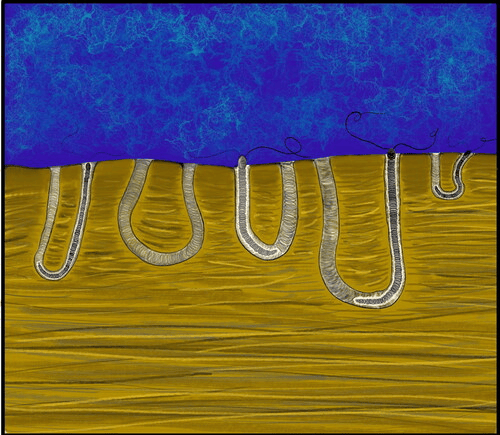
Ichnoplanet Master’s student Jess Morstad and co-authors Gabriela Mángano, Luis Buatois and Fabio Cabrera De Leo have just published new research in Ichnos on the neoichnology of the Barkley Canyon off the coast of Vancouver Island, Canada. This research analyzes the activity of benthic fauna using Ocean Networks Canada’s NEPTUNE observatory during periods of high and low turbidity. The benthos is dominated by spionid polychaete burrows representing an occurrence of the Skolithos ichnofacies within an oxygen minimum zone. This represents a departure from the traditional understanding of the Skolithos ichnofacies as typically occurring within well-oxygenated sediments. Jess’s research bridges the gap between modern and ancient environments by combining conceptual ichnologic frameworks with the current knowledge of submarine canyons.
Figure 8. Ichnofabric diagram representing the simple ichnofabric suggested by the Barkley Canyon infauna. Burrows tentatively identified as Arenicolites.
New research from PhD candidate Alejandro Corrales-García, Gabriela Mángano and Jean Benard-Canon was just published on Burgess-shale type deposits from southeastern British Columbia.
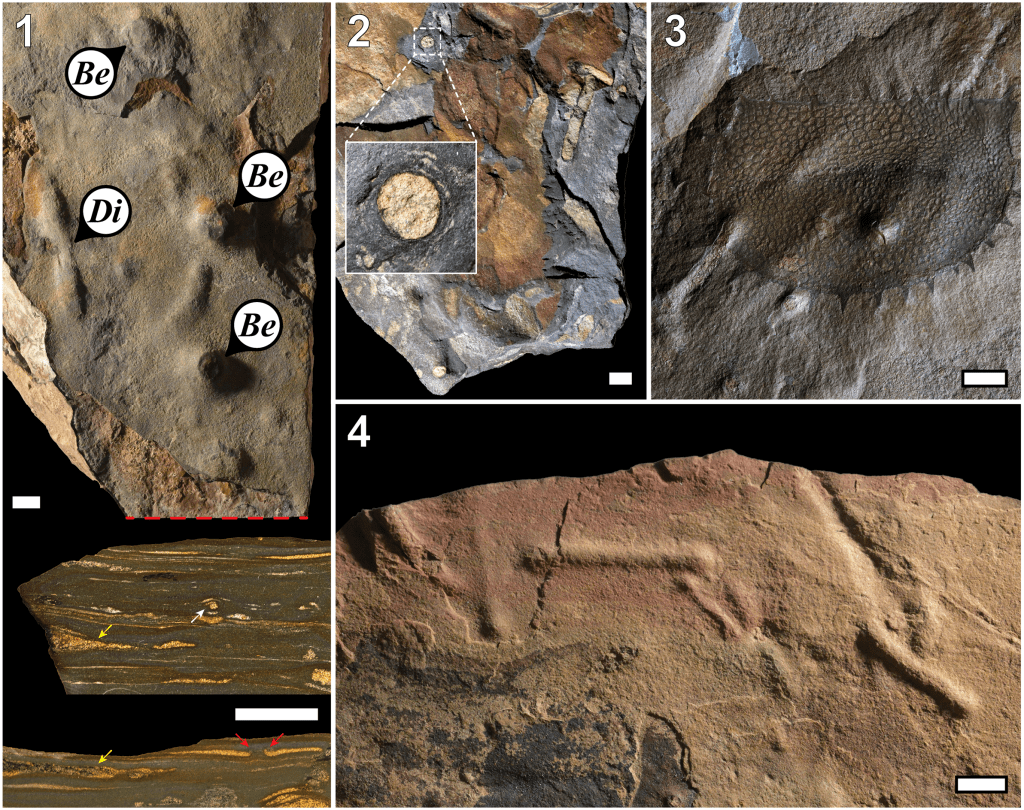
A 2015 investigation of a 2.65 m interval recovered 12 ichnotaxa and three types of trace fossils left in open nomenclature, the most frequent including Helminthoidichnites tenuis, Palaeophycus tubularis, Diplocraterion isp., and finger-like structures (FLS). Overall, the Cranbrook assemblages do not present well-defined tiering structures and represent surficial epifauna and shallow-tier infauna that colonized the sea bottoms during brief windows between episodic flows and inhabited dysoxic to relatively well-oxygenated outer shelf environments. This study gives us additional insight into the behavior of soft-bodied organisms in some of the most recognizable deposits representing early animal life.
Figure 2. Trace fossils and physical sedimentary structures in the Diplocraterion isp. Ichnocoenosis. (1) General bedding-plane view of Bergaueria isp. (Be) and Diplocraterion isp. (Di) and close-ups of polished cross section showing typical claystone with thin intercalations of coarser grains in thin and discontinuous laminae displaying starved ripples and associated cross-lamination (yellow arrows), passively filled burrows (white arrow), and ruptured laminae of fine-grained sand (red arrows). (2) Bedding-plane view with close-up of Diplocraterion isp. with fine-grained sand fill. (3) Bedding-plane view displaying Diplocraterion isp. with fine-grained sand fill in incidental association with a Tuzoia carapace. Notice deformation of Tuzoia-bearing laminae by the overprinting burrow. (4) Bedding-plane view displaying stick-like individuals. Notice common individuals having slightly broader ends. All scale bars = 10 mm.
To learn more, check out the paper published in The Journal of Paleontology here.