Meet Himatiichnus mangano!

Recently, an international team of ichnologists led by Katherine A. Turk described a new ichnogenus from the late Ediacaran Huns Member of the Urusis Formation, in southern Namibia. They described a series of meandering, intertwining tubes exhibiting dual lineation patterns preserved in convex relief, appearing to disappear into the sediment and reemerge on the sediment surface. The distal terminal ends of the tubes are rounded and bulbous. Modern priapulid worms have produced such structures via peristaltic probing. This is similar to the famous Ediacaran-Cambrian biostratigraphic marker trace fossil Treptichnus pedum, also attributed to priapulid worms.
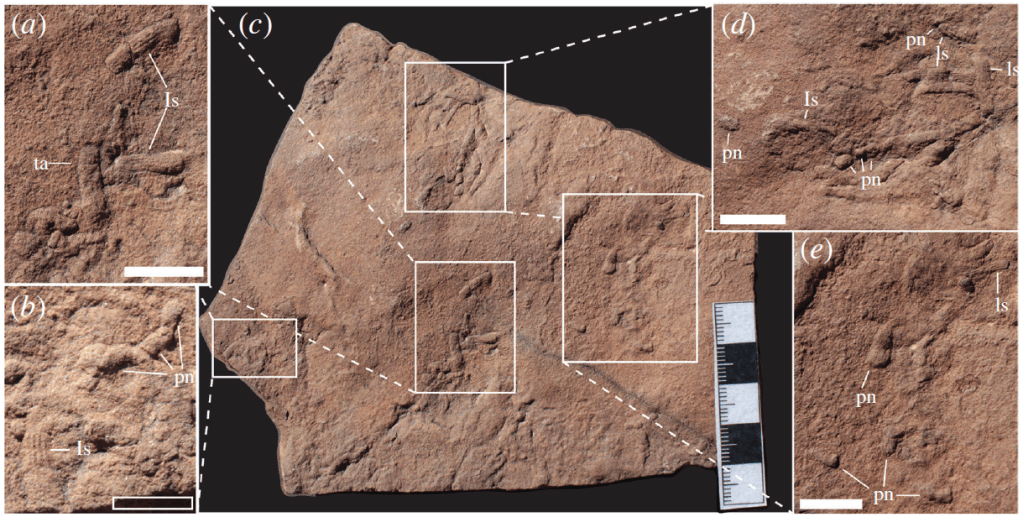
Figure 2 from Turk et al., 2024 showing the holotype of Himatiichnus mangano. See paper here.

The team also noted that these new trace fossils represented the earliest occurrence of Scalidophora, and are much like those traces of worms in the Cambrian, suggesting ecological interactions typical of the Cambrian Explosion appeared earlier than previously thought (the long fuse hypothesis). The morphological evidence pointed to these trace fossils being a novel ichnogenus and ichnospecies. The team gave the trace fossils the name Himatiichnus mangano, named after our very own Dr. M. Gabriela Mángano!

We couldn’t agree more with this decision, as Dr. Mángano has not only spent her career furthering the field of ichnology from all aspects, but has also contributed greatly to research on the Ediacaran-Cambrian transition around the world. Congrats Dr. Mangano on this great honour and achievement!

Written by Jack Milligan

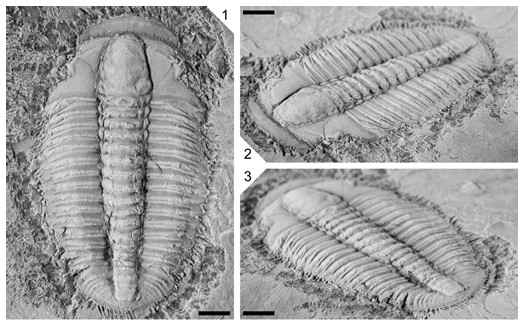
Trilobite fossil recovered from southwestern Saskatchewan subsurface Earlie Formation core sample

During his studies on the subsurface geology and ichnology of the Basal Sandstone Unit and Earlie Formation in Alberta and Saskatchewan, Ph.D. student Andrei Ichaso conducted core analysis of the study area. One of the studied core samples records the tide-influenced marginal-marine shales of the middle Cambrian Earlie Formation (~500 Ma), and also happened to capture something else. The complete body fossil of a trilobite, a Paleozoic marine invertebrate, was caught and preserved within the drill core! The trilobite was identified by a National University of Cordoba Ph.D. student, and former M.Sc. student in the Department of Geological Sciences at USask, Neal Handkamer, as Ehmania weedi. The specimen is around 32 mm long and recovered from a drilling depth of 2.3 km (see figure below, Handkamer et al., 2023).

This discovery marks the first occurrence of a trilobite body fossil of Cambrian age from the province of Saskatchewan. Following this discovery, the trilobite was featured on the front cover of the 2023 Saskatchewan Geoscience Calendar from the Saskatchewan Geological Society! You can read more in the Canadian Journal of Earth Sciences here.

Congratulations to Andrei on this awesome and remarkable find!

Written by Jack Milligan

Modern animal life could have arisen in a storm-dominated deltaic environment

Our understanding of how and where the ancestors of modern life evolved has been the question of many paleontologists for a long time. Recently, an international team of sedimentologists and paleontologists, including Dr. Luis Buatois, Dr. Gabriela Mángano, and Dr. Maximiliano Paz, demonstrated that a world-famous Cambrian soft-bodied fossil assemblage in Yunnan province, China, lived and died in a delta front environment affected by storms. The Chengjiang Biota records the exquisite preservation of soft-bodied marine invertebrates, including worms, early arthropods, and early vertebrates. This assemblage is around 518 million years old, around the time of the famous Cambrian explosion, where modern communities of animals first started to truly diversify. The Chenjiang biota has a similar faunal makeup to the Burgess Shale biota from British Columbia, Canada. The team analyzed a core taken from Cambrian outcrops in Yunnan, China, and discovered that the sequence of strata was formed in a shallow marine, deltaic environment. High rates of sedimentation and indications of high salinity point to this deltaic environment being dominated by storms and river floods. These kinds of sediments help us to understand the exceptional taphonomy of fossils from these Cambrian assemblages.

Figure. Block diagram showing the storm-flood-dominated delta and associated cores showing depositional sequences. (From F. Saleh et al., 2022)

The full article can be accessed in Nature Communications.

Written by Jack Milligan