
Recently, new research by Gabriela Mángano, Luis Buatois, and coauthors from Stoney Brook University and the MUJA near Colunga, Asturias, Spain, on fecal mounds produced by arenicolid worms from the Upper Jurassic Lastres Formation in Asturias, Spain, has been featured in local news in Asturias. Students who have recently taken the Asturias geology field course offered through the University of Saskatchewan had the opportunity to see these trace fossils in the collections/galleries at the Museo del Jurásico de Asturias (MUJA).
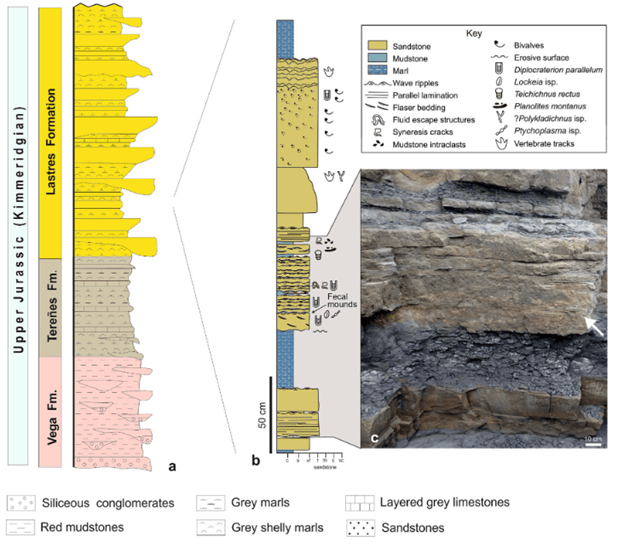
Figure from Mángano et al., 2024 showing the stratigraphy and detailed sedimentologic characteristics of the lowermost Upper Jurassic interval of the Lastres Formation at Arroyo Solero containing one of the surfaces with fecal cast mounds, including a close-up picture of the deposits showing the bedding surface that contains fecal cast mounds in cross-section.
The fecal mounds were given the name Cumulusichnus asturiensis. They are made up of an accumulation of thin sandstone cords roughly 1 to 2.3 mm thick and are preserved on a paleosurface comprised of rippled sandstone formed by wave action. The traces are preferentially located within the depressions located between the crests of the ripples. In the modern, the worms that generate this type of structure are known as Arenicola marina, a benthic polychaete from the family Arenicolidae (also called lugworms) that can be found in estuaries, deltas, tidal flats, and shallow marine settings of Europe. North America and New Zealand. The worm lives upside down inside the sediment inside an L- or J-shaped tube (domichnia) and feeds on bacteria and various microorganisms that live within the substrate. The worm swallows sand, takes in nutrients, and expels the waste, forming small sandy fecal piles on the surface that resemble squiggles or spaghetti.
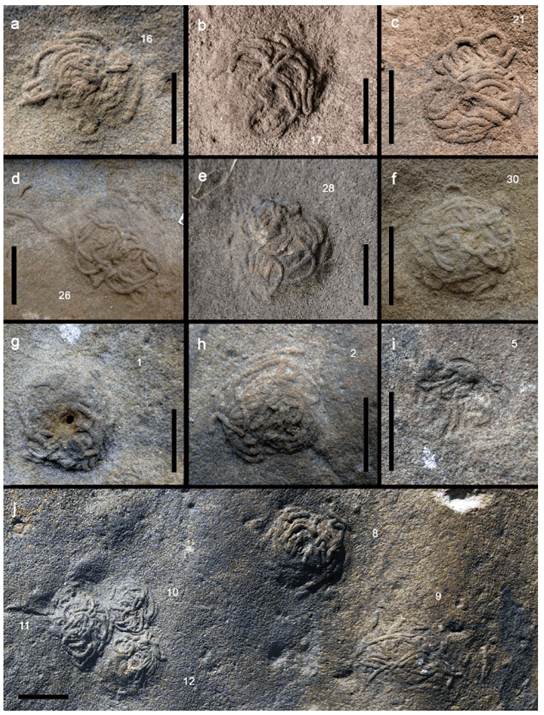
Figure from Mángano et al., 2024, showing examples of arenicolid fecal mounds from Playa España, Upper Jurassic Lastres Formation of Asturias, Spain. Scale bars are 2 cm long.
You can read the paper in the journal Nature here. You can watch a brief news clip (in Spanish) here (skip to 11 min 40 sec). You can also read an article and watch another video highlighting the discovery here. Once again, congratulations to Gabriela, Luis, and the other researchers involved with this project!
Written by Jack Milligan
 ichnoplanet.ca