Defining the “Poorly Defined” in Ichnology: Biodeformational Structures, Bioturbation Fabrics, and Cryptobioturbation

New research was recently published in Earth-Science Reviews by authors Maximiliano Paz, Luis Buatois and Gabriela Mángano tackling the problem of biodeformation and cryptobioturbation nomenclature.

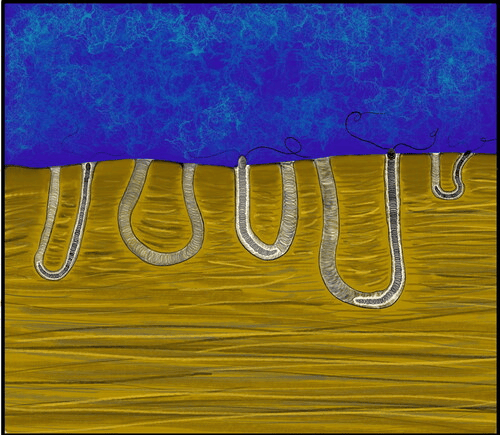
Research on biodeformational structures has lagged behind that of discrete trace fossils due to their indistinct appearance and lower utility. As such, the terminology surrounding such structures has not been standardized, with many conflicting usages across literature. To rectify this problem, the authors have outlined a set of proposed definitions to create nomenclature that can adequately describe the diversity of biodeformation structures without ambiguity. The authors also make recommendations regarding semantic usage of the terms “cryptobioturbation” and “cryptobioturbation fabric” and characterize common forms of indistinct bioturbation fabrics (e.g. mottled, massive, banded).

Figure. 1. Descriptive-genetic classification of individual bioturbation structures and their relationship with the bioturbation fabric concept. 

You can check out the article on Earth-Science Reviews by clicking on this link.

Written by Zane Gabriel Goodell

Drs. Buatois and Mángano to Give a Short Course at 7th International Conference of Palaeogeography

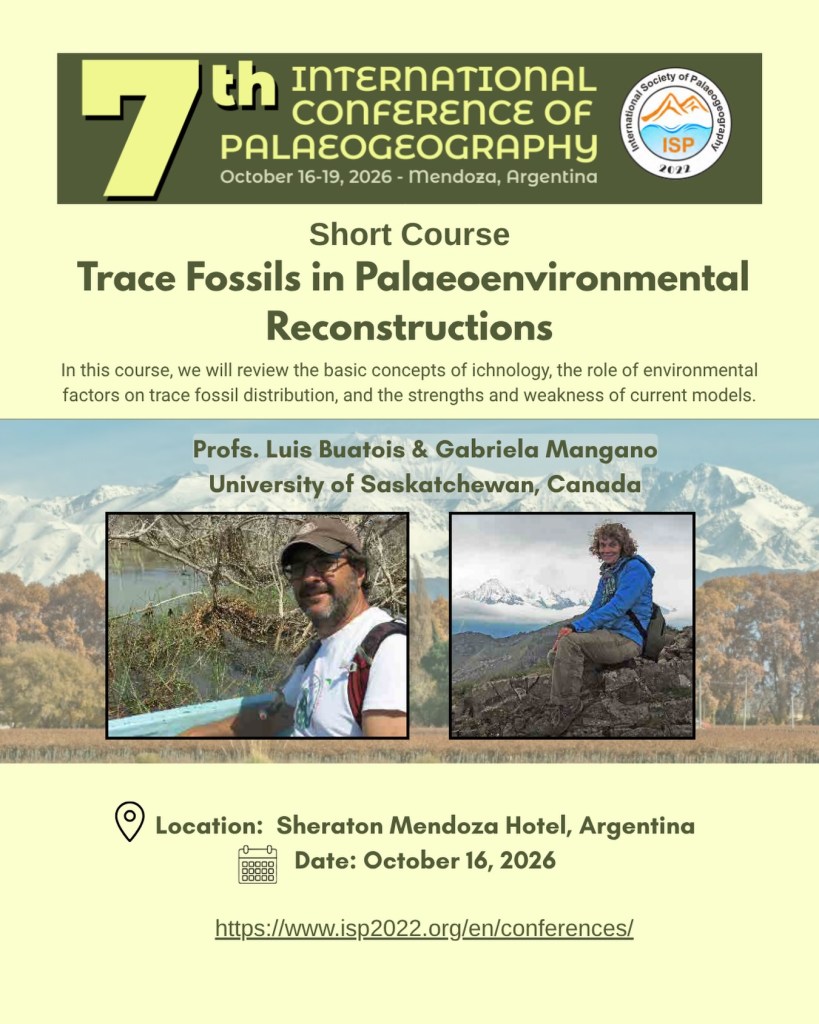
Our very own Drs. Luis Buatois and Gabriela Mángano will be teaching a short course at the 7th International Conference of Palaeogeography in Mendoza, Argentina, which will be held from October 16th-19th 2026. This will be the first International Conference of Palaeogeography held outside of China and it will take advantage of the wealth of knowledge of earth scientists from around the globe and the breathtaking vistas of the Andes mountains to better understand geological processes.

This short course will focus on trace fossils in palaeoenvironmental reconstructions, reviewing basic ichnology, the role of environmental factors on trace fossil distribution, and the strengths and weakness of current models. In addition, they will explore perspectives for future developments that may result in the construction of trace-fossil models for less understood depositional environments.

This course is scheduled for the 16th of October, 2026 at the Sheraton Mendoza Hotel in Mendoza, Argentina. For more information please check out the ISP’s website at the following link: https://www.isp2022.org/en/conferences/

Written by Zane Gabriel Goodell

Ichnoplanet at the Inaugural USASK Palaeobiology Society Geoscience Symposium

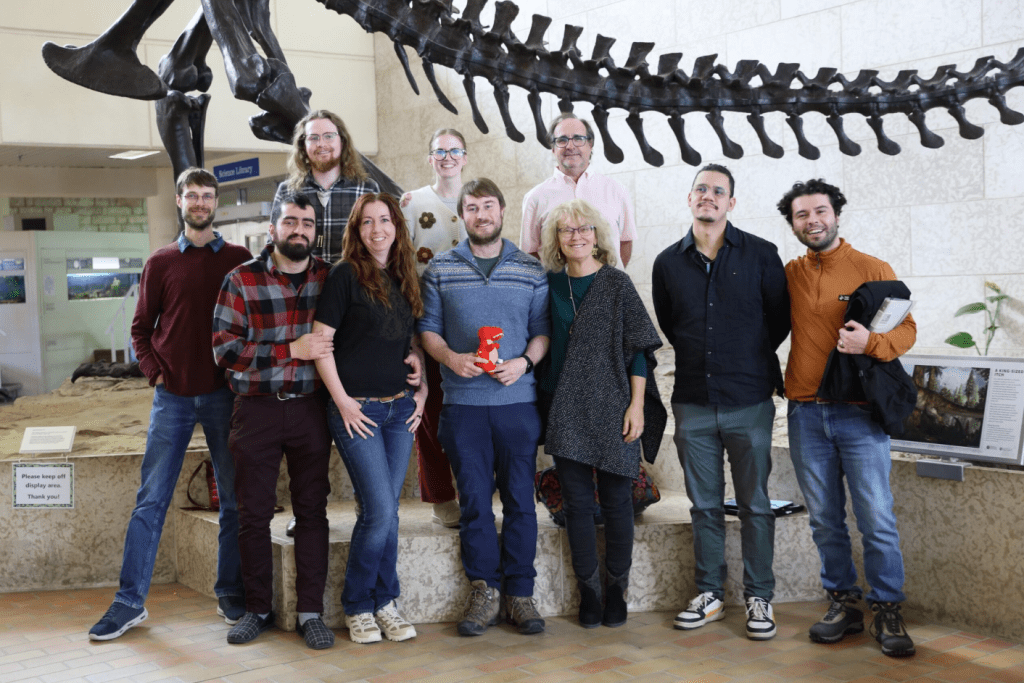
Seven members of Ichnoplanet presented original research at the first ever USASK Palaeobiology Society Geoscience Symposium on the University of Saskatchewan campus on March 7th, 2026. The symposium featured keynote speakers Dr. Emily Bamforth from the Phillip Curie Museum and Dr. Anthony Shillito from the University of Saskatchewan presenting their original research on Triceratops from Saskatchewan and the colonization of terrestrial environments, respectively. We had a full and exciting day of presentations on a wide range of topics including dinosaurs, brachiopods, plesiosaurs, and, of course, trace fossils.

We’d like to thank the USASK Palaeobiology Society for organizing this outstanding conference and all of the attendees that came out to see the talks highlighting new findings in paleontology.

The Ichnoplanet research group at the USASK Palaeobiology Society 2026 Geoscience Symposium. From left to right, top: Zane Goodell, Jessica Morstad, Dr. Luis Buatois. Bottom: Dmitri Ponomarenko, Martín Schenardi, Chantelle Edwards, Dr. Anthony Shillito, Dr. Gabriela Mángano, Alejandro Corrales-García, and Miguel Norambuena.

Written by Zane Gabriel Goodell

Ichnoplanet alum Dr. Maximiliano Paz begins professorship at Oberlin College

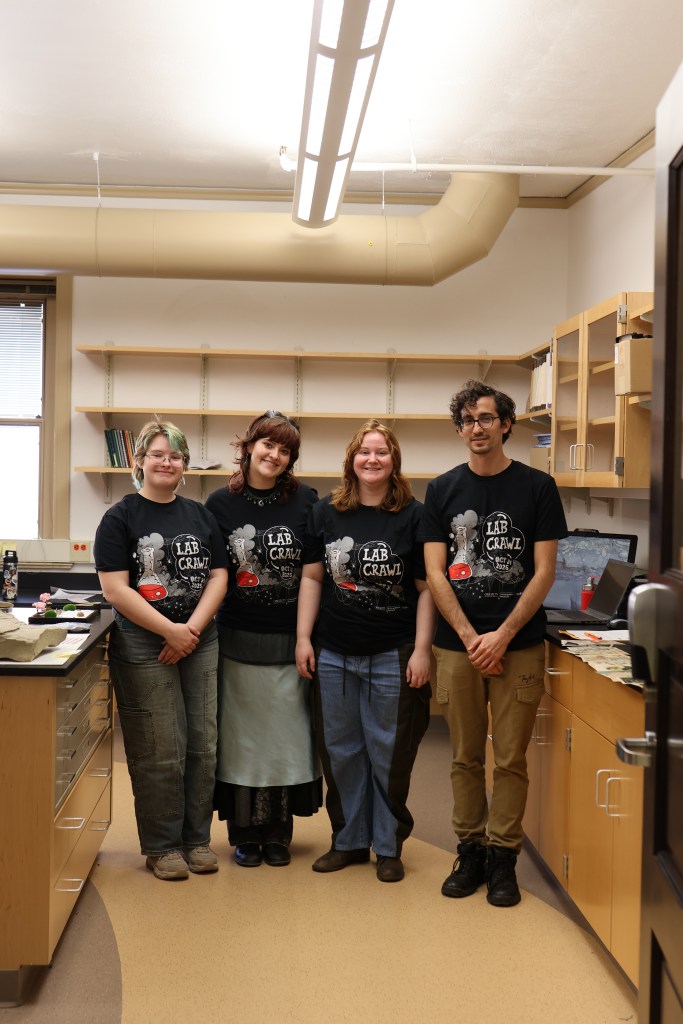
Maxi started a new teaching position in 2024 after finishing his Ph.D. and postdoctoral studies in the Ichnoplanet lab at the University of Saskatchewan. He is currently an Assistant Professor at Oberlin College, a liberal arts college in Ohio, USA. Oberlin is known for its extensive history on abolitionist and progressive ideas, being the first college to provide higher education to women and one of the first to admit African Americans in the United States. Maxi currently teaches Sed-Strat, Paleontology, Historical Geology, and courses about the Energy Transition and Patagonian landscapes. He also created a research lab currently consisting of 4 undergraduate students researching trace fossils from Paleozoic rocks of Asturias (Spain), Brittany (France), Houston (Texas, USA), and Cincinnati (Ohio, USA).

Photo of the trace fossil lab at Oberlin College. From left to right, undergraduate research students Paige Grossenbacher, Anika Roos, and Quinn O’Halloran, and professor Maximiliano Paz.

Congratulations to Maxi for his new position and research group!

Written by Maximiliano Paz and Zane Gabriel Goodell

Psammichnites from the Pennsylvanian Rod El-Hamal Formation of Egypt: revisiting paleoenvironmental and paleogeographic patterns of distribution of late Paleozoic ichnospecies

New research has just been published in Ichnos by authors Ahmed A. El-Refaiy, Luis Buatois, Magdy M. El Hedeny, Ahmed M. El-Sabbagh, Ahmed N. El-Barkooky and Ahmed S. Mansour on Psammichnites in the Pennsylvanian Rod El-Hamal Formation of Egypt.

The researchers found high density occurrences of three different ichnospecies of Psammichnites preserved in the rippled troughs of sandstones in off-shore transition settings. Global compilation of Psammichnites show its presence in marginal and fully-marine deposits, showing its tolerance to brackish to normal marine salinity conditions. Psammichnites appears to be a cosmopolitan ichnogenus showing a broad latitudinal distribution during the late Paleozoic, having been particularly widespread during the Pennsylvanian.

Figure 3. Psammichnites ichnospecies from the Pennsylvanian Rod El-Hamal Formation, Wadi Araba, Eastern Desert of Egypt. Scale bars are 2.5 cm. (A–D) Psammichnites plummeri (Fenton & Fenton,1937). (E–H) Psammichnites grumula (Romano & Meléndez, 1979). From El-Refaiy et al. (2026).

Learn more about this research published in Ichnos here.

Written by Zane Gabriel Goodell