Jurassic paleosurfaces with fecal mounds reveal the last supper of arenicolid worms

Recently, new research by Gabriela Mángano, Luis Buatois, and coauthors from Stoney Brook University and the MUJA near Colunga, Asturias, Spain, on fecal mounds produced by arenicolid worms from the Upper Jurassic Lastres Formation in Asturias, Spain, has been featured in local news in Asturias. Students who have recently taken the Asturias geology field course offered through the University of Saskatchewan had the opportunity to see these trace fossils in the collections/galleries at the Museo del Jurásico de Asturias (MUJA).
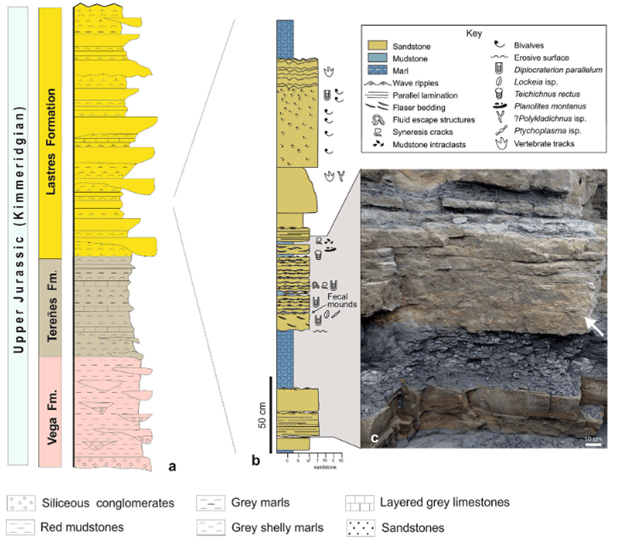
Figure from Mángano et al., 2024 showing the stratigraphy and detailed sedimentologic characteristics of the lowermost Upper Jurassic interval of the Lastres Formation at Arroyo Solero containing one of the surfaces with fecal cast mounds, including a close-up picture of the deposits showing the bedding surface that contains fecal cast mounds in cross-section.

The fecal mounds were given the name Cumulusichnus asturiensis. They are made up of an accumulation of thin sandstone cords roughly 1 to 2.3 mm thick and are preserved on a paleosurface comprised of rippled sandstone formed by wave action. The traces are preferentially located within the depressions located between the crests of the ripples. In the modern, the worms that generate this type of structure are known as Arenicola marina, a benthic polychaete from the family Arenicolidae (also called lugworms) that can be found in estuaries, deltas, tidal flats, and shallow marine settings of Europe. North America and New Zealand. The worm lives upside down inside the sediment inside an L- or J-shaped tube (domichnia) and feeds on bacteria and various microorganisms that live within the substrate. The worm swallows sand, takes in nutrients, and expels the waste, forming small sandy fecal piles on the surface that resemble squiggles or spaghetti.
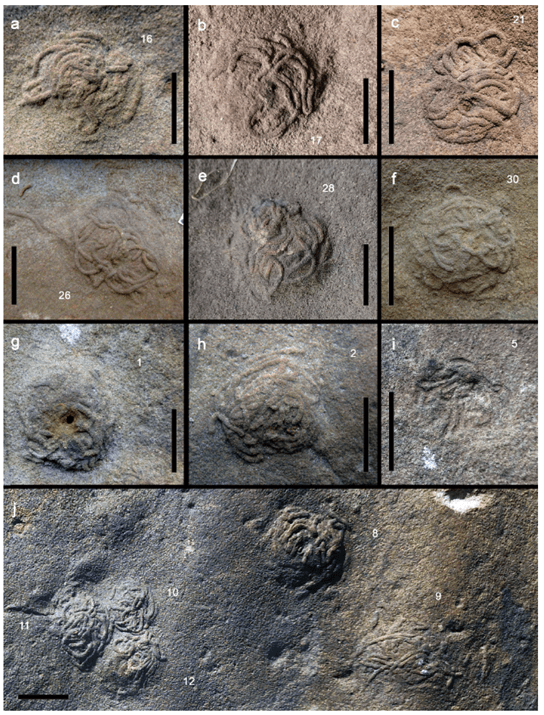
Figure from Mángano et al., 2024, showing examples of arenicolid fecal mounds from Playa España, Upper Jurassic Lastres Formation of Asturias, Spain. Scale bars are 2 cm long.

You can read the paper in the journal Nature here. You can watch a brief news clip (in Spanish) here (skip to 11 min 40 sec). You can also read an article and watch another video highlighting the discovery here. Once again, congratulations to Gabriela, Luis, and the other researchers involved with this project!

Written by Jack Milligan

Congrats Dr. Andrei Ichaso!

Last week, our own Andrei Ichaso successfully defended his doctoral thesis! His thesis focused on the stratigraphy, sedimentology, and ichnology of the middle Cambrian to Early Ordovician Deadwood Formation in western Canada and the midwestern United States. Congratulations Dr. Ichaso!

Andrei’s doctoral thesis earned him the University of Saskatchewan Graduate Thesis Award in the Physical & Engineering Sciences category from the College of Graduate & Postdoctoral Studies at USASK. Congratulations Andrei!

Check out Andrei’s ICHNOPLANET profile here.

Written by Jack Milligan

Gabriela Mángano receives the Distinguished Career Award at GSA!

At the annual meeting of the Geologic Society of America in Pittsburgh, Pennsylvania, our own Dr. Gabriela Mángano is the 2023 recipient of the Distinguished Career Award from the Geobiology and Geomicrobiology Division! We’re super thrilled to have Gabriela receive this awesome award and couldn’t agree more as to her deserving of this recognition.

From the Geologic Society of America Geobiology and Geomicrobiology Division website: “Gabriela has approached geobiology from the perspective of animal-substrate interactions in deep time. She likes to move along the geologic time scale to detect evolutionary breakthroughs and track the deep history of bioturbation. Her research attempts to reconstruct the emergence of modern marine benthic ecology discern environmental from evolutionary controls, and temporally calibrate ichnofacies and ichnofabrics.”

Congratulations Gabriela from all of us at Ichnoplanet!

Photos courtesy of the Geologic Society of America Geobiology and Geomicrobiology Division and Luis Buatois

Written by Jack Milligan

Three Ichnoplanet students at the University of Saskatchewan receive awards from the International Association of Sedimentologists!

Dr. Maximiliano Paz has received the International Association of Sedimentologists (IAS) Postdoctoral Research Grant. He is currently studying the sedimentology and ichnology of the Cambrian-Ordovician Los Cabos Series. These funds will be used to cover one month of fieldwork expenses to log 4000 m of the succession in the rocky cliffs of western Asturias, Spain.

Jack Milligan has received the IAS Judith McKenzie Fieldwork Award. He is studying the sequence stratigraphy and taphonomy of dinosaur bones including describing osteic bioerosion trace fossils from the latest Cretaceous Frenchman Formation. This funding will cover fieldwork expenses to measure coastal floodplain and fluvial outcrops along the Frenchman River Valley of southwestern Saskatchewan.

Federico Wenger also received the IAS Judith McKenzie Fieldwork Award. He will be studying the sequence stratigraphy and ichnology including the degree of bioturbation, ichnodisparity, and ichnodiversity to understand the different environmental zones of the Devonian Talacasto Formation, in the geological province of Precordillera, western Argentina. This funding will help finance the trip to the study area.

Congratulations to Maximiliano, Jack, and Federico, and best of luck with your fieldwork, and thank you to the International Association of Sedimentologists for helping fund Ichnoplanet research at USask!

Written by Jack Milligan