
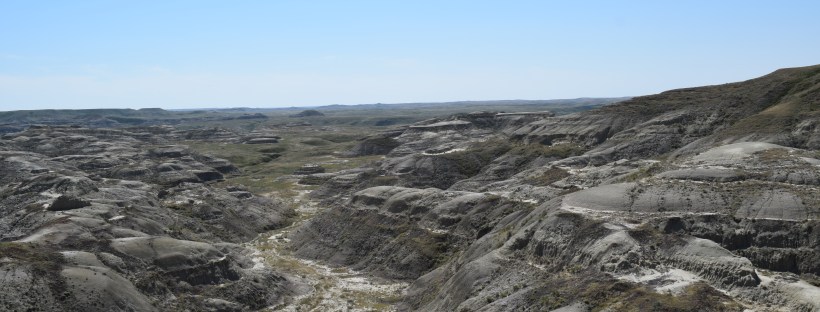
Towards the end of the summer, I had the opportunity to continue fieldwork at two multitaxic Edmontosaurus quarries within the Uppermost Cretaceous Frenchman Formation in the East Block of Grasslands National Park in southern Saskatchewan under the supervision of Dr. Emily Bamforth of the Philip J. Currie Dinosaur Museum and Dr. Ryan McKellar of the Royal Saskatchewan Museum. These excavations have been ongoing and have yielded some fantastic fossil specimens and interesting geology.
We collected a limb bone (tibia) from one of our two Edmontosaurus quarries, called the “Leo” quarry. The tibia shows feeding traces as evidenced by well-defined tooth marks. During the excavation of the tibia, a shed tooth from a tyrannosaurid (Tyrannosaurus rex) was collected from the same depositional layer. This association of tooth traces on Edmontosaurus bones and T. rex teeth suggests that Leo was scavenged during subaerial exposure on a floodplain within a meandering fluvial system. Limb bones have a high likelihood of being consumed due to large locomotor muscles being present (a great food source for predators like T. rex), and thus will tend to have more tooth traces on the bone.
On an adjacent butte within the same depositional layer as the “Leo” quarry, there is a point bar deposit containing a second active quarry named the “Clifford“ quarry. While the Edmontosaurus in this quarry has yet to produce elements with tooth marks, teeth from T. rex and the crocodyliform Borealosuchus have shown up this past season. Adding to the mystery of this quarry, several articulated turtle skeletons have been collected from this deposit, showing no evidence of being scavenged.

Tooth marks have been a widely debated aspect of vertebrate ichnology. Recently, the category-modifier (CM) system was proposed by Wyenberg-Henzler et al., 2024, as a method to identify different morphologies of tooth marks and their associated behaviours. While not strictly defined within a traditional ichnological framework, it is the most comprehensive overview of tooth marks on bones in the literature to date. Based on the CM system, the tooth marks left on the Edmontosaurus tibia appear to be internally chattered, referring to the crescentic depression on the inside of the tooth mark. Shed carnivore teeth from both quarries suggest that the dominant predators within this ecosystem were crocodyliforms and tyrannosaurs.

Further excavation of the quarries is required, and research into the taphonomy of these two Edmontosaurus quarries is ongoing, but there are sure to be some exciting discoveries to be made in future field seasons!
Written by Jack Milligan
 ichnoplanet.ca