New research has just been published in Ichnos by authors Ahmed A. El-Refaiy, Luis Buatois, Magdy M. El Hedeny, Ahmed M. El-Sabbagh, Ahmed N. El-Barkooky and Ahmed S. Mansour on Psammichnites in the Pennsylvanian Rod El-Hamal Formation of Egypt.
The researchers found high density occurrences of three different ichnospecies of Psammichnites preserved in the rippled troughs of sandstones in off-shore transition settings. Global compilation of Psammichnites show its presence in marginal and fully-marine deposits, showing its tolerance to brackish to normal marine salinity conditions. Psammichnites appears to be a cosmopolitan ichnogenus showing a broad latitudinal distribution during the late Paleozoic, having been particularly widespread during the Pennsylvanian.
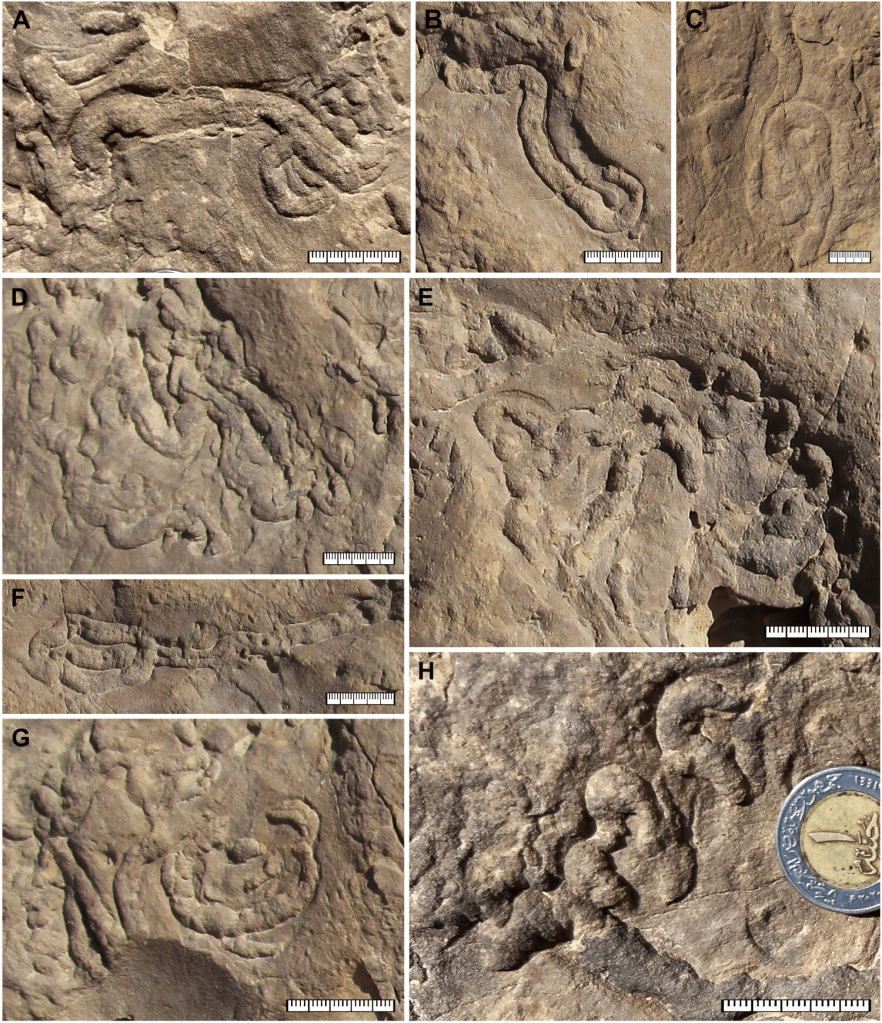
Figure 3. Psammichnites ichnospecies from the Pennsylvanian Rod El-Hamal Formation, Wadi Araba, Eastern Desert of Egypt. Scale bars are 2.5 cm. (A–D) Psammichnites plummeri (Fenton & Fenton,1937). (E–H) Psammichnites grumula (Romano & Meléndez, 1979). From El-Refaiy et al. (2026).
Learn more about this research published in Ichnos here.
New research from PhD candidate Alejandro Corrales-García, Gabriela Mángano and Jean Benard-Canon was just published on Burgess-shale type deposits from southeastern British Columbia.
A 2015 investigation of a 2.65 m interval recovered 12 ichnotaxa and three types of trace fossils left in open nomenclature, the most frequent including Helminthoidichnites tenuis, Palaeophycus tubularis, Diplocraterion isp., and finger-like structures (FLS). Overall, the Cranbrook assemblages do not present well-defined tiering structures and represent surficial epifauna and shallow-tier infauna that colonized the sea bottoms during brief windows between episodic flows and inhabited dysoxic to relatively well-oxygenated outer shelf environments. This study gives us additional insight into the behavior of soft-bodied organisms in some of the most recognizable deposits representing early animal life.
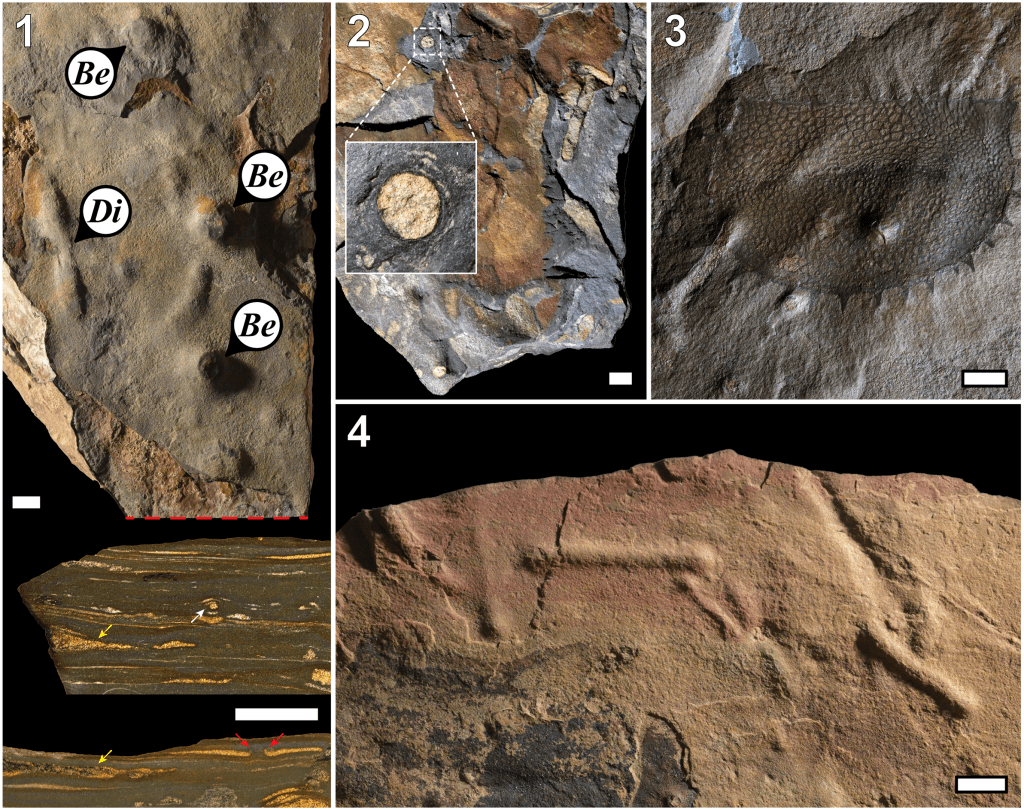
Figure 2. Trace fossils and physical sedimentary structures in the Diplocraterion isp. Ichnocoenosis. (1) General bedding-plane view of Bergaueria isp. (Be) and Diplocraterion isp. (Di) and close-ups of polished cross section showing typical claystone with thin intercalations of coarser grains in thin and discontinuous laminae displaying starved ripples and associated cross-lamination (yellow arrows), passively filled burrows (white arrow), and ruptured laminae of fine-grained sand (red arrows). (2) Bedding-plane view with close-up of Diplocraterion isp. with fine-grained sand fill. (3) Bedding-plane view displaying Diplocraterion isp. with fine-grained sand fill in incidental association with a Tuzoia carapace. Notice deformation of Tuzoia-bearing laminae by the overprinting burrow. (4) Bedding-plane view displaying stick-like individuals. Notice common individuals having slightly broader ends. All scale bars = 10 mm.
To learn more, check out the paper published in The Journal of Paleontology here.
A new paper was published in Ichnos by Luis Buatois, Euridice Solórzano, Williams Rodríguez, and Gabriela Mángano examining Precambrian continental trace fossils in Venezuela.
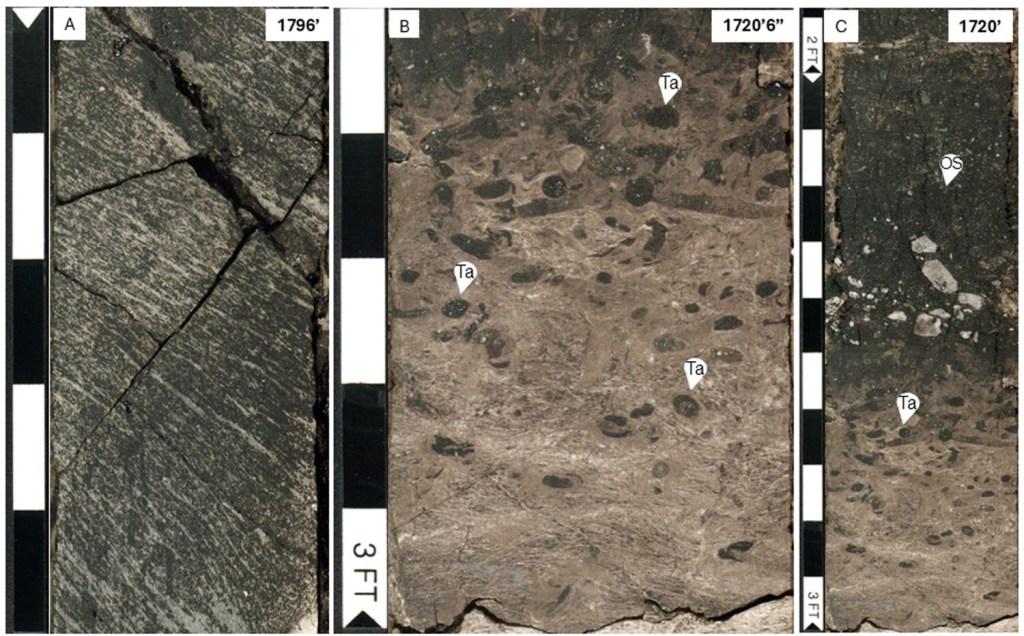
This study documents a specific type of simple ichnofabric referred to as an unconformity-bound simple ichnofabric. The well cores in this study feature the Precambrian basement of the Orinoco Oil Belt hosting continental ichnofossils attributed to Taenidium. The bioturbation is interpreted to have be produced in the Miocene in a regolith formed on top of the Precambrian basement. The ichnofabric found here is similar to ultracomposite ichnofabrics in that it involves a significant difference in time, but it is still considered a simple ichnofabric due to representing a single bioturbation event. This study highlights the importance of recognizing temporal disjunctions in the stratigraphic record that may mislead researchers about evolutionary events.
Metamorphic basement and monospecific ichnocoenosis of the meniscate backfilled trace fossil Taenidium isp. (Ta) in the Ayacucho area in the Orinoco Oil Belt. (A) Precambrian quartz micaceous schist. (B) Taenidium isp. (Ta) in basement regolith. (C) oil-impregnated sands (OS) from fluvial Miocene Oficina Formation filling Taenidium isp. Figure 3. from Buatois et al., 2026.
A new paper was published in Nature Ecology and Evolution by Dr. Claire Browning and co-authors, including our own Dr. Gabriela Mángano and Dr. Luis Buatois, examining trace fossils of a meiofaunal ecosystem that flourished in the immediate aftermath of the end-Ordovician extinction event (444 million years ago).
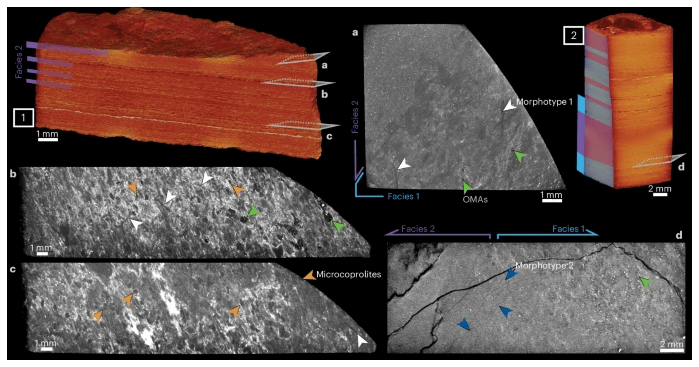
The trace fossils studied in this paper come from the Soom Shale Lagerstätte, South Africa. Three-dimensionally preserved ichnofossils, including two burrow/trail morphotypes and microcoprolites, were scanned using micro-computed tomography. These trace fossils are attributed to a low-diversity meiofaunal benthic community, dominated by nematodes and foraminifera. The ichnofossils are preserved in and consistently occur within fossilized marine-snow-bearing beds. Marine snow describes episodic deposition of organic material, including phytoplankton and phytodetritus, generated when wind-blown dust particles are then bound together with phytoplankton blooms in the surface water. The Soom Shale Lagerstätte provides a remarkable insight into one of the oldest meiofaunal trace-fossil records, and the earliest account of an ancient behavioural response to episodic marine snow deposition.
Occurrence and distribution patterns of trace fossils, microcoprolites, and organomineralic aggregates within distinct laminae. Figure 4 from Browning et al., 2025.
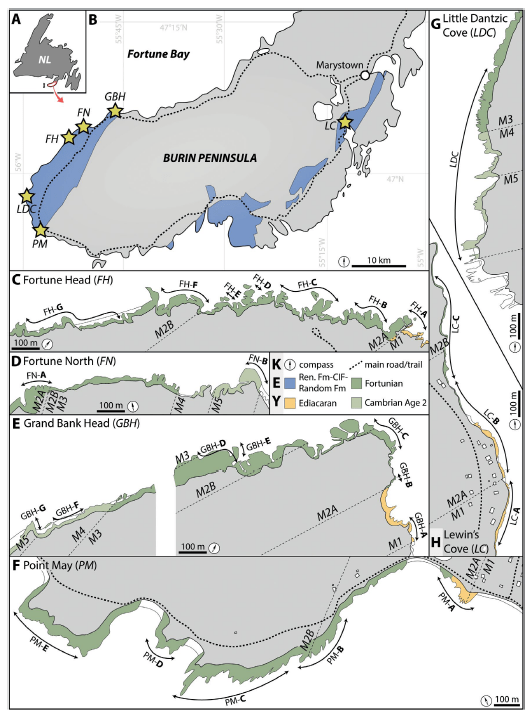
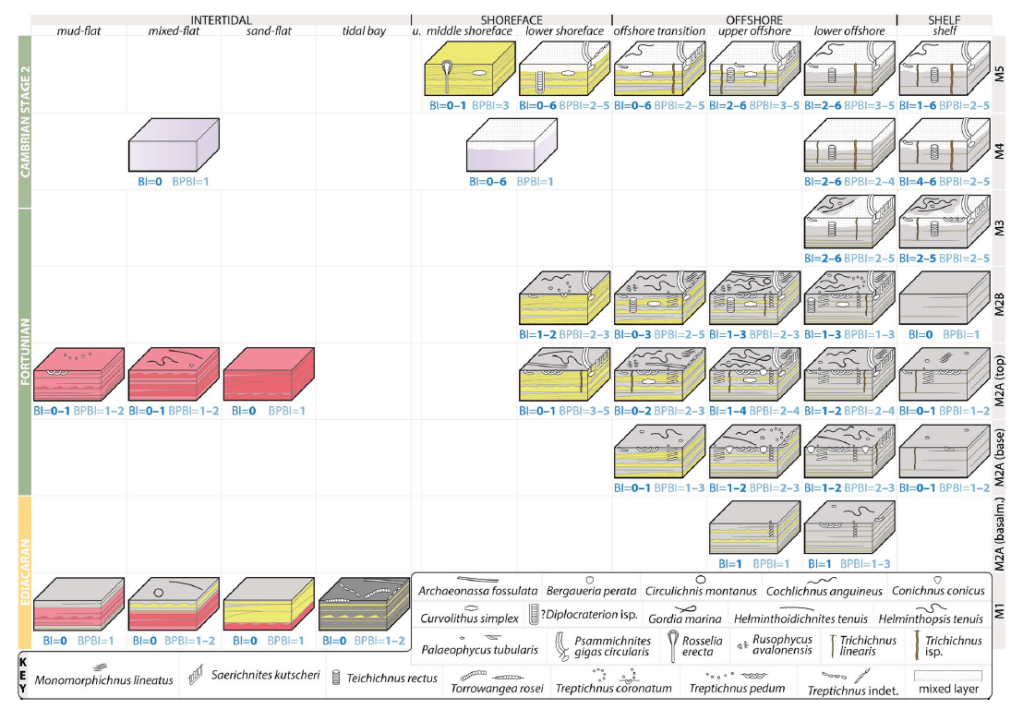
Dr. Romain Gougeon, Dr. Gabriela Mángano, Dr. Luis Buatois, Dr. Guy Narbonne, Dr. Brittany Laing, and Dr. Maximiliano Paz have just published their research on bioturbation at the onset of the Cambrian Explosion within the monograph series Fossils and Strata. This is the culmination of 4 field seasons that took place from 2016 to 2021 at the Cambrian-type section in Newfoundland. The monograph consists of a comprehensive ichnotaxonomic review that is essential to understanding the Cambrian explosion from a trace-fossil perspective.
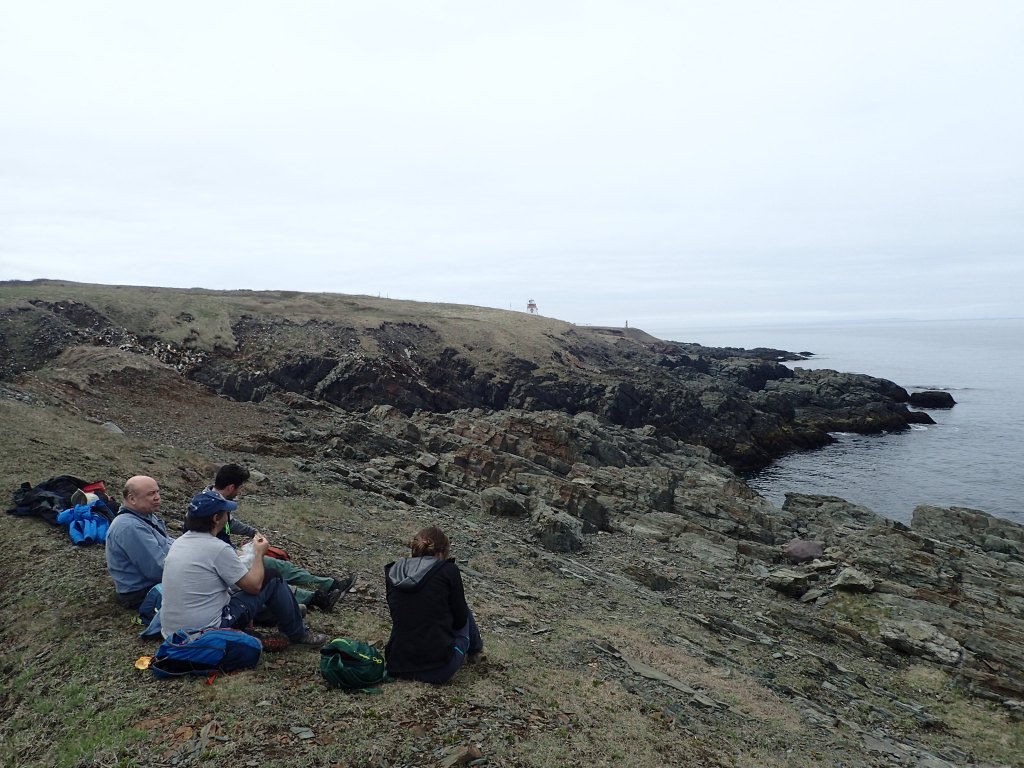
Romain Gougeon and colleagues conducting fieldwork in Newfoundland, Canada. See Fossils and Strata for open access monograph.
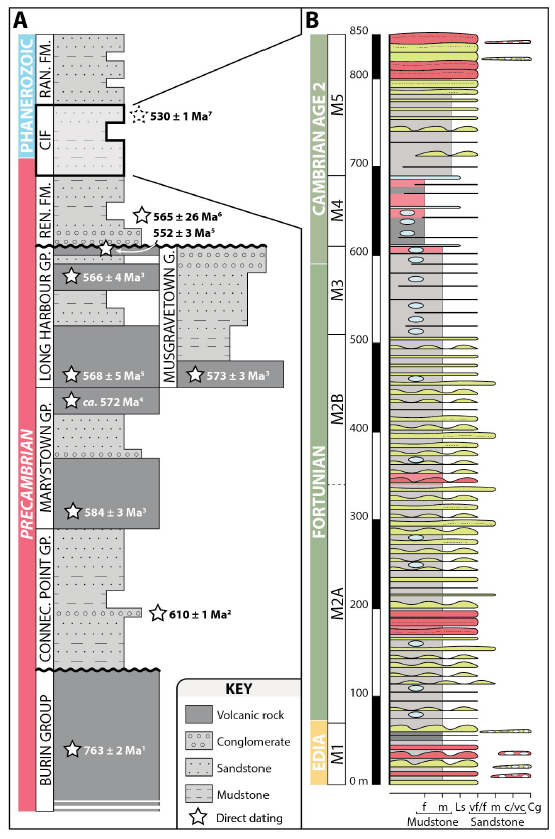
The Chapel Island Formation is a 1000+ m-thick, mainly siliciclastic succession that is well-exposed in coastal cliffs of Burin Peninsula, southeastern Newfoundland, eastern Canada. This unit contains an outstanding record of the transition from the Ediacaran (635–538 Ma) to the Cambrian (538–487 Ma). Fossils from the Chapel Island Formation include an incredible diversity of trace fossils, with some intervals rich in small shelly fossils. The monograph integrates sedimentologic and ichnologic information for the whole formation, reinforces the status of the current Cambrian Global Stratotype Section and Point for the Cambrian System, and advocates for the need for more comprehensive and multi-disciplinary approaches and studies to fully decipher the scale, tempo, and loci of the early evolution of animal life on Earth.
Congratulations to Romain and the team on this incredible achievement! You can check out Romans’ ResearchGate profile here, where you can read other studies he’s authored on the Chapel Island Formation throughout the years. These include the origin of the shelf sediment mixed layer and the impact of outcrop quality on trace fossil datasets.



 ichnoplanet.ca