Tracking hadrosaurs in northwestern Alberta with the Boreal Alberta Dinosaur Project

This past summer, Jack Milligan represented Ichnoplanet during fieldwork conducted by the Boreal Alberta Dinosaur Project (BADP) at the University of Alberta (UA), and the Philip J. Currie Dinosaur Museum (PJCDM) under the leadership of UA professor Dr. Corwin Sullivan, and USASK adjunct professor and PJCDM curator Dr. Emily Bamforth. Objectives of this fieldwork include collecting fossils from the late Cretaceous Wapiti Formation near the city of Grande Prairie. The Wapiti Formation is rich in fossils, including freshwater invertebrates, small vertebrates, and especially non-avian dinosaurs. The most common dinosaurs in northern Alberta based on the number of occurrences are the hadrosaurs, commonly referred to as the “duck-billed” dinosaurs. These are large herbivorous dinosaurs that have been suggested to travel in large herds in search of new food sources and as a defense against predatory theropod dinosaurs.

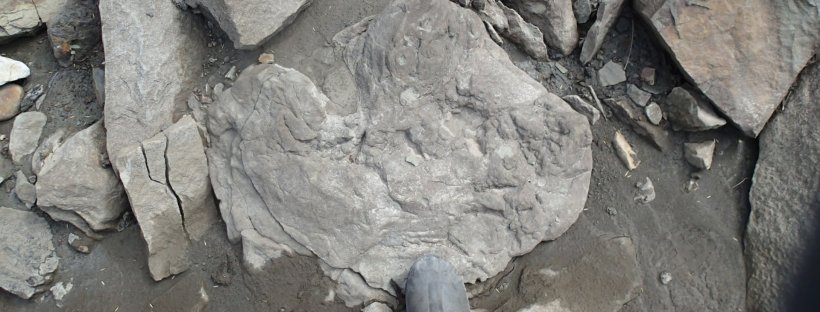
During July and August, BADP collected several large, three-toed hadrosaur tracks from various sites across northwestern Alberta. These tracks are isolated natural casts of footprints that infilled the original track and weathered out of situ. Some of these tracks were carried out of the site by hand across rushing rivers much to the chagrin, all be it temporary, by the team. Studying these tracks will allow the BADP team to learn more about the kinds of environments these dinosaurs were walking through and the taphonomy and different preservation of the tracks.
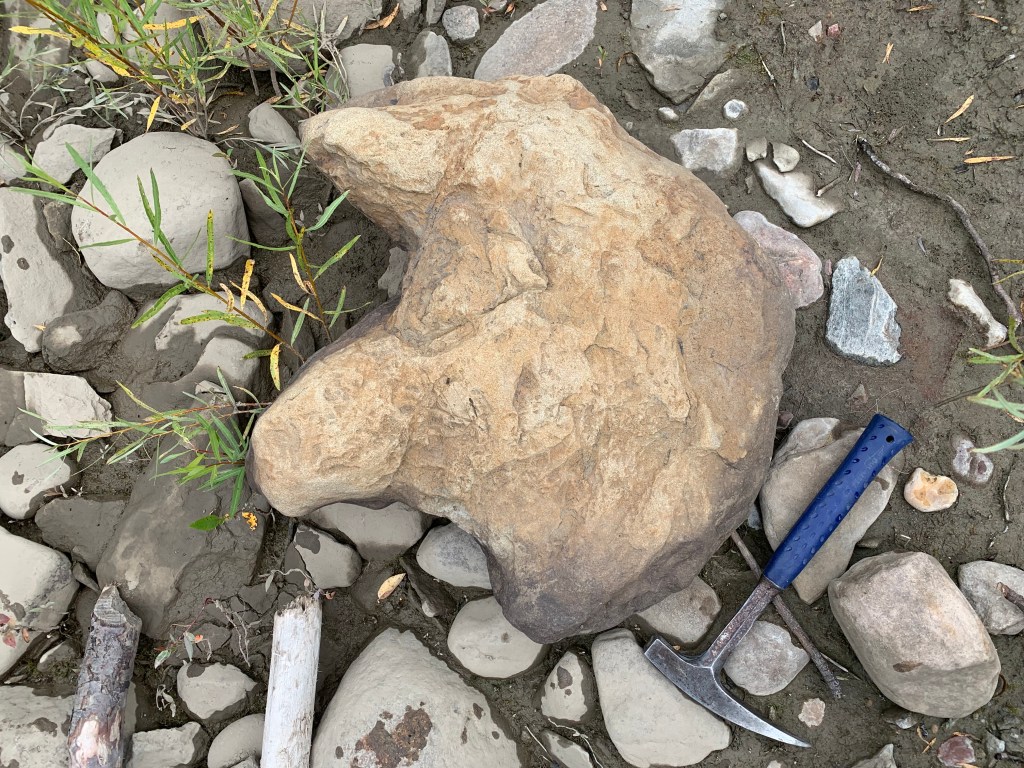
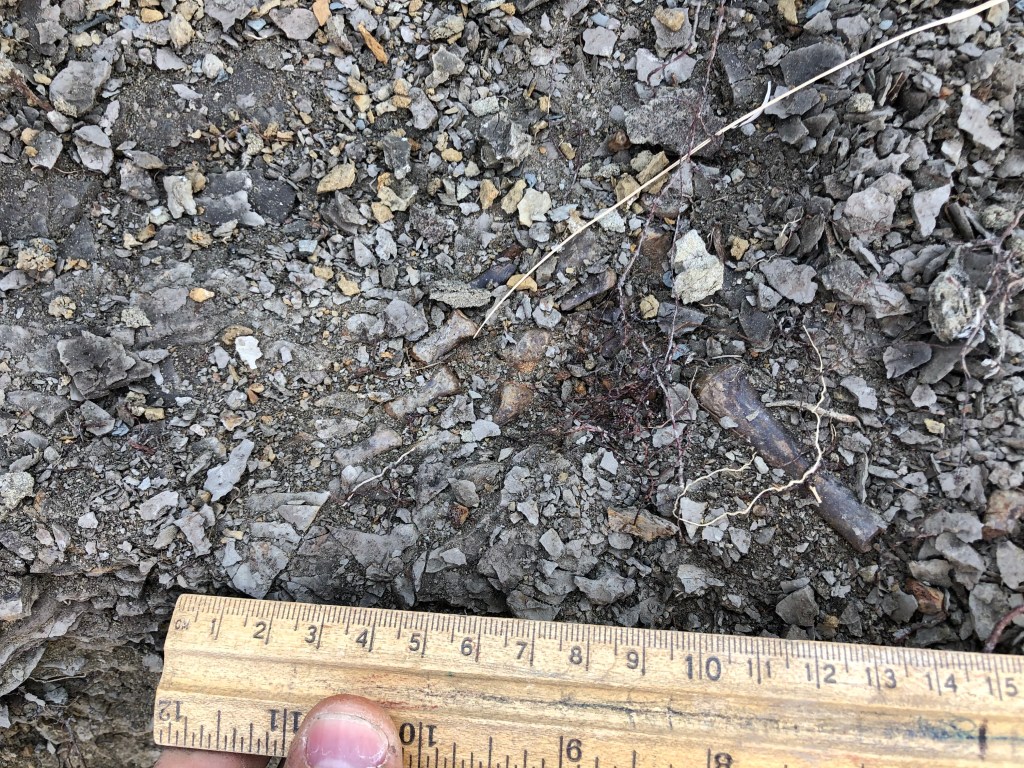
Large hadrosaur track with a rock hammer for scale, surrounded by grass and mud covered stones

Images provided by Jack Milligan and Emily Bamforth.

Written by Jack Milligan

Associated champsosaur skeleton in southwest Saskatchewan discovered by Jack Milligan

Following the K-Pg mass extinction event which wiped out the non-avian dinosaurs, the swamps and floodplains of southwest Saskatchewan were populated by an assortment of small to medium-sized vertebrates including turtles, crocodiles, early mammals, and a now-extinct group of semi-aquatic reptiles known as champsosaurs. During a joint research expedition near the town of Climax, Saskatchewan by the Royal Saskatchewan Museum and Carleton University in Ottawa in August 2020, an associated skeleton of a champsosaur was recovered by Jack Milligan. The champsosaur was collected in a terrestrial shale horizon around 3 m above the K-Pg boundary, from the Paleocene-aged Grey facies of the Ravenscrag Formation. The Grey facies records a low-energy, vegetated swamp environment. 

Champsosaur hind foot (middle right in image). Photo by Jack Milligan.

This skeleton is between 35-40% complete and is comprised of several dorsal and caudal vertebrae with intact neural arches and transverse processes, incomplete bones from all four limbs including a humerus and femurs, dozens of ribs, and several elements making up the pectoral and pelvic girdles. Numerous gastralia as well as a near complete hind foot were found in situ upon examination of the shale horizon from which the bones had eroded out. More fieldwork is needed to try and recover cranial material to affirm an accurate taxonomic identification of this specimen.

You can read more about the discovery in this Usask news article.

Written by Jack Milligan

Note: Jack recently joined the ichnofamily at Usask as an M.Sc. student! You can read more about him on his ichnoplanet profile, or follow him on ResearchGate or Twitter. –Brittany

Charlie Zheng secures a Student Research Award in Planetary Habitability!

We’re pleased to share that our colleague Charlie Zheng, Ph.D. candidate at the University of Texas Austin, was just awarded a Student Research Award in Planetary Habitability!

The award is distributed by the UT Center for Planetary Systems Habitability and consists of $24,960. It is a well deserved award which will allow Charlie, along with project collaborators Dr.’s Buatois & Màngano, to continue their fascinating research into the resilience of marine infaunal communities. Charlie describes the project as:

“Trace fossil records are the best indicator of habitability in harsh environments after mass extinctions or during the early evolution of life on earth. In fact, oceanic anoxia is a common theme linked to major environmental perturbations and ancient oceans that hosted early metazoan life ordinarily contained low oxygenations. A comprehensive dataset documenting marine infaunal communities under oxygen-deficient environments from different settings and geologic ages is necessary to better understand the habitability of environments. Moreover ichnology should play an essential role in the search for evidence of early lifeform in other worlds, especially under similar environmental conditions.

The Cretaceous Maverick intrashelf basin is one of the world’s best examples of a shallow marine shelf ecosystem impacted by locally developed anoxia, creating “dead zones” that evolve into shallow basins within the shallow-water shelf. This project aims to integrate ichnologic and sedimentological signatures to characterize distinctive infaunal communities under hostile, oxygen-limited conditions and assess the resilience of marine infaunal communities and the carbonate factory ecosystem evolution across the environmental perturbation. This study will extend the existing ichnologic database in oxygen-deficient settings by providing the first case study on the intrashelf basin lacking modern analogs and serve as an needed update on the subject since the 90’s, when relevant studies were most abundant.” 

Panoramic photograph of an outcrop from the Del Norte area, Devils River State Natural Area, Texas. This outcrop shows the more proximal shallow-water platform facies & architecture of the basin. The awarded research will focus on more distal portions of this same basin. (photo by Charlie Zheng)

A big congratulation’s to Charlie on this accomplishment!! We can’t wait to read about the results of this research!

You can follow Charlie’s research via his Research Gate profile.

Written by Brittany Laing

Luancaia igen. nov., a molting trace fossil

Research in Northern Spain yielded some spectacular Devonian trace fossils. While they may look superficially similar to classic resting traces like Rusophycus, they lack any scratch imprint and have a distinctive axial ridge. In fact, their morphology is strikingly similar to the dorsal side of the euarthropod Camptophyllia. Detailed research by Mangano and workers in Scientific Reports determined that these traces instead represent evidence of infaunal molting. Their new article formally describing these traces and the palaeoecologic and paleonenvironmental implications they hold is available for free until January 16th through this link: https://authors.elsevier.com/c/1c8ca73N~0BeE

Fig. 3

Asturias field course

2017-09-02 07.32.45

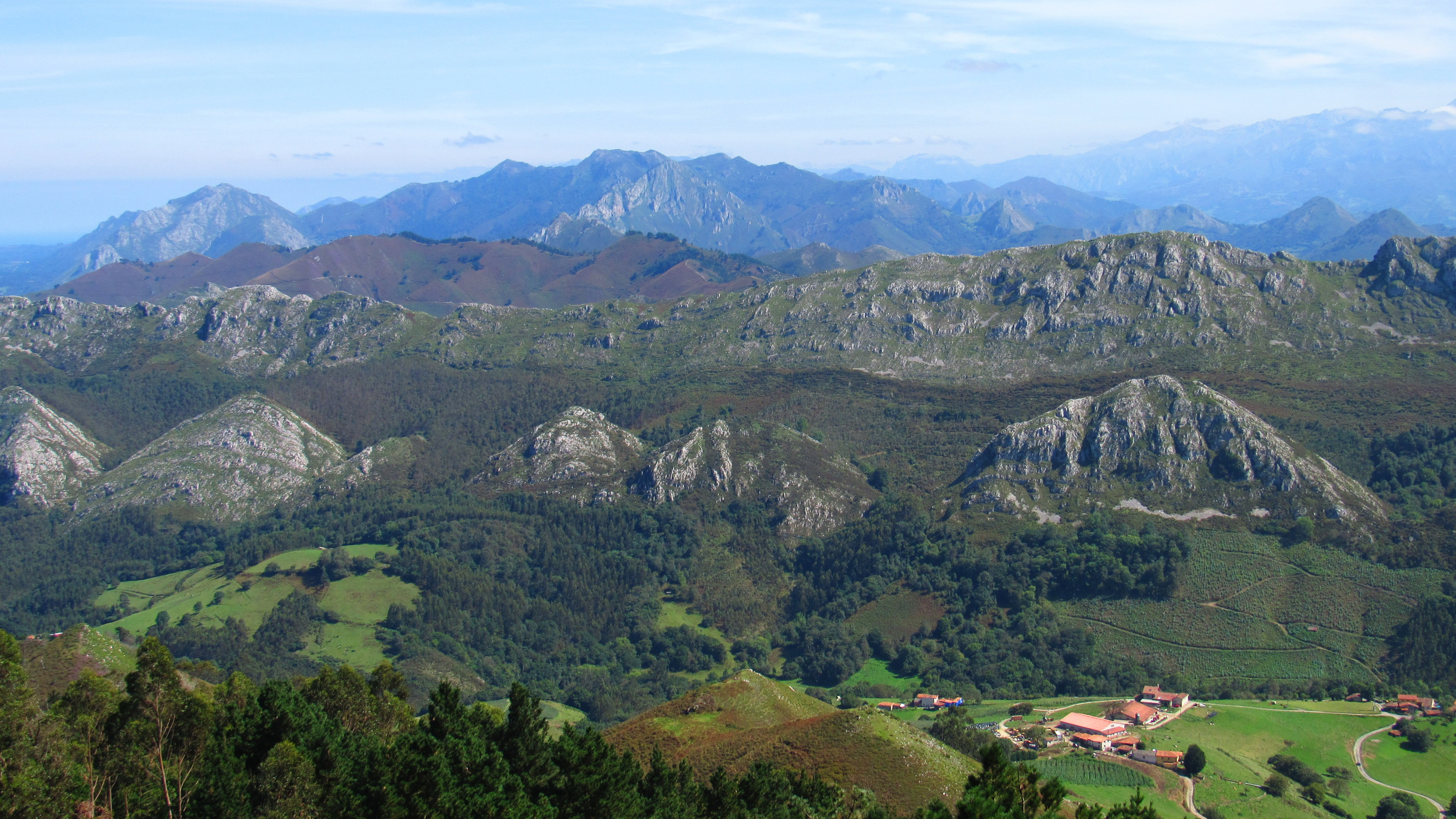
What is better than learning about trace fossils? Learning about trace fossils in the gorgeous setting of Asturias, Spain!

This will be the third iteration of Dr. Mángano’s and Dr. Buatois’ field course in Asturias, where they travel the timescale and look at everything from carbonate reefs to turbidites. They’ll be joined by geological sciences students from Canada and Spain, giving a truly international flavour to the trip.

While I can’t share exactly what the students will be learning (they need to learn that themselves!) I can share photos to make others jealous of this incredible adventure!

2017-09-07 05.07.27.jpg

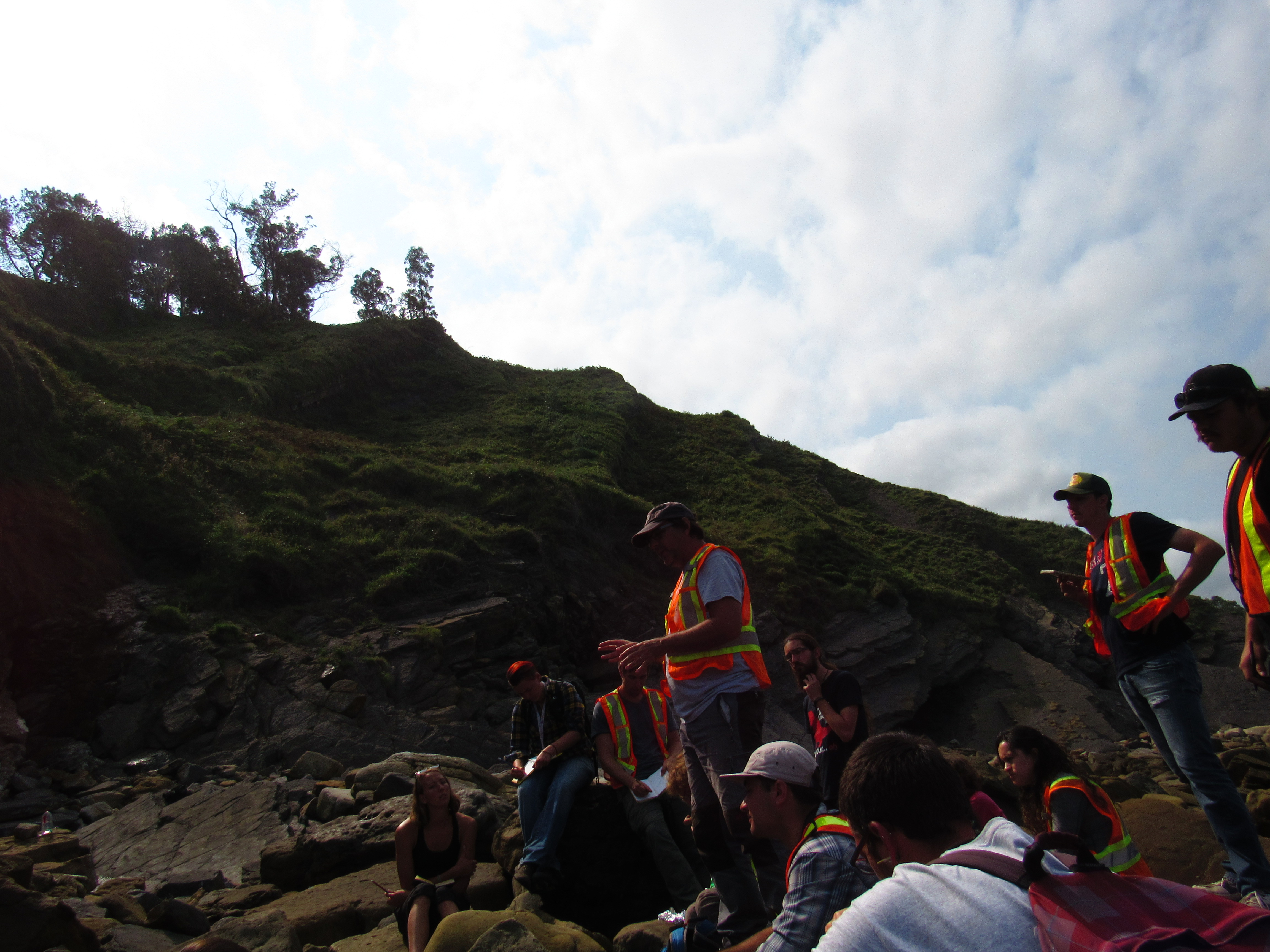
Students listening as Dr. Buatois gives a lecture on the sedimentology of the surrounding rocks.

2017-09-04 01.59.09.jpg

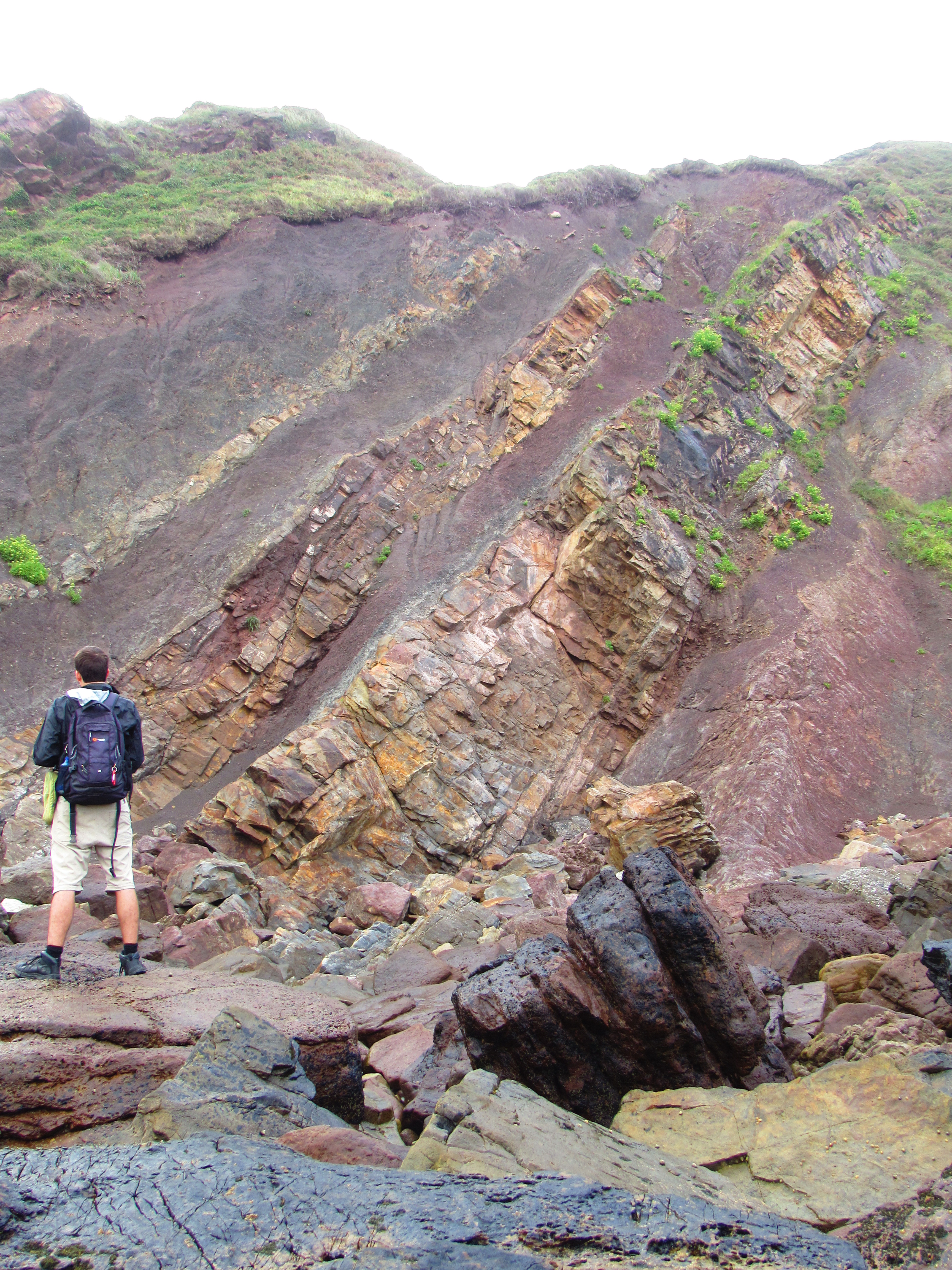
Ph.D. candidate Maxi, graciously acting as my scale.

2017-09-04 01.40.24.jpg

The best classroom on earth.

2017-09-07 05.57.07.jpg

Some of the more… adventurous students, trying some fresh-from-the-sea cuisine.

By Brittany Laing