Were all trilobites fully marine?

Trilobites, the poster-fossil of the Paleozoic, have long been considered to be invariably fully marine. Collaborative work between Dr. Mángano, Dr. Buatois, and Argentinian colleagues questions this assumption. Through the integration of multiple datasets they report uncontroversial evidence of the exploration of tide-dominated estuaries by some trilobite groups (olenids & asaphids) throughout the Furongian to Middle Ordovician. Thick siliciclastic successions in northwest Argentina expose vertically-repeating nearly-identical environments and allowed for the comparison of body-fossil and trace-fossil data in tide-dominated estuaries through time. Their research indicates two forays into brackish water, first the colonization of the outer portion of estuaries by olenids, followed by the colonization of inner to middle estuarine zones by asaphids.

The full article is available in the Proceedings of the Royal Society B (including some fantastic photos of trilobite trace fossils in the Supplementary Info!).

Figure. Time-environment matrix showing protracted trilobite expansion into marginal-marine estuarine settings. (From Mángano et al., 2021)

Written by Brittany Laing

Large wild boar tracks discovered in SW Spain

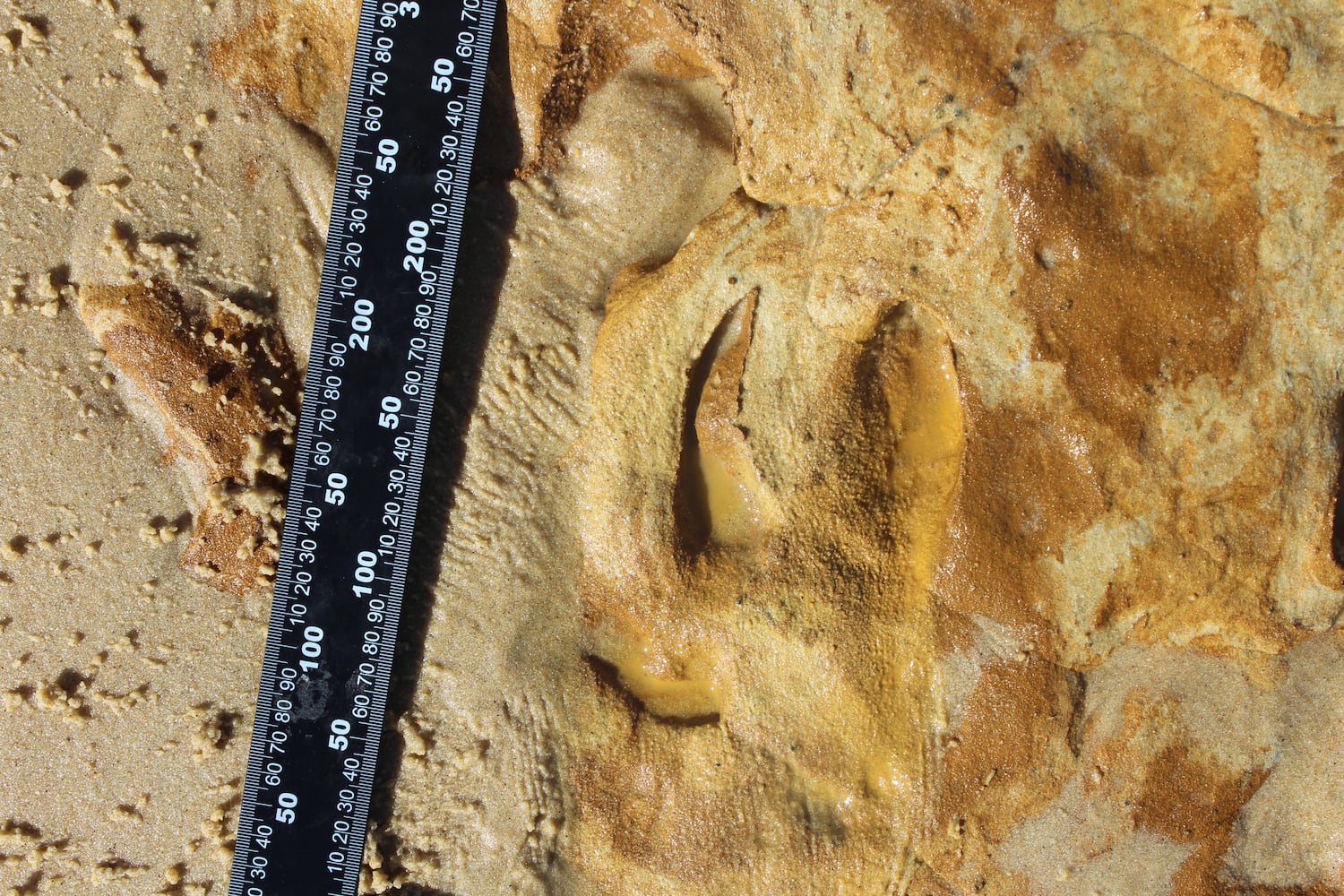
Recent research by colleagues, including former visiting researcher Dr. Belaústegui and former postdoc Dr. Muñiz, has been featured in the Spanish newspaper El País. Their research, first published in Palaois, examines large wild boar tracks from the Late Pleistocene of Huelva, Spain. The novel ichnogenus and ichnospecies (Suidichnus galani igen. and isp. nov.) described in their article are the first published record of fossil suid tracks. The ichnogenus is named after the family Suidae while the ichnospecies name is a nod to José María Galán, a respected local tracker who discovered the trackways (and many more in the formation).

Footprint 'Suidichnus galani' found in Matalascañas.
Paratype of Suidichnus galani igen. and isp. nov., vertically oriented. (Fig. 3 in Neto De Carvalho et al., 2020)

The large size of these tracks, and the boars themselves, are a divergence from the overall trend of the species towards smaller size. The authors delve into the cause of this divergence and suggest that the increase in size was an adaption to either an increase in predation pressure and/or a resource bonanza.

The article in El País is a fantastic piece of science communication and we highly recommend you give it a read! While the text is originally in Spanish, the Google Translate function on Google Chrome produced a good English translation.

Written by Brittany Laing

Luancaia igen. nov., a molting trace fossil

Research in Northern Spain yielded some spectacular Devonian trace fossils. While they may look superficially similar to classic resting traces like Rusophycus, they lack any scratch imprint and have a distinctive axial ridge. In fact, their morphology is strikingly similar to the dorsal side of the euarthropod Camptophyllia. Detailed research by Mangano and workers in Scientific Reports determined that these traces instead represent evidence of infaunal molting. Their new article formally describing these traces and the palaeoecologic and paleonenvironmental implications they hold is available for free until January 16th through this link: https://authors.elsevier.com/c/1c8ca73N~0BeE

Fig. 3

Congratulations to Gustavo!

This past Monday our very own Gustavo Valencia successfully defended his Master’s thesis. A big congratulations to Gustavo on this great accomplishment! His thesis examined both the ichnology and fluvial architecture of the Miocene Vinchina Formation in the Vinchina Basin from NW Argentina. Keep an eye out for a journal article on the subject soon! You can hear about the research from Gustavo himself in his final seminar to the University of Saskatchewan here.

Gustavo at his field of study in NW Argentina.

Written by Brittany Laing

Recent field work on the Buda Limestone

During three field campaigns from 2017 to 2019, Fernando Valencia together with Gustavo Valencia and colleagues from the Texas A&M University (Dr. Juan Laya and Dr. Mike Pope) have been describing several stratigraphic sections where the highly-bioturbated Buda Limestone crops out. Most outcrops are distributed along the central and west Texas regions (Fig. 1). The main focus of Fernando’s project is to define the sedimentological model of the Buda Limestone in west-central Texas and the implications of the pervasive bioturbation in the process of porosity creation. Preliminary observations recognized a strong influence of the trace fossils in the diagenetic processes of the carbonate succession (Fig. 2).

Follow Fernando’s Research Gate project detailing this research here!

Picture1

Figure 1. Sharp contact between the Buda Limestone and the overlying Eagle Ford Gp. along the U.S. Highway 90 in the Comstock – Texas area.

Picture2 

Figure 2. Detail of intra-burrow secondary porosity developed in a Thalassinoides isp. Upper-Cretaceous Buda Limestone (west Texas).

By Fernando Valencia