
A new paper was published in Nature Ecology and Evolution by Dr. Claire Browning and co-authors, including our own Dr. Gabriela Mángano and Dr. Luis Buatois, examining trace fossils of a meiofaunal ecosystem that flourished in the immediate aftermath of the end-Ordovician extinction event (444 million years ago).
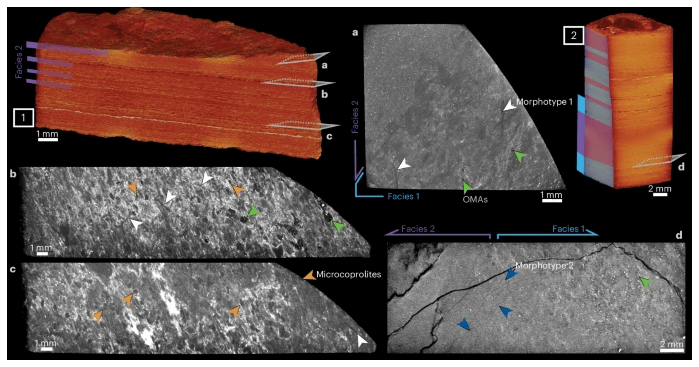
The trace fossils studied in this paper come from the Soom Shale Lagerstätte, South Africa. Three-dimensionally preserved ichnofossils, including two burrow/trail morphotypes and microcoprolites, were scanned using micro-computed tomography. These trace fossils are attributed to a low-diversity meiofaunal benthic community, dominated by nematodes and foraminifera. The ichnofossils are preserved in and consistently occur within fossilized marine-snow-bearing beds. Marine snow describes episodic deposition of organic material, including phytoplankton and phytodetritus, generated when wind-blown dust particles are then bound together with phytoplankton blooms in the surface water. The Soom Shale Lagerstätte provides a remarkable insight into one of the oldest meiofaunal trace-fossil records, and the earliest account of an ancient behavioural response to episodic marine snow deposition.
Check out Clarie Browning’s blog post about this research on Springer Nature Research Communities, and read the paper in Nature here.
Written by Jack Milligan
 ichnoplanet.ca