IMECT 2019

On October 17-24th, 2019 the International Meeting on the Ediacaran and the Ediacaran-Cambrian Transition (IMECT) in Guadalupe, Spain was held. Romain Gougeon represented the Ichnology Research Group with two projects: a talk on ‘The Ediacaran-Cambrian Chapel Island Formation of Newfoundland revisited: Evaluating changes in ecospace utilization by early animals’ and a poster on ‘Loops, circles, spirals and the appearance of guided behaviors from the Ediacaran-Cambrian of Brittany, NW France’. The meeting was organized by J. J. Álvaro and S. Jensen and have allowed the visit to the beautiful Villuercas-Ibores-Jara UNESCO Global Geopark during pre- and post-conference field trips. Highlights of these trips were: the access to the type species of Cloudina carinata in Nañamero; the geology of the Lower Alcudian Group and its striking unconformities; and the body fossils (Beltanelliformis) and trace fossils (simple horizontal grazing trails, treptichnids) from the Pusa and Cíjara formations. Romain is extremely thankful to J.J. Álvaro, I. Cortijo, S. Jensen, T. Palacios, A. Pieren Pidal and C. Quesada for their kindness and many fruitful conversations on the geology and paleontology of the region.

This slideshow requires JavaScript.


By Romain Gougeon

Sabbatical activities in Lyon and Lausanne.

Sabbatical activities continued for Gabriela Mángano and Luis Buatois who visited the Université Claude Bernard Lyon 1 (France) and the University of Lausanne (Switzerland) within the framework of research on the Great Ordovician Biodiversification Event during the last couple of weeks of November. In Lyon, Gabriela was an invited speaker for the European seminar with a talk on the Ediacaran-Cambrian transition and an interactive lecture for Master Students in Earth Sciences. Luis did a Department Seminar on the applications of ichnology in paleoenvironmental reconstructions.

This slideshow requires JavaScript.

By Luis Buatois

Recent field work on the Buda Limestone

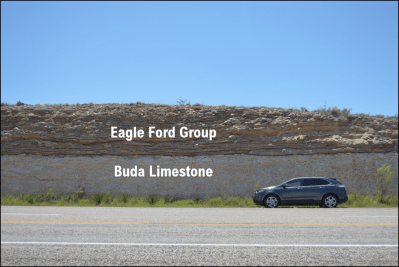
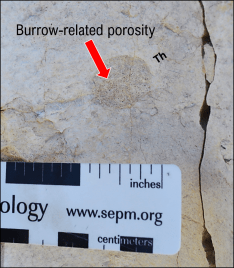
During three field campaigns from 2017 to 2019, Fernando Valencia together with Gustavo Valencia and colleagues from the Texas A&M University (Dr. Juan Laya and Dr. Mike Pope) have been describing several stratigraphic sections where the highly-bioturbated Buda Limestone crops out. Most outcrops are distributed along the central and west Texas regions (Fig. 1). The main focus of Fernando’s project is to define the sedimentological model of the Buda Limestone in west-central Texas and the implications of the pervasive bioturbation in the process of porosity creation. Preliminary observations recognized a strong influence of the trace fossils in the diagenetic processes of the carbonate succession (Fig. 2).

Follow Fernando’s Research Gate project detailing this research here!

Picture1

Figure 1. Sharp contact between the Buda Limestone and the overlying Eagle Ford Gp. along the U.S. Highway 90 in the Comstock – Texas area.

Picture2 

Figure 2. Detail of intra-burrow secondary porosity developed in a Thalassinoides isp. Upper-Cretaceous Buda Limestone (west Texas).

By Fernando Valencia

ICCI 2019- Exploring continental ichnology in Germany.

This past September both Dr.’s Mángano and Buatois travelled to Halle, Germany, to attend the 3rd International Conference of Continental Ichnology. The meeting was organized by Oliver Wings at the Martin Luther University Halle-Wittenberg. There, Gabriela Mángano delivered her keynote talk entitled “Continental invertebrate and plant trace fossils in space and time: State of the art and prospects.”. Luis Buatois gave a talk entitled “Trace fossils, water table and depositional evolution in eolian systems (Cretaceous Mulichinco Formation, subsurface of western Argentina)”. Activities during the conference include visits to several museums, including the Halle Paleontological and Zoological Museums and to Museum of Prehistory. One of the highlights of the meeting was the post-conference fieldtrip to visit Permian-Cretaceous outcrops in the Bavaria, Thuringia, Lower Saxony, and Saxony-Anhalt regions! The collections at the Museums at Gotha and Schleusingen were visited as well.

This slideshow requires JavaScript.

By Luis Buatois

13th International Symposium on the Ordovician System

LogoThis July, Luis Buatois travelled to Novosibirsk, Russia to give a keynote at the 13th International Symposium on the Ordovician System. Luis’ talk was entitled “Quantifying the role of bioturbation and bioerosion in ecospace utilization and ecosystem engineering during the Cambrian Explosion and the Great Ordovician Biodiversification Event”. This meeting was organized by Olga Obut, Nokolay Sennikov and Tat’yana Kipriyanova from the Trofimuk Institute of Petroleum Geology and Geophysics in Novosibirsk. Activities during the conference included visits to the Paleontological and Mineralogical Museums and to the recently created University Museum which hosts a nice exhibition on the history of life. Luis also participated in a pre-conference fieldtrip to visit Cambrian-Ordovician outcrops in the St Petersburg area led by Andrey Dronov. The fieldtrip was a great opportunity to look at spectacular examples of the so-called Ordovician Bioerosion Revolution.


This slideshow requires JavaScript.

By Luis Buatois